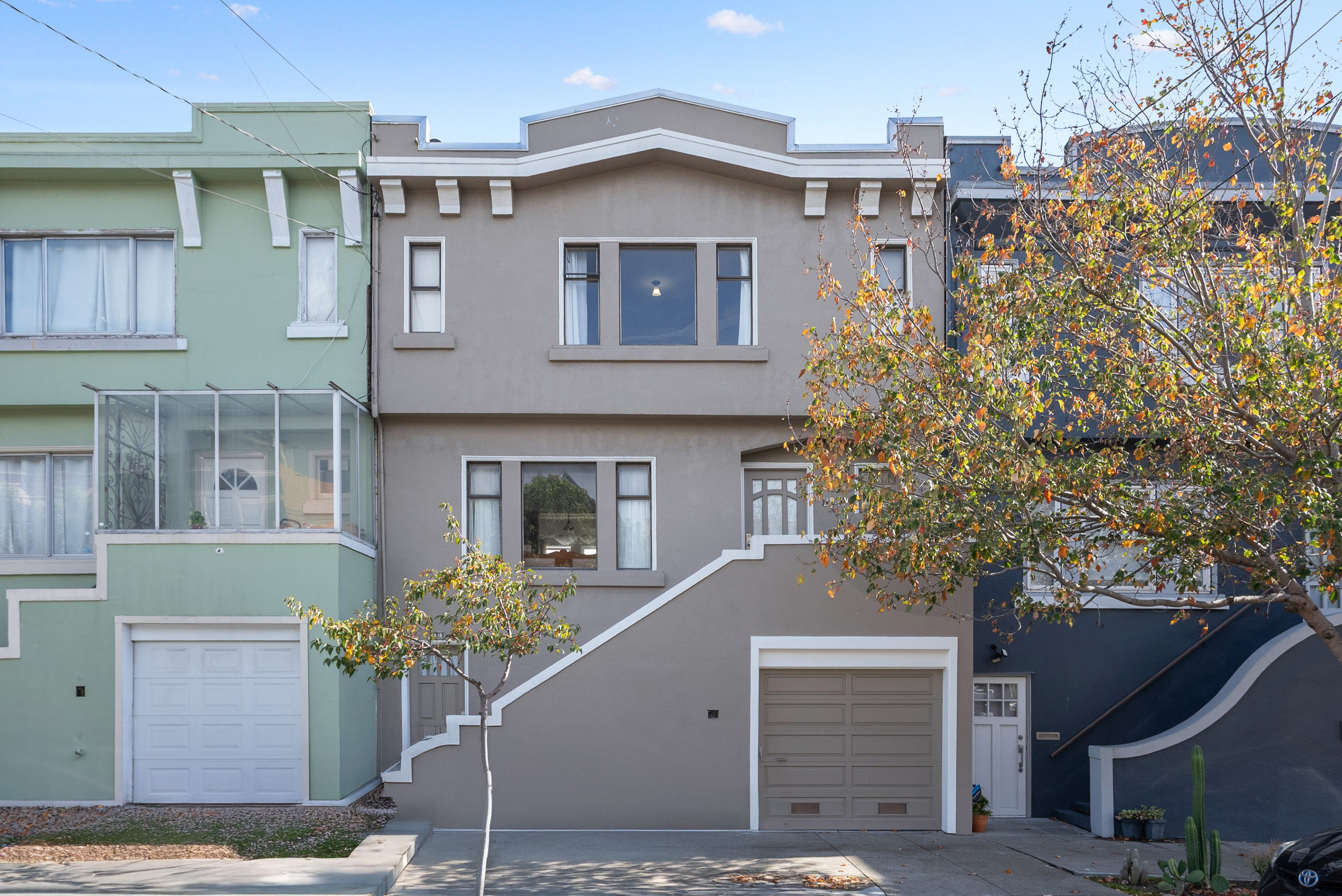
Case Study: How 2849 Bryant St in San Francisco’s Inner Mission Jumped From $1,295,000 to $1,875,000 in 2 Weeks
Every seller wants the same thing, even if they say it differently.
They want the strongest price the market will pay, the cleanest terms possible, and a process that does not drag on for months with endless showings and constant second-guessing.
This case study is a real example of what that can look like in San Francisco when pricing, timing, and exposure all work together.
We listed 2849 Bryant St, San Francisco, CA 94110 (Inner Mission) at $1,295,000. Within two weeks, we received 6 offers. The highest offer came in at $1,875,000, financed, and with no contingencies. We held a firm offer date and did not accept preemptive offers.
This was not a staged, freshly renovated “perfect” home either. It was a single-family home, 3 bed / 3 bath, 2,014 sq ft, move-in condition, well kept, but with some updates still on the table. No staging. No repairs.
So what created the jump?
A competitive price to pull the right crowd in, two weekends of open houses run like an event, thorough pre-sale inspections and disclosures, and a tight marketing stack that made the listing easy to understand online before buyers ever stepped through the door.
Key takeaways
- In San Francisco, list price is a marketing decision. A competitive list price can be the spark that pulls the biggest pool of qualified buyers into the first two weekends.
- A two-week launch calendar beats a “see what happens” approach. A clear schedule plus an offer date compresses attention into action.
- Thorough disclosures create confident buyers. We had about 26 disclosure requests, which is often the early warning sign that offers are coming.
- You can skip staging and still win, if your presentation is sharp. Pro photos, video, 3D tour, floor plan, and a property site did heavy lifting.
- Paid social does not need to be expensive. A $200 Instagram/Facebook ad spend helped widen the funnel during the two-week window.
The listing snapshot
Here are the facts, because sellers deserve specifics:
- Address: 2849 Bryant St, San Francisco, CA 94110
- Neighborhood: Inner Mission (Mission District area)
- Home type: Single-family
- Size: 2,014 sq ft
- Beds/Baths: 3 bed / 3 bath
- Condition: Move-in, well kept, some updates still possible
- Prep work: No staging, no repairs
- Disclosures: Pre-sale inspections and disclosures, very thorough
- List price: $1,295,000
- Marketing window: 2 weeks
- Open houses: Sat/Sun 2 to 4pm (two weekends)
- Broker tours: Two Tuesdays 2 to 4pm
- Offers: 6
- Top offer: $1,875,000, financed, no contingencies
- Offer strategy: Offer date on a Wednesday, no preemptives accepted
- Buyer profile: Majority tech
That is the foundation. Now here is what mattered most behind the scenes.
Why starting “competitive” worked in this neighborhood and price range
A lot of sellers hear “price it competitively” and assume it means leaving money on the table.
In reality, competitive pricing is often how you find the ceiling, especially in San Francisco where buyers watch the market closely and move fast when something feels underpriced relative to its potential.
The main goal of a competitive list price is not to predict the final sale price perfectly. The goal is to:
- Expand the buyer pool so more qualified people feel like they can participate.
- Increase first-weekend showing volume, because that is when attention is highest.
- Create visible demand, which changes buyer behavior from negotiation mode to competition mode.
When you combine a competitive list price with an offer date, you are basically telling the market:
“If you want this one, you need to engage now, not later.”
And that matters because in late 2025 the broader market was still moving, but not every home was flying off the shelf automatically.
For context, Redfin’s November 2025 snapshot shows San Francisco’s median sale price around $1,489,000 and homes selling after about 24 days on market on average. (Redfin)
Mission District numbers can look different month to month. Redfin’s November 2025 Mission District page shows a median sale price around $1,075,000 and about 35 days on market on average. (Redfin)
That spread is exactly why strategy matters. A strong result is rarely just “the market.” It is how you launch into the market.
The two-week launch calendar that turned attention into urgency
This is where sellers can learn the most. The timeline was simple, but it was not casual.
The cadence
- Listed on a Thursday
- Two weekends of open houses (Sat/Sun, 2 to 4pm)
- Two Tuesday broker tours (2 to 4pm)
- Offer date on a Wednesday
- No preemptive offers accepted
This is the opposite of a listing that sits while buyers trickle through one at a time.
Instead, you stack demand into predictable windows so buyers overlap. When buyers overlap, urgency rises. When urgency rises, offers come in stronger and cleaner.
Why the time blocks mattered
Holding the open houses at consistent times (2 to 4pm) did a few practical things:
- It made it easy for buyers to plan around, especially busy tech buyers.
- It created repeat traffic. The most serious buyers often come back.
- It concentrated “the crowd,” which creates instant social proof.
When sellers ask how you get multiple offers quickly, it is usually not one trick. It is this combination of structure plus momentum.
The moment you knew it was going to pop: activity plus disclosure requests
If you want an early signal that a listing is headed toward multiple offers, watch two numbers:
- Open house group count
- Disclosure requests
In this case, open house traffic was strong, but the detail that matters is the disclosure activity. You had roughly 26 disclosure requests.
That is the “buyers are getting serious” indicator.
Buyers do not request disclosures because they are casually browsing. They request disclosures because they are trying to answer:
- “Is there anything here that will blow up later?”
- “Can I waive contingencies safely?”
- “If we love it, can we write fast and win?”
Thorough pre-sale inspections and disclosures reduce uncertainty, and uncertainty is what causes buyers to slow down.
Confidence speeds people up.
How a financed buyer can still write a no-contingency offer
This part is important for sellers, because some sellers assume only cash buyers can deliver clean terms.
Your top offer was financed and still came in with no contingencies.
In practice, that usually happens when a buyer has:
- A strong down payment and cash reserves
- A lender who is responsive and has already verified the file (sometimes called strong pre-approval or underwriting prep)
- A clear understanding of the home’s condition because disclosures were thorough
- A real reason to be aggressive, like visible competition
From the seller side, the win is not just “highest price.” It is also “least likely to fall apart.”
A financed offer can be very safe when the buyer is qualified and the paperwork is tight. One reason tech buyers often perform well in competitive situations is that they tend to be organized, data-driven, and ready to move quickly when the opportunity feels right.
No staging, no repairs, still a premium result: what actually did the work
This listing is a great reminder for sellers who do not want to pour money into improvements they may not get back.
You did not stage. You did not repair. The home was move-in, well kept, and still had some room for updates.
So how do you still get buyers excited?
You make sure the marketing is not the weak link.
Your marketing stack
- Professional photography
- Video
- 3D tour
- Floor plan
- Dedicated property website
- Paid social on Instagram and Facebook
That is a full presentation package. It gives buyers multiple ways to understand the home before they visit.
This matters because buyers decide whether a home is “worth seeing” online first. If the online experience feels unclear, dated, or incomplete, you lose the buyer before they ever step inside.
With a 3D tour and floor plan, you remove one of the biggest points of hesitation in San Francisco: layout questions. With video, you help buyers picture how the home lives. With pro photos, you create the emotional pull.
Then, when they arrive at the open house, they are already partly sold. The open house just confirms it.
The role of paid social when the budget is only $200
Sellers sometimes hear “social media advertising” and assume it means a big spend.
Here, the ad budget was about $200.
That is enough to do one thing very well: compress awareness into your short launch window.
Paid social helped in a few ways:
- Put the listing in front of buyers who are active but may not be checking portals constantly
- Reach renters who are on the edge of buying and just need a reason to go see something
- Drive additional open house traffic, which increases urgency for everyone
The secret with paid social is that it works best when the “call to action” is simple.
Not “look at this house.”
But “come see it this weekend, here are the hours.”
The seller playbook: how to replicate this kind of launch
If you are a San Francisco seller and you want a fast, strong outcome, here is the playbook in a practical format.
The 14-day launch template
Thursday: go live
- MLS goes live with all media already uploaded
- Property website is live
- Disclosures are ready and easy to request or download
Friday: outreach
- Agent-to-agent outreach to active neighborhood agents
- Social posts begin (organic)
- Confirm signage plan and access instructions
Weekend 1: create the crowd
- Saturday open house 2 to 4pm
- Sunday open house 2 to 4pm
- Track traffic and identify repeat visitors
Tuesday: broker tour 2 to 4pm
- Gather feedback
- Encourage second showings for serious parties
- Follow up with agents who came through
Weekend 2: reinforce urgency
- Saturday open house 2 to 4pm
- Sunday open house 2 to 4pm
- This is where many buyers decide they have seen enough and are ready
Tuesday: second broker tour 2 to 4pm
- Final agent follow-up
- Confirm buyers have disclosures and are clear on offer instructions
Wednesday: offer date
- Clear written instructions
- Clear response timeline
- A plan for countering and selecting the best overall offer, not just highest headline number
What sellers should copy from this case study
If you want the short list, it is this:
- Price to create participation, not to “test the market.”
- Choose a tight timeline and commit to it.
- Do thorough pre-sale inspections and disclosures so buyers can move faster.
- Make the online presentation complete, especially floor plan and 3D tour.
- Use paid social to pack the open houses, even if the budget is small.
- Hold the offer date if your goal is maximum competition.
When this approach is not the right fit
This strategy works best when a home is easy to show, easy to understand, and you are willing to be organized.
It can be harder when:
- Access is limited (tenants, restricted showings)
- The home has major unknowns and you are unwilling to do pre-sale inspections
- The pricing strategy is ambitious but there is no plan to create traffic
The common thread is uncertainty. Uncertainty slows buyers down. A strong launch reduces uncertainty.
Call to action
If you are considering selling in San Francisco and you want to know what your home could realistically sell for with a smart launch plan, we can help in two ways:
- Get a home valuation based on current neighborhood activity, buyer demand, and recent sales. Grab your Home Valuation Here: https://nicholasguzmanestates.com/home-valuation/
- Learn our seller process, including how we build a two-week launch calendar, disclosures strategy, and marketing plan tailored to your home. Learn more here: https://nicholasguzmanestates.com/sellers/
FAQs
1) If my home is not fully updated, should I still try a competitive pricing strategy?
Sometimes yes. Buyers will tolerate “needs updates” when the home is well cared for, the location is strong, and the disclosures are thorough. The bigger question is whether your home will show cleanly and whether you can remove uncertainty for buyers early.
2) Do open houses still matter in San Francisco, or is everything private showings now?
Open houses still matter when they are treated like an event. Private showings are important too, but open houses create overlap. Overlap creates urgency. That urgency is often what turns interest into strong offers.
3) How do you decide whether to accept a preemptive offer?
We did not accept preemptive offers on this listing because the goal was maximum competition and clean terms by the offer date. In other situations, a preemptive offer can make sense if it is truly compelling and reduces risk, but it should be weighed against what you might earn by letting the market fully engage.
4) If the winning offer is financed, how do I know it is safe without contingencies?
A financed, no-contingency offer can be very strong if the buyer is well qualified, the lender is credible, and the buyer has reviewed thorough disclosures up front. The seller’s agent should verify the buyer’s strength, lender responsiveness, and the buyer’s ability to close on the timeline.
5) What is the biggest mistake sellers make when trying to “create a bidding war”?
They try to force it with a price, but skip the structure. Competitive pricing without a clear timeline, strong disclosures, and a complete marketing package often creates curiosity, not urgency. The strategy works when all the parts reinforce each other.
Check out this article next