I want to try something different in this post.
I've written before about how to match your lifestyle to a Miami neighborhood — the framework of thinking through your Tuesday morning, your commute, your priorities, your budget. That post gave you the tool for making the decision.
This post is different. Here I'm going to walk you through each of Miami's eight most-searched neighborhoods, one at a time, and tell you what living there actually feels like. Not what the tourism board says. Not what the marketing brochures promise. What the residents I've worked with — the ones who chose right and the ones who chose wrong — have actually told me about their daily lives.
Think of this less as a comparison chart and more as walking into a series of open houses with someone who knows the buildings, the blocks, and the trade-offs. Each neighborhood gets its own honest profile: who thrives here, who struggles, what nobody puts in the listings, and what the 2026 market actually looks like on the ground.
If you're already narrowing down where to live and want expert guidance through the actual home search, our Florida Buyers Guide walks through what to expect at every stage. If you're leaning toward leasing your first year to test the neighborhoods before committing, our Florida Leasing Process is built around that decision. And for deeper community-specific info as you narrow down, our community guides go deeper on each area.
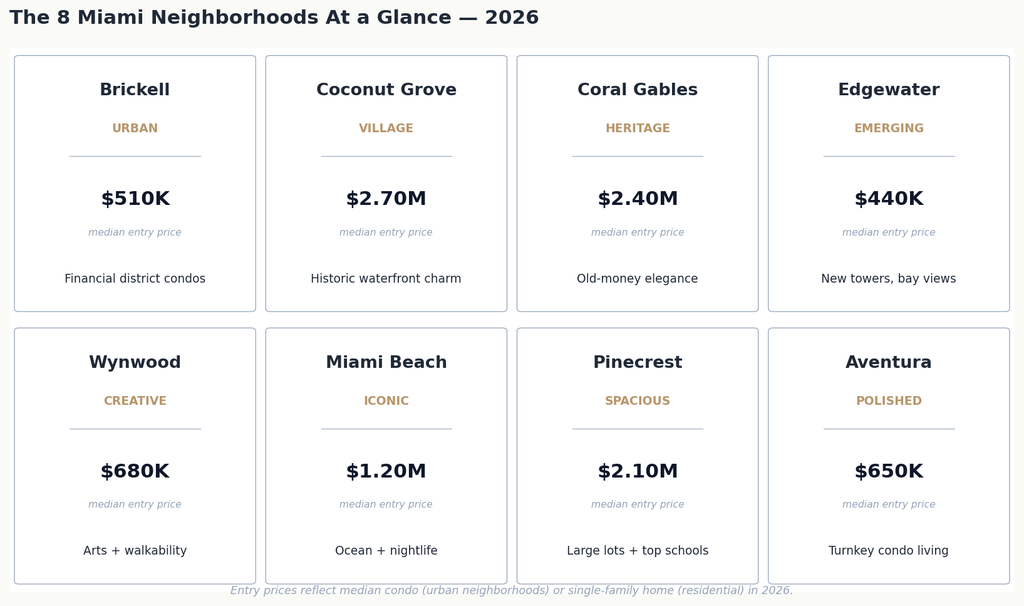
The 8 Neighborhoods at a Glance
Before we go deep, here's the fast summary — the signature vibe and entry-level price of each area:
Now let's go one at a time.
Brickell: Miami's Manhattan
Signature word: Urban. Dense. Fast.
What it actually feels like to live here: You wake up in a high-rise. You walk to work, or you take the Metromover two stops. You get coffee from a rotating list of specialty shops. Lunch is one of 40+ options within a five-minute walk. Evenings are rooftop bars, waterfront dinners at Cipriani or Zuma, and the constant background hum of a financial district that never fully quiets down.
Brickell is the most Manhattan-adjacent lifestyle Miami offers — walk-everywhere density, professional energy, 24/7 dining, and a young-professional social layer that recycles through the same restaurants and clubs on repeat.
The 2026 median: Around $509K for a condo, though newer luxury towers (Baccarat, Cipriani Residences, St. Regis) trade well into the $1M-$15M range depending on view and finish level.
Who thrives here: Young professionals, urban couples without kids, corporate renters relocated by their firms, and condo investors chasing the deepest rental market in South Florida. Brickell's rental yield is strong because corporate demand is constant — new hires from finance and tech firms lease furnished condos on 6-12 month terms year after year.
Who struggles here: Families with school-age kids. Anyone who needs quiet. Anyone who needs green space or a yard. Anyone who bristles at HOA rules or association politics — condo life comes with meetings, and Brickell condos have busy ones.
What nobody warns you about: The construction. Brickell has been under continuous construction for a decade and shows no sign of stopping. If you're viewing a unit that's near a vacant lot, assume there will be a crane there in 18 months. Ask your building manager directly about pending nearby construction.
Coconut Grove: Miami's Village
Signature word: Village. Historic. Green.
What it actually feels like to live here: Slower mornings. Coffee at Panther Coffee or Vice City Bean under a canopy of banyan trees. Bikes are common. You know your neighbors, or at least you recognize them. Weekends are the marina, Peacock Park, farmers markets, kids' soccer at Kennedy Park.
The Grove has retained something Miami has mostly lost — a genuine village feel with mature landscaping, walkable streets, and community events that draw actual residents (not just tourists). It's Miami's oldest settled neighborhood, established in the 1800s, and it still feels that way in the best sense.
The 2026 median: Single-family homes run $2.7M and up, with waterfront estates in gated enclaves like The Moorings and Hughes Cove reaching $10M+. Condos in newer luxury projects (Grove at Grand Bay by Bjarke Ingels, Park Grove by OMA) start around $1.5M.
Who thrives here: Families with kids, remote workers, empty nesters, and boaters. The Grove has some of Miami's best private schools (Ransom Everglades, Carrollton), excellent public schools, real waterfront access with multiple marinas, and a village-scale community that feels genuinely rooted.
Who struggles here: Anyone who wants a fast-paced urban lifestyle. Anyone who needs to be in the middle of the nightlife scene. Younger renters looking for affordability — the Grove's price floor is genuinely high.
What nobody warns you about: The trees. Coconut Grove's beautiful mature canopy is also a hurricane liability. Landscaping maintenance is a real cost, and after a major storm, the neighborhood can look like a warzone for weeks. Older Grove homes also come with older infrastructure — expect to budget for roof, plumbing, and drainage upgrades if you buy anything built pre-2000.
Coral Gables: Miami's Old Money
Signature word: Heritage. Elegant. Established.
What it actually feels like to live here: Wide, tree-lined streets. Mediterranean-revival architecture with strict zoning that keeps it that way. Miracle Mile for shopping and dining. Venetian Pool for cooling off. The University of Miami campus at the southern edge. A pace that's meaningfully slower than Brickell but more polished than the Grove.
Coral Gables was designed as a planned community in the 1920s by George Merrick, and it's held its architectural coherence better than anywhere else in Miami. It's a separate city, not a Miami neighborhood — with its own government, police, and stricter permitting than most of Miami-Dade.
The 2026 median: Single-family homes at $2.4M median, with plenty of $5M-$10M+ estates. Condos at Merrick Manor and other newer buildings start around $700K-$1.5M.
Who thrives here: Established families, professionals working at the University of Miami or the major hospitals (Baptist Health, University of Miami Health), heritage-oriented buyers who value architecture, and long-term Miami residents who want stability. Coral Gables leads Miami-Dade single-family appreciation right now.
Who struggles here: Younger buyers priced out of the market. Anyone needing walkable urban density (the Gables is walkable in the Miracle Mile core, but sprawls outward into more car-dependent residential zones). Anyone who wants nightlife — the Gables is closed by 11 pm.
What nobody warns you about: The permitting. Coral Gables has some of the strictest architectural review boards in South Florida. If you buy a home planning to renovate, expect a 6-12 month permit approval process for anything meaningful. Even paint colors are regulated in the historic districts.
Edgewater: The Emerging Bay Corridor
Signature word: Emerging. Bay views. Newer.
What it actually feels like to live here: High-rise living with bay views at meaningfully lower prices than Brickell or Miami Beach. Walking distance to Wynwood, Downtown, and the Design District. A newer condo neighborhood — most inventory is 2010 or later — which means modern amenities but less of a rooted community feel.
Edgewater has been Miami's fastest-growing condo corridor for the last decade. The signature is water views without waterfront pricing, and neighborhoods like Missoni Baia, Aria Reserve, and Elysee have made this a real destination for buyers who want new construction with view premiums.
The 2026 median: Around $440K for a condo — meaningfully cheaper than Brickell for comparable square footage and views. New construction commands premiums, but pre-owned units offer real value.
Who thrives here: First-time buyers wanting bay views without Brickell prices. Young couples. Condo investors chasing appreciation — Edgewater posted 120% transaction volume growth in Q1 2026, making it one of the fastest-growing micro-markets in Miami-Dade.
Who struggles here: Anyone needing established community. Families with kids — Edgewater has essentially no school infrastructure. Anyone who wants ground-level walkability like Brickell has; Edgewater is a corridor of towers with less street-level retail energy.
What nobody warns you about: The construction pace is even faster than Brickell right now. What's a bay view today may be blocked in three years by a new tower next door. When buying in Edgewater, ask specifically about air rights, view protection, and adjacent lots — this matters more here than almost anywhere else.
Wynwood: The Creative Core
Signature word: Creative. Cultural. Kinetic.
What it actually feels like to live here: Murals everywhere. Galleries. Craft breweries. Restaurants that punch far above their price point. A weekend energy that's genuinely different from the rest of Miami — more Brooklyn or East Austin than typical South Florida. New residential inventory (Wynwood 25, Marlowe, Standard Residences) has finally made living here viable rather than just visiting.
Wynwood transformed from an industrial warehouse district into an arts neighborhood roughly 15 years ago and has been evolving into a residential neighborhood over the last five. It's the most culturally distinctive part of Miami if you value creativity, art, and a scene that's actively being made rather than curated.
The 2026 median: Around $675K for condos, with new construction at higher premiums. Rental yields have been strong given the neighborhood's tourism draw for shorter-term stays.
Who thrives here: Creative professionals, artists, buyers seeking cultural energy, and younger urban households who want lifestyle over prestige. Anyone whose life involves the food and art scenes will find Wynwood delivers something the rest of Miami doesn't.
Who struggles here: Families with kids (no schools, no green space, active nightlife). Anyone who needs quiet — Wynwood has a real nightlife scene that runs late. Empty nesters and retirees who want established residential character.
What nobody warns you about: The neighborhood is still evolving. Some blocks feel finished; some blocks are one vacant lot away from feeling in-progress for a decade. Walk the specific streets around any listing at different hours before committing.
Miami Beach: The Iconic Barrier Island
Signature word: Iconic. Ocean. International.
What it actually feels like to live here: Sand between your toes on the way home from work. A social scene that's genuinely international — you'll hear five languages walking down Lincoln Road on any given afternoon. Sunrise runs on the boardwalk. Ocean Drive on the weekends is tourism theater; residents mostly avoid it. But Sunset Harbour, South of Fifth, and mid-Beach neighborhoods offer a genuine year-round residential experience.
Miami Beach is technically its own city, and living there is genuinely different from mainland Miami — the ocean is 3 minutes from most points, the causeways separate you from the mainland (sometimes helpfully, sometimes not), and the community skews international in ways nowhere else in Miami quite matches.
The 2026 median: Around $1.2M for condos with high variance — South of Fifth trades $2M-$20M+, North Beach can be $500K-$800K. Single-family homes on the barrier islands (Star Island, Palm Island) are their own separate universe of $10M-$100M+.
Who thrives here: Beach-lifestyle buyers whose daily rhythm involves the ocean. International buyers wanting a Miami presence. Part-time residents from other countries. Hospitality and creative industry workers. Retirees who want walkable ocean living.
Who struggles here: Anyone who commutes to Brickell or Downtown daily during rush hour — the causeways can turn 15 minutes into 60. Families with kids (schools are limited, and the tourist churn wears on families over time). Anyone who wants to avoid nightlife noise (some blocks are much louder than others).
What nobody warns you about: Flood risk. Miami Beach has 400% more sunny-day tidal flooding than it did in 2006. Elevation matters here more than anywhere else in Miami. Specific buildings, specific streets, and specific blocks have wildly different flood profiles. Insurance quotes on the exact address are non-negotiable.
Pinecrest: The Spacious Suburb
Signature word: Spacious. Green. Family.
What it actually feels like to live here: Large lots — often over an acre. Mature landscaping. Kids on bikes. Excellent public schools (Palmetto High is one of the best public schools in Florida). A pace of life that's suburban in the best sense — space, privacy, backyards, room to spread out. About 20-25 minutes to Brickell in normal traffic, 45-60 minutes at rush hour.
Pinecrest is a separate village government, incorporated in 1996 specifically to preserve its low-density character. Zoning is strict — no apartment buildings, minimum lot sizes preserved, tree canopy protected. What you get is space and character you can't find north.
The 2026 median: Single-family homes around $2.1M median, with new construction and estate lots reaching $5M-$15M+. Coral Gables and Ponce Davis-Pinecrest lead single-family appreciation in Miami right now.
Who thrives here: Families needing space and top schools. Executives commuting to Downtown or Coral Gables. Established households with kids. Anyone who valued a suburban childhood and wants to give their kids that experience.
Who struggles here: Anyone who wants urban energy. Young singles or childless couples — Pinecrest can feel isolating without kids to plug into the community. Anyone commuting to Miami Beach or Aventura daily (30-45 min each way).
What nobody warns you about: The car dependence is total. There is no meaningful walking infrastructure, no transit, and even simple errands require driving. If you're moving from a walkable city, this shift can feel jarring for the first six months.
Aventura: The Polished North
Signature word: Polished. Turnkey. Curated.
What it actually feels like to live here: High-rise condos with everything included. Concierge, valet, professional management. Walking distance to Aventura Mall (one of the largest luxury shopping centers in the country). A community that skews older, wealthier, and international — significant South American and Eastern European populations. Well-run buildings with strong reserves in most cases. A pace that's easier than Brickell but not slow.
Aventura was master-planned in the 1970s and has retained its polished, curated character since — you'll notice the difference in landscaping, building maintenance, and general upkeep. It's a separate city with its own government.
The 2026 median: Around $650K for condos. Newer luxury towers (Prive Island, Turnberry Ocean Club Residences) trade $1M-$8M+.
Who thrives here: Retirees, empty nesters, snowbirds, international part-time residents, and buyers wanting turnkey condo life with concierge everything. The building infrastructure is genuinely a step above much of Miami-Dade.
Who struggles here: Young professionals wanting Brickell-style urban energy. Families with kids of a specific age (schools are okay but not top-tier). Anyone who works in Coral Gables, South Miami, or the airport (60+ minute commute at rush hour).
What nobody warns you about: The concentration of high-rises means limited variety in housing type — if you want a townhome or single-family home in Aventura, options are much more limited than the mall-and-tower vibe suggests. Golden Beach and Hallandale nearby offer some alternatives, but pure Aventura is condo-tower living.
Best-Fit Profiles by Neighborhood
If I flip the question and ask "who does each neighborhood actually serve best," here's the answer:
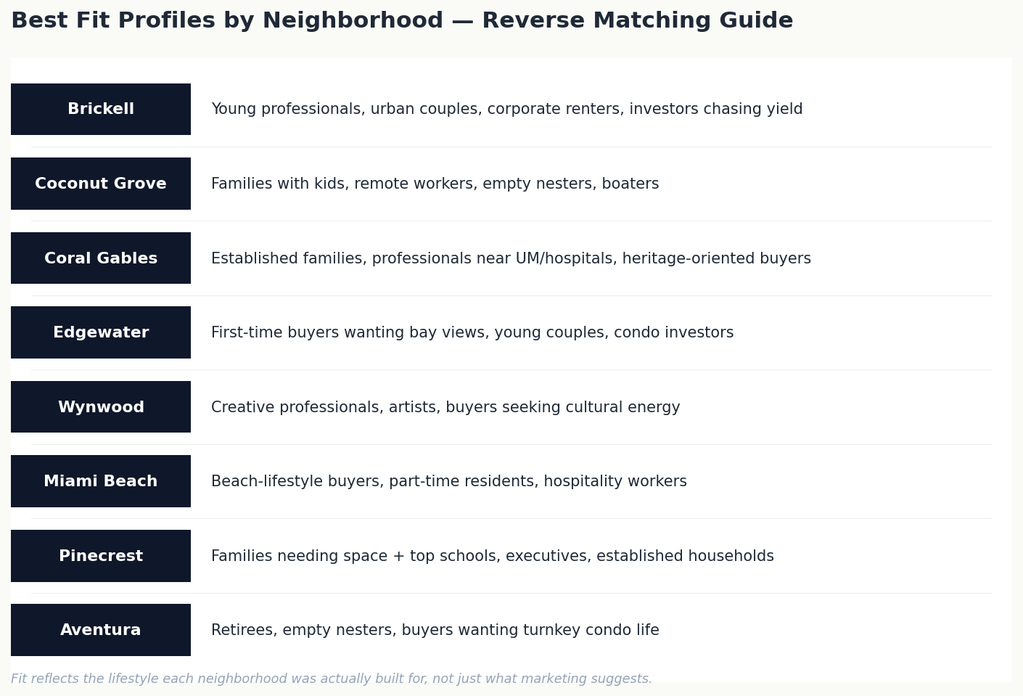
Notice something: none of these fits are marketing claims. They're the pattern I see in who actually thrives long-term. Coconut Grove doesn't just claim to be family-friendly — the school access, waterfront lifestyle, and village community actually deliver that. Miami Beach doesn't just claim to be beach lifestyle — the ocean is a 3-minute walk from most points.
Where marketing and reality diverge most is usually around Brickell (marketed to families sometimes, actually built for young professionals) and Wynwood (marketed as an emerging residential neighborhood, still deeply oriented around scene rather than daily life).
What Each Neighborhood Is Actually Strong At
Think of this next chart as neighborhood profiles across the six dimensions that matter most to lifestyle:
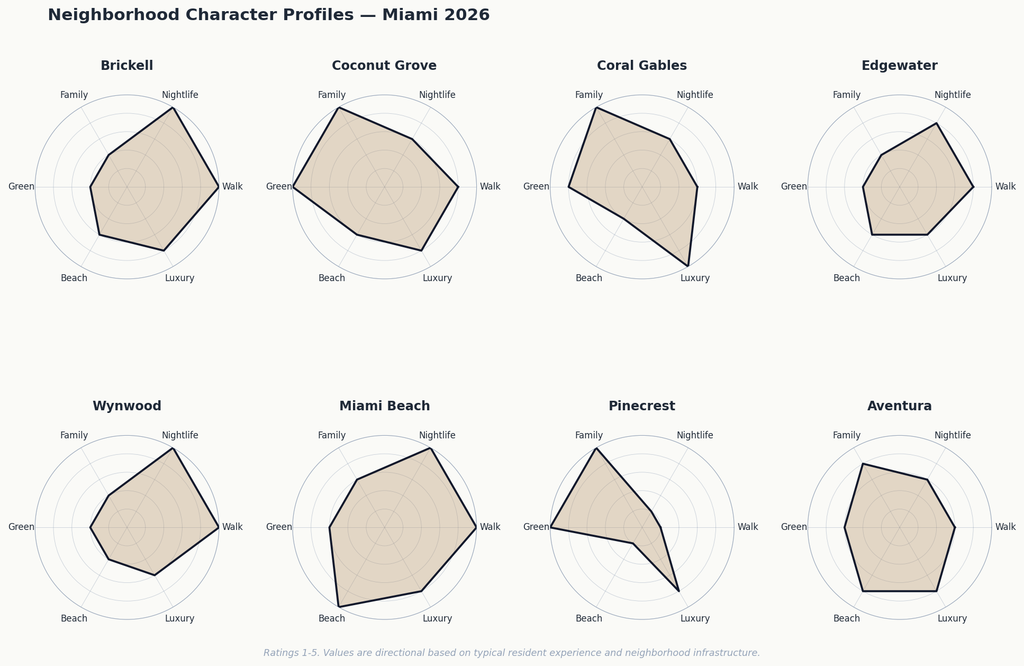
Reading these correctly:
Brickell dominates urban categories (walk, nightlife) and is weak on family/green. That's the DNA — it's a financial district that residents live in.
Coconut Grove is broadly strong across most categories — it's genuinely one of the most balanced neighborhoods in Miami. The reason it's my top recommendation for most families and remote workers is right there in the shape of that radar.
Coral Gables peaks on luxury and family, moderate on everything else. It's the "established heritage" pick.
Miami Beach peaks on everything but family — the beach access, walkability, nightlife, and luxury are all there, but family infrastructure is the weakest of any of these.
Pinecrest is completely the opposite of Brickell — high on family and green, low on walk and nightlife. Suburban DNA.
Aventura is the most balanced-flat neighborhood — moderately strong across everything, not exceptional in any category. That's actually what makes it a genuine retirees' choice: no glaring weaknesses.
The Trade-Off You're Actually Making
Every Miami neighborhood decision is a trade between lifestyle quality and cost of living. Here's how the 8 compare:
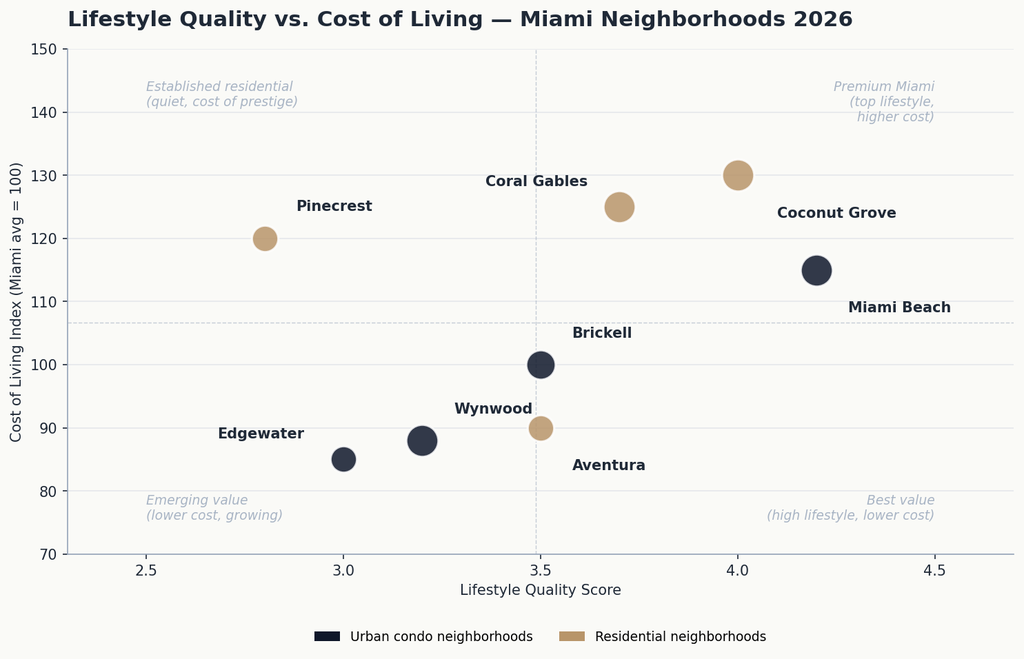
The premium quadrant (top right — Coconut Grove, Coral Gables, Miami Beach) is where you pay more for genuine lifestyle depth. If your income supports it and your life fits, these are the strongest long-term picks.
The "best value" quadrant (bottom right — sparsely populated in Miami) is what most buyers wish existed. Aventura is the closest thing to it — solid lifestyle at lower cost — but only for the right buyer profile.
The "emerging value" quadrant (bottom left — Edgewater, Wynwood) is where you're paying less because the neighborhood is still becoming what it will be. Real upside potential, but you're betting on the trajectory.
Pinecrest is a bit of an outlier — high cost, moderate walkable lifestyle quality, but the specific family fit is what pushes value there for the right buyer.
The Neighborhoods Not on This List
You'll notice some absences:
Downtown Miami — technically the most walkable Miami neighborhood by Walk Score (99), but the residential feel still hasn't caught up to the walkability infrastructure. Most people who think they want Downtown actually want Brickell.
Doral — a real neighborhood with a real audience (people working near the airport, western Miami-Dade employment, families wanting planned-community suburbs), but it doesn't fit any of the eight main lifestyle profiles most relocation clients ask about.
Hialeah — the largest Miami-adjacent city and genuinely affordable, but almost never selected by relocation clients unless they have specific cultural or community ties.
Key Biscayne — technically an island. Beautiful, tight-knit community, top schools, but the single-bridge access makes it work only for very specific buyers.
North Miami / Aventura outer edges — real value, but you're increasingly committing to a Broward-oriented life. Great if you work in Fort Lauderdale; confusing choice if your center of gravity is Miami-Dade.
I cover more of these in our community guides if you want to explore them further.
How I Actually Recommend Working Through This
Reading a post like this is useful for narrowing. Making the final call takes more.
Get on the ground in your top 2-3. No amount of research substitutes for spending a Tuesday morning, a Saturday night, and a Sunday afternoon in the neighborhood you're seriously considering.
Test the commute at real rush hour. A neighborhood that's "20 minutes from Brickell" is very different at 5pm than at 11am.
Get insurance quotes on specific properties. Two condos in the same neighborhood can have $3,000-$5,000/year differences in insurance based on building age, elevation, and construction. This affects your monthly total more than most buyers realize.
Look at HOA reserves, not just the fee. A "cheap" HOA in an older building is often the one that will hit you with a $20,000-$50,000 special assessment in year two.
Consider leasing your first year. For most relocation clients, a 12-month lease in your top-choice neighborhood is the best investment you can make. Live it. Understand it. Then buy — or move to your second choice with real data.
The Honest Bottom Line
Miami is not one place. It's eight or ten distinct places sharing a name, and picking the wrong one is the fastest way to end up disappointed in a city that could have been perfect for you.
The good news: the right neighborhood is genuinely rewarding. The people I work with who chose right talk about their lives here with a kind of unforced enthusiasm that's rare. They live in the right size home, in the right community, with the right daily rhythm — and Miami works for them in ways they didn't fully expect.
That's what I'd rather help you land in than the alternative.
Frequently Asked Questions
What's the best Miami neighborhood to live in?
There isn't a single best neighborhood — it depends entirely on your lifestyle, budget, and daily routine. Coconut Grove tends to be the most broadly recommended for families and remote workers. Brickell is the top choice for young professionals wanting walkability. Coral Gables suits established families and heritage-oriented buyers. Miami Beach fits beach-lifestyle buyers. Pinecrest is best for families needing space and top schools.
Which Miami neighborhood is best for families?
Coconut Grove, Coral Gables, and Pinecrest are the three consistently top picks for growing families. Coral Gables and Pinecrest both offer 9/10 GreatSchools-rated public high schools. All three have strong private school options, established residential character, and family-oriented community infrastructure that the urban condo neighborhoods lack.
Which Miami neighborhood is best for young professionals?
Brickell and Wynwood-Edgewater are the strongest fits. Brickell offers walkable financial-district energy and the deepest professional network. Wynwood-Edgewater delivers a more creative, cultural energy at generally better value. Coconut Grove works for young professionals who prefer village character over urban density.
What's the difference between Brickell and Coral Gables?
Brickell is Miami's financial district — high-rise condos, walkable urban energy, young-professional culture, and dense restaurant and nightlife scene. Coral Gables is a heritage residential city with Mediterranean-revival architecture, top-tier schools, and a slower, more established feel. Brickell suits young singles and couples; Coral Gables suits established families with means.
Which Miami neighborhood has the best value in 2026?
Edgewater and Wynwood offer the most potential upside — lower entry prices ($440K-$675K condo medians) in emerging corridors that continue growing. Aventura offers the best turnkey value for buyers wanting established building infrastructure at lower cost than Brickell or Miami Beach.
Ready to actually work through which Miami neighborhood fits your specific life? Our Florida Buyers Guide walks through what to expect at every stage of the buying process. If you're leaning toward leasing first to test-drive a neighborhood before committing, our Florida Leasing Process is built specifically for that. For deeper neighborhood-by-neighborhood information, our community guides go into more detail on each area. And if you're focused on new construction, our Miami new developments page covers what's actively coming to market across all these neighborhoods. Either way — I'd rather help you land in the right Miami neighborhood upfront than watch you learn the hard way.
Check out this article next