The retirement conversation I have most often with relocation clients goes like this: "My spouse and I have been thinking about Florida. Miami keeps coming up. But everyone tells us different things — is it actually a good place to retire, or is it just a vacation place we're romanticizing?" The honest answer for 2026 is that Miami just ranked #4 out of 182 US cities for retirement (WalletHub, September 2026).
It genuinely is one of the best US cities to retire in. But it's also the most expensive city on the top-10 list, the most culturally distinctive, and the one most likely to be a spectacular win or a spectacular mismatch depending on the specific retiree. Miami retirement isn't the Aventura-only, snowbird-only, gated-condo cliché most people picture. It's a much broader landscape — from HNW ultra-luxury waterfront estates on Fisher Island to genuinely affordable retiree condos in Kendall and Palmetto Bay, with a vast range of Cuban, Colombian, and international cultural options in between.
There's a Miami retirement for almost every priority set. The key is matching your specific retirement priorities to a specific neighborhood and price point — because a $6,250/month modest retirement in a Miami condo rental and a $19,300/month luxury waterfront retirement are both legitimate Miami retirement experiences, just for completely different people. Let me walk you through the honest 2026 guide to retiring in Miami — the rankings, the real budgets, the neighborhood matches, and the specific decisions retirees need to make before they commit. If you're already thinking through Miami retirement and want expert guidance from someone who works with HNW retiree clients across South Florida, our Florida Relocation Process is designed for exactly this. Our team at The Carroll Group at Compass — the #1 team at Compass Florida with $9B+ in career sales — specializes in HNW retirees across Miami-Dade, Broward, and Palm Beach counties.
Why Miami Actually Ranks #4 for Retirement in 2026
The WalletHub September 2026 rankings evaluated 182 US cities across 45 metrics covering affordability, activities, quality of life, and healthcare. Miami placed #4 overall — a genuinely strong ranking. But the breakdown tells you where Miami wins and where it doesn't: 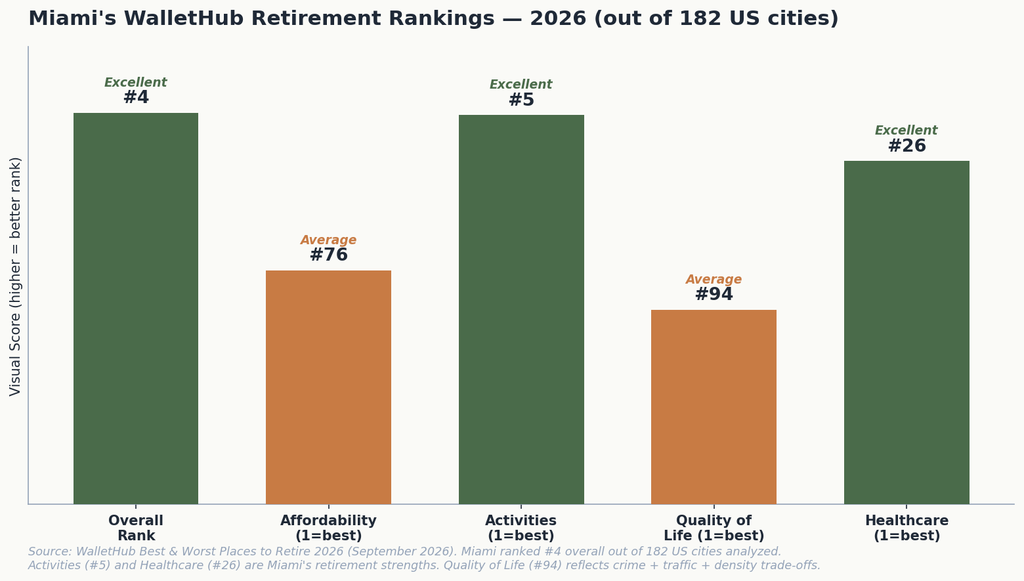 Activities: #5 in the country. This is Miami's biggest retirement strength. Miami ranks at the top of the nation for adult volunteer activities, art galleries, and fishing facilities per capita. It has the 17th-most museums and 11th-most recreation and senior centers of any US city. For active retirees who want cultural richness and physical options, few American cities compete.
Healthcare: #26 in the country. Strong but not top-tier. Miami has world-class medical infrastructure — Baptist Health South Florida, University of Miami Health System, Jackson Memorial, Mount Sinai Miami Beach — but the sheer volume of population per specialist means access varies dramatically by neighborhood and by insurance type. Retirees who manage serious health conditions should specifically vet their target neighborhood's proximity to top specialty care.
Overall: #4 out of 182 US cities. The composite score reflects Miami's genuine retirement strengths — no state income tax, strong healthcare access, exceptional activities, warm year-round climate — offset by its two real weaknesses.
Affordability: #76. Miami costs meaningfully more than most retirement destinations. Cost of living runs approximately 20% above the national average. Home prices sit around $569K median (versus $357K nationwide), and monthly rent averages $3,100 (versus $1,995 nationwide). Retirees on fixed Social Security-only income will find Miami genuinely stretching.
Quality of Life: #94. The lowest of Miami's four scores. This reflects Miami's real trade-offs: traffic congestion, urban density, higher crime rates in some neighborhoods, hurricane risk. Retirees who prioritize peaceful, quiet daily life over cultural intensity will need to specifically choose neighborhoods that offer that (Pinecrest, Palmetto Bay, Key Biscayne) rather than assuming any Miami neighborhood will provide it.
What Miami Retirement Actually Costs
Let's get concrete. Here's what a Miami retirement actually costs at different lifestyle levels for a couple both age 65+: 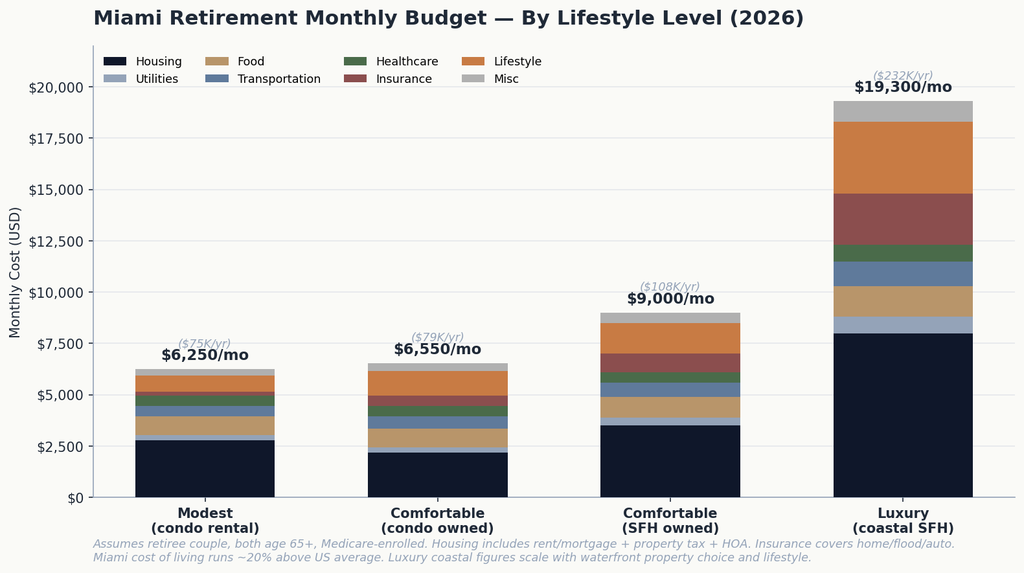 Modest retirement ($6,250/month, $75K/year): A rental condo in an inland Miami neighborhood (Kendall, Palmetto Bay, or a smaller unit in Aventura), one modest car, Medicare-supplemented health coverage, and a lifestyle focused on outdoor activities and reasonable dining. This is realistic for retirees on above-average fixed incomes ($75K+ combined Social Security + modest pension/withdrawals).
Comfortable owned-condo retirement ($6,550/month, $79K/year): Own a 1-2 bedroom condo in a mid-tier building in Aventura, Coral Gables, or Coconut Grove, no mortgage payment, HOA fees factored in, comfortable lifestyle with regular dining out and cultural activities. This is genuinely achievable for retirees who arrive with home equity from a high-cost-state sale plus modest ongoing income.
Comfortable SFH retirement ($9,000/month, $108K/year): Own a single-family home in Coral Gables, Pinecrest, or Palmetto Bay, no mortgage, budget for home maintenance and insurance, regular travel, boat or country club membership. This is the "downsizing HNW retiree" version — comfortable but not extravagant.
Luxury coastal retirement ($19,300/month, $232K/year): Own a waterfront home in Key Biscayne, Coconut Grove, or Miami Beach, with private dock, top-tier country club membership, luxury car(s), staff, frequent international travel, and Miami's full HNW social scene. This is the version most Miami luxury marketing depicts.
The honest reality: most Miami retirees fall in the $75K-$150K annual spending range. The luxury version gets the Instagram attention, but the practical middle is where most HNW retirees actually land.
The Best Miami Retirement Neighborhoods
Not every Miami neighborhood works for retirement. Here are the ones that consistently do — with real 2026 price ranges and healthcare access: 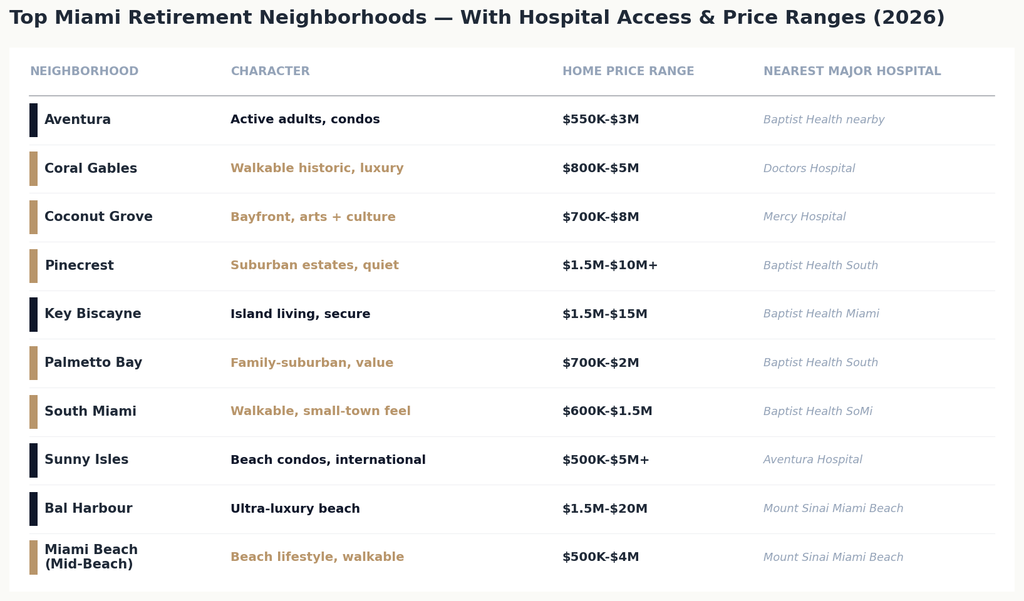 Let me walk through the top options:
Aventura — The Active Adult Standard
Aventura is Miami's most established retiree neighborhood. Extensive condo inventory ranging from $550K starter units to $3M+ luxury; Aventura Mall for shopping and dining; Turnberry Isle for golf; Aventura Hospital for healthcare; and a walkable, secure community feel. Substantial Jewish and Russian retiree populations create a specific cultural texture. Not for retirees seeking Latin American immersion, but excellent for retirees prioritizing amenities, security, and English-primary daily life.
Coral Gables — Walkable Historic Luxury
Coral Gables is arguably the best Miami neighborhood for HNW retirees who want walkability and cultural richness. Tree-lined streets, historic Mediterranean architecture, Miracle Mile shopping, Venetian Pool, and easy access to Doctors Hospital and Baptist Health. Homes range $800K for smaller Villages to $5M+ for the classic historic estates. Bilingual (55% Hispanic) but English works comfortably everywhere.
Coconut Grove — Bayfront + Arts
Coconut Grove offers bayfront waterfront living with a distinct arts and cultural character. Home to Vizcaya Museum, CocoWalk, and the Grove's boutique retail. Mercy Hospital is the nearest major medical facility. Price range $700K for condos to $8M+ for waterfront estates. Attracts retirees who want cultural richness alongside daily outdoor access.
Pinecrest — Suburban Estates for Quiet Retirement
Pinecrest offers acre-plus estates, tree canopy, low density, and one of Miami-Dade's highest-ranking school districts (relevant if grandchildren visit or move nearby). Estates range $1.5M to $10M+. Baptist Health South Miami is the neighborhood hospital. This is the retirement neighborhood for HNW clients prioritizing peace, privacy, and space over walkability or urban amenities.
Key Biscayne — Island Retirement
Key Biscayne is Miami's premier island retirement community. Gated feel via the causeway bridge, low-density housing, Crandon Park's beaches and parks, Baptist Health Miami accessible. Property values range $1.5M to $15M+. Popular with international retirees (large South American and European populations) who value privacy and security.
Palmetto Bay — Value + Suburban Comfort
Palmetto Bay is the value pick among Miami retirement neighborhoods. Single-family homes in the $700K-$2M range (below equivalent Coral Gables or Pinecrest properties), family-suburban character, close to Baptist Health South Miami, and reasonable commute to Coral Gables/downtown Miami for cultural activities. Excellent for retirees who want SFH quality without top-tier prices.
South Miami — Walkable Small-Town Feel
South Miami is walkable, low-density, and offers a small-town retirement feel while remaining connected to greater Miami. Home prices from $600K-$1.5M. Baptist Health SoMi is the neighborhood hospital. Popular with retirees who want simplicity, walkability, and connection to city amenities.
Sunny Isles — Beach Condo Living
Sunny Isles is the "beach condo retirement" option, with high-rise oceanfront condos in the $500K-$5M+ range. Large international population (Russian, Brazilian, Argentine) and easy access to Aventura Hospital. Best for retirees who prioritize daily beach access and don't require English-only environments.
Bal Harbour — Ultra-Luxury Beach
Bal Harbour is Miami's ultra-luxury beach retirement enclave. Bal Harbour Shops (some of the highest-end retail in America) anchors the community. Mount Sinai Miami Beach is nearby. Home values $1.5M-$20M+. This is trophy-tier HNW retirement — waterfront, secure, exclusive.
Miami Beach (Mid-Beach) — Beach + Walkability
Mid-Beach (roughly 25th-63rd Streets) offers a more residential, less party-oriented version of Miami Beach retirement. Beach lifestyle, walkable dining, Mount Sinai Miami Beach for healthcare. Property values $500K-$4M. Popular with retirees who want beach access without South Beach's nightlife density.
Matching Your Retirement Priorities to a Neighborhood
Different retirees have different priorities. Here's the honest framework for matching yours: 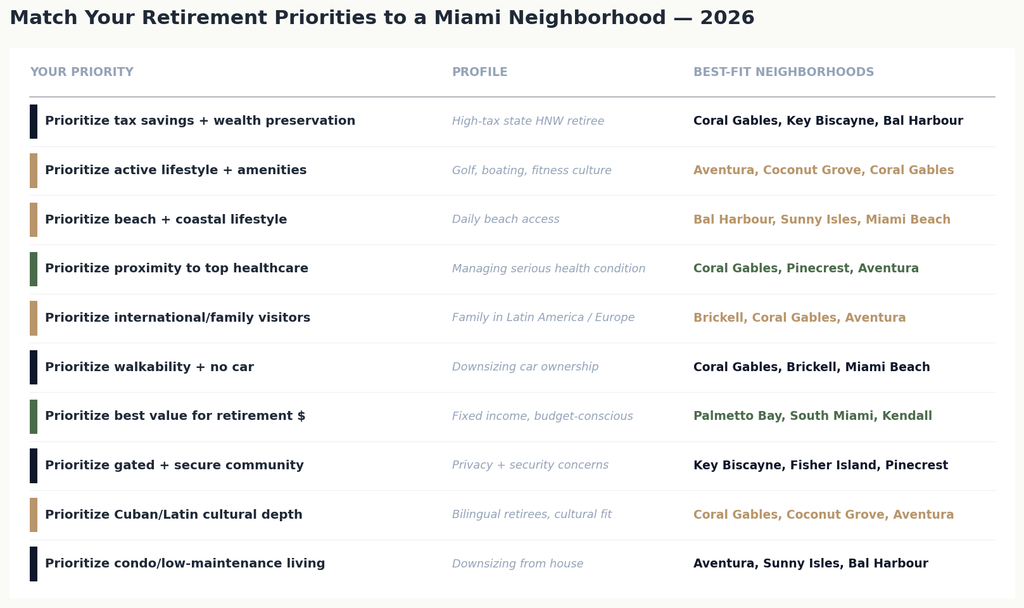 The clearest patterns I see:
If you're an HNW retiree from a high-tax state prioritizing wealth preservation: Coral Gables, Key Biscayne, or Bal Harbour. Florida's tax advantages (no state income tax, no estate tax, homestead protections) meaningfully compound at HNW levels — a $500K annual income retiree saves $50,000-$55,000/year in state taxes moving from NYC or California, which is enough to pay a substantial part of your Miami mortgage.
If you're managing a serious health condition: Coral Gables (Doctors Hospital + Baptist Health nearby), Pinecrest (Baptist Health South), or Aventura (Aventura Hospital). Proximity to specialty care matters more than lifestyle amenities when health becomes a priority.
If you're prioritizing active lifestyle amenities: Aventura (mall, dining, golf), Coconut Grove (bayfront, boating, arts), or Coral Gables (walkable culture). All three have strong retiree infrastructure alongside recreation.
If you're value-conscious on fixed income: Palmetto Bay, South Miami, or Kendall. These offer legitimate Miami-Dade retirement quality at meaningfully lower price points than the trophy neighborhoods. If you're downsizing to condo living: Aventura, Sunny Isles, or Bal Harbour. These have the most condo inventory across a wide price range with retirement-appropriate amenities (security, elevator access, on-site services).
If you're a bilingual retiree seeking Cuban/Latin cultural depth: Coral Gables, Coconut Grove, or Aventura all offer strong Latin cultural infrastructure while remaining functional in English. If you're fully Spanish-primary, Coral Gables specifically has a large Cuban-American retiree population.
The Financial Advantages Most Retirees Miss
Beyond the cost of living picture, Miami retirement has three specific financial advantages that HNW retirees especially benefit from:
1. No state income tax on any income type. Florida taxes zero on wages, pension income, Social Security, IRA/401(k) withdrawals, short-term or long-term capital gains, and investment income. For a retiree with $500K/year in withdrawals + investment income, this saves $50K-$55K/year vs. New York or California. Over a 20-year retirement, that compounds to $1.5M-$5M+ in preserved wealth depending on income level.
2. Homestead exemption + Save Our Homes cap. Florida's homestead exemption removes $50,000 from your primary residence's assessed value for property tax purposes. More importantly, the Save Our Homes cap limits annual property tax assessment increases to 3% for primary residences. This means retirees who buy in Miami and stay 10-20 years benefit from a widening gap between market value and taxable value — a real inflation hedge that most retirees don't realize exists.
3. No estate tax; strong asset protection. Florida repealed its estate tax in 2004 and has no inheritance tax. Combined with strong homestead asset protection (creditors generally cannot force sale of a Florida primary residence), Florida becomes attractive for wealth transfer planning. HNW retirees planning generational wealth transfer benefit meaningfully from establishing Florida domicile.
The important caveat: to capture these benefits, you must legally establish Florida domicile. Simply spending winters in Miami while keeping a NY apartment doesn't get you Florida's tax benefits — and NY's Department of Taxation actively audits retirees who claim Florida residency while spending significant time in NY. If you're moving for tax benefits, do it properly: 183+ days per year in Florida, Declaration of Domicile filed, Florida driver's license, voter registration, all bank accounts moved.
What Retirees Should Actually Do Before Moving
The retirees who thrive in Miami spend real time in the 6-12 months before their move working through specific decisions: T
est-drive Miami for a full year before buying. Rent for 12 months in your target neighborhood before committing to a purchase. Living through one Miami summer (heat + hurricane season) is essential — some retirees discover they don't tolerate the summer well and shift their planning. Others discover they love it. Either way, you don't want to find out after buying.
Get healthcare established early. Move your Medicare enrollment records to Florida. Choose Miami-based primary care and any specialists you regularly see. Establish care while you're healthy — not while you're managing a crisis.
Verify Medicare Advantage and supplement coverage in Miami. Not all plans travel well. Some Medicare Advantage plans that worked great in your prior state may not have equivalent Miami networks. Verify with your insurance broker before you move.
Complete Florida domicile checklist within your first 60 days. File Declaration of Domicile, register to vote, get Florida driver's license within 30 days, register vehicles within 10 days, file homestead exemption by March 1 (if you close on a home).
Update estate planning under Florida law. Have your will, trusts, and powers of attorney re-executed under Florida law. Florida has different rules for probate, homestead protection, and asset protection than most states.
Connect with the retiree infrastructure early. Every neighborhood has retiree social infrastructure — country clubs, synagogues, churches, cultural centers, dining clubs, boating groups. Miami's retiree networks are dense but require active participation. Introverted retirees who wait for social connections to find them tend to isolate.
Plan for hurricane season Year One. Your first hurricane season will be your steepest learning curve. Build supply kit in June, understand your evacuation zone, know your Medicare providers' storm protocols, keep prescriptions filled in advance.
The Retiree Profile Miami Serves Best
Based on the HNW retirees I work with, Miami retirement works exceptionally well for:
- HNW retirees relocating from high-tax states (NYC, California, New Jersey, Massachusetts) who want to preserve wealth while enjoying warm-weather living
- Active retirees who value cultural depth, dining, and social intensity more than quiet suburban life
- International retirees or bilingual retirees with family in Latin America or Europe
- Boaters, golfers, and outdoor-active retirees who want year-round access to activities
- Retirees who want walkability and urban amenities rather than driving-dependent suburban retirement
- Estate-planning-focused retirees using Florida domicile for wealth transfer optimization
Miami retirement is not the right fit for:
- Fixed-income retirees on Social Security only who need retirement cost-of-living below national average
- Retirees prioritizing peaceful, quiet suburban life over cultural intensity
- Retirees who don't tolerate heat, humidity, or hurricane risk
- Retirees with serious health conditions requiring specialty care that's stronger elsewhere (some retirees genuinely need Cleveland Clinic, Mayo, or Johns Hopkins proximity more than Miami's healthcare)
- Retirees who dislike bilingual environments or feel excluded by Miami's Latin cultural character
The Bottom Line
Miami is genuinely one of America's best retirement cities in 2026 — but "best" depends entirely on whether the specific city character matches your specific retirement priorities. The WalletHub #4 ranking is real. So are the trade-offs: higher cost of living, weaker quality-of-life scores relative to top-tier metros, cultural intensity that doesn't fit every retiree. The HNW retirees I see thrive in Miami consciously chose this specific retirement experience — the tax advantages, the cultural richness, the year-round outdoor lifestyle, the international community, the boating and beach access. The ones who struggle underestimated the cultural adjustment, overestimated their heat tolerance, or bought before renting long enough to know if the neighborhood actually fit them. Your retirement decision deserves that specific matching work — not a generic "Miami is great" pitch. That's the conversation I'd rather have with you before you list your NY or California home than after.
Frequently Asked Questions
Is Miami a good place to retire in 2026? Yes. Miami ranked #4 out of 182 US cities in WalletHub's Best Places to Retire 2026 rankings (published September 2026), with particular strength in activities (#5) and healthcare (#26). Miami offers no state income tax on any income type, world-class healthcare infrastructure (Baptist Health, UM Health, Jackson Memorial, Mount Sinai), year-round warm climate, exceptional cultural amenities, and a large international retiree community. Trade-offs include cost of living approximately 20% above national average, hurricane season (June-November), and cultural intensity that doesn't fit every retiree.
How much does it cost to retire in Miami? Miami retirement costs range from approximately $75,000/year for a modest condo-rental retirement to $232,000/year for luxury coastal waterfront retirement. Most HNW retirees fall in the $79K-$108K/year range for a comfortable owned-condo or single-family-home retirement. Cost of living runs approximately 20% above the national average. Median home value is $569,760 versus $357,445 nationwide; median rent is $3,100/month versus $1,995 nationwide. Retirees on Social Security-only fixed incomes will find Miami genuinely stretching.
What are the best Miami neighborhoods for retirement? The top Miami retirement neighborhoods depend on priorities. Aventura offers active adult amenities and condos ($550K-$3M). Coral Gables provides walkable historic luxury ($800K-$5M). Coconut Grove offers bayfront arts and culture ($700K-$8M). Pinecrest provides suburban estates for quiet retirement ($1.5M-$10M+). Key Biscayne offers island living and security ($1.5M-$15M). Palmetto Bay and South Miami provide better value ($600K-$2M range). Sunny Isles, Bal Harbour, and Mid-Beach Miami Beach offer beach-focused options. Match neighborhood to specific priorities: healthcare proximity, walkability, tax benefits, cultural fit, or property type.
What are the tax advantages of retiring in Miami? Florida has no state income tax on any type of income — wages, pension distributions, Social Security, IRA/401(k) withdrawals, short-term or long-term capital gains, dividends, or interest. Florida also has no estate tax (repealed 2004) and no inheritance tax. The homestead exemption removes $50,000 from your primary residence's property tax assessment. The Save Our Homes cap limits annual property tax assessment increases to 3% for primary residences. For HNW retirees with significant income, tax savings vs. NYC or California can exceed $50,000-$150,000+ annually. Establishing legal Florida domicile requires proper steps: 183+ days per year in Florida, Declaration of Domicile, Florida driver's license and voter registration.
How does healthcare compare in Miami for retirees? Miami has strong healthcare infrastructure ranked #26 nationally by WalletHub for retirement healthcare. Major medical systems include Baptist Health South Florida (multiple locations), University of Miami Health System (Jackson Memorial Hospital and UHealth), Mount Sinai Miami Beach, and Aventura Hospital. Access varies significantly by neighborhood — Coral Gables, Pinecrest, Aventura, and Coconut Grove all have close proximity to major medical centers. Retirees with serious health conditions should specifically verify Medicare Advantage or supplemental coverage networks include their preferred providers before moving, as not all plans that worked in prior states have equivalent Miami networks.
Ready to work through Miami retirement for your specific situation? Our team at The Carroll Group at Compass — the #1 team at Compass Florida with $9B+ in career sales — specializes in HNW retirees relocating from high-tax states across Miami-Dade, Broward, and Palm Beach counties. Our Florida Relocation Process is designed specifically for retiree decisions — matching lifestyle priorities, tax planning, healthcare access, and neighborhood fit before you commit. If you're planning to test-drive Miami with a 12-month rental before buying (which we strongly recommend), our Florida Leasing Process walks through that stage. When you're ready to buy, our Florida Buyers Guide covers the purchase side including retiree-specific considerations. For deeper neighborhood-by-neighborhood context on which areas actually fit retiree life, our community guides break down each option in detail. Either way — I'd rather help you match Miami retirement to your actual retirement priorities than watch you buy in the wrong neighborhood for who you actually are.
Check out this article next