Miami isn't a Southern American city that happens to have a lot of Latin culture.
Miami is a Latin American city that happens to sit inside the United States.
That distinction — which most relocation guides skip entirely — is the single most important thing to understand before you move here. It shapes your daily life, your neighborhood decision, your ability to make friends, your success in business, and whether Miami ultimately feels like home or feels like a place you're always slightly outside of.
Two-thirds of Miami-Dade residents speak Spanish at home. Approximately 68% of the county identifies as Hispanic or Latino — the highest concentration of any major US metro area. Hialeah is 94% Hispanic. Little Havana is 92%. Doral is 80%. Even in Miami's more "American-feeling" neighborhoods like Coral Gables and Coconut Grove, bilingualism is the baseline, not the exception.
None of this makes Miami harder to live in. It makes Miami different from any other American city you've probably lived in. And newcomers who arrive prepared for that difference settle in successfully. Newcomers who arrive expecting "just another warm American city with beaches" hit a specific wall around month two or three that nobody warned them about.
Let me walk you through the honest cultural reality of Miami in 2026 — what to actually expect, how to navigate it, and how to match your neighborhood choice to your cultural comfort level — so you can arrive prepared rather than surprised.
If you're already thinking through Miami relocation and want expert guidance on matching neighborhoods to your cultural preferences, our Florida Relocation Process walks through exactly this. Our team at The Carroll Group at Compass — the #1 team at Compass Florida — is bilingual by default and works across the full cultural range of South Florida, so we can give you the honest read on which neighborhoods actually fit you.
The Cultural Composition Miami Newcomers Don't Expect
Here's the neighborhood-by-neighborhood cultural density most newcomers only discover after they move:
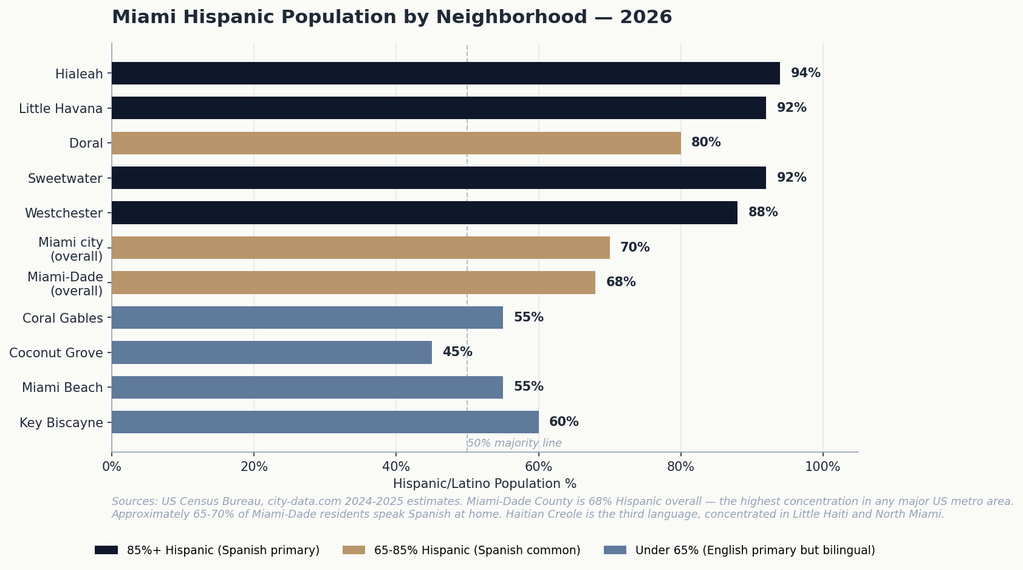
Hialeah, Little Havana, Sweetwater, and Westchester are essentially Spanish-primary neighborhoods. If you don't speak Spanish and don't intend to learn any, these neighborhoods will be a constant friction point. Not because people are unfriendly — Miami is remarkably warm to newcomers — but because commerce, service, and casual social interaction happen primarily in Spanish. Ordering coffee, hiring a plumber, understanding your building's WhatsApp group, or making small talk with a neighbor all default to Spanish.
Doral is 80% Hispanic but bilingual. Doral is meaningfully different from Hialeah or Little Havana. It's newer, more corporate (large Venezuelan business population), and English works everywhere in commerce and service. But Spanish is still the dominant social language.
Miami city overall is about 70% Hispanic; Miami-Dade County is 68%. These are the highest concentrations of any major US metro area. For context, Los Angeles County is about 49% Hispanic; Houston is about 45%. Miami is meaningfully more Latin in daily character than the rest of the "Sun Belt" cities Americans think of as culturally similar.
Coral Gables, Coconut Grove, Miami Beach, and Key Biscayne are the more American-feeling neighborhoods. Not because they're less Hispanic — Coral Gables is still 55% Hispanic, Key Biscayne 60% — but because they were established earlier as international/wealthy areas where English is the default language of commerce and English-speaking American families still form a significant demographic.
The critical insight: Miami has genuine cultural range within it. You can pick your comfort level. But you have to pick consciously, because the difference between living in Hialeah and living in Coconut Grove is genuinely dramatic in daily lived experience.
What Miami Culture Actually Feels Like Day-to-Day
Beyond language, Miami has specific cultural traits that shape daily life in ways most newcomers don't expect:
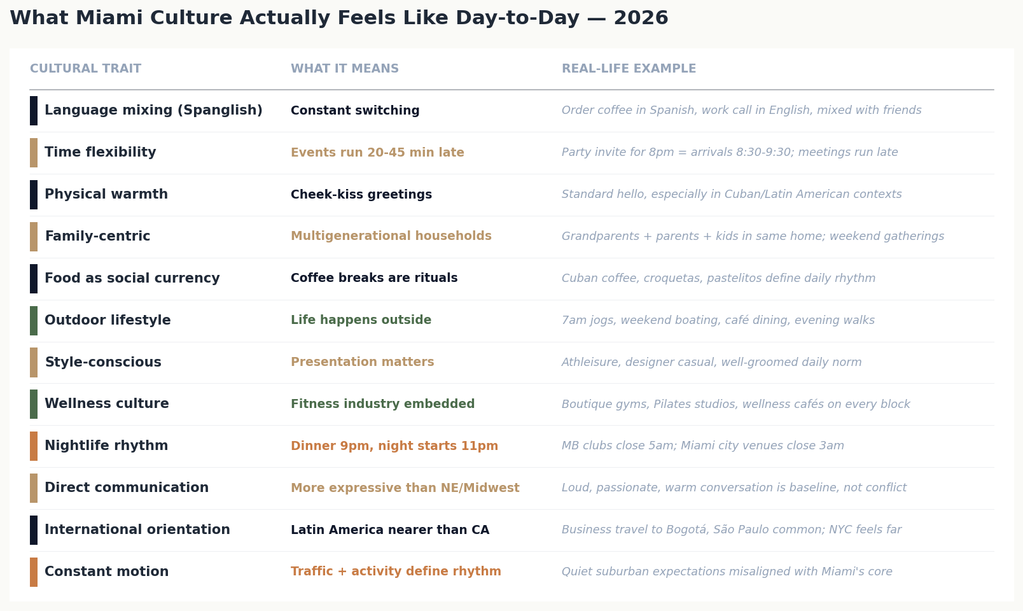
Let me walk through the ones that most affect newcomers:
Language Mixing (Spanglish)
Miami has developed its own English dialect, influenced by decades of Spanish-English bilingualism. Phrases you'll hear regularly that sound "off" to newcomers but are normal Miami English:
- "Get down from the car" (calqued from Spanish "bajarse del carro" meaning "get out of the car")
- "Make a party" (from "hacer una fiesta")
- "Make the line" (from "hacer la fila" meaning "wait in line")
- "Super" as an intensifier ("super close," "super easy") — used far more than in general American English
Additionally, expect constant code-switching in conversations. A Miami native might start a sentence in English, switch to Spanish for a specific word or phrase, then finish in English. This isn't sloppy language — it's an efficient bilingual mode that most Miami residents operate in naturally.
Time Flexibility
Miami operates on what many locals call "Miami time" — a more flexible attitude toward punctuality that mirrors Latin American conventions.
- Social events invited for 8pm will typically have arrivals from 8:30-9:30pm. Arriving at 8:00pm sharp is more likely to catch the host still getting ready than to be seen as punctual.
- Business meetings technically start on time but often run 15-30 minutes late for start, and can run 30-60 minutes over their scheduled end.
- Dinner reservations at 7pm are unusually early by Miami standards — 8:30-9:30pm is standard, and 10pm dinners aren't unusual on weekends.
This isn't unreliability or disrespect — it's a cultural convention. Newcomers from northern American cities where punctuality signals professionalism often experience this as friction for the first few months, then adjust.
Physical Warmth and Direct Communication
Miami is a more physically warm culture than most American cities. Cheek kisses in greeting are standard, especially among Cuban, Latin American, and international residents. Hugs are common in professional contexts that would be handshake-only in other American cities.
Communication style is more expressive — louder, more emotional, more direct. Miami conversations can feel passionate to newcomers from more reserved American cultures. This isn't conflict; it's baseline expressive communication that most residents interpret as warmth and engagement.
The Nightlife Rhythm
Miami's daily rhythm is shifted meaningfully later than most American cities:
- Dinner: 9:00-10:00pm is standard weekend dinner time
- Going out: 11pm-midnight is when nightlife venues actually fill up
- Miami Beach clubs: Close at 5:00am
- Miami city venues: Close at 3:00am
For newcomers used to Northeast or Midwest schedules where 10pm feels like time to go home, this rhythm requires genuine adjustment. Trying to have a "night out" starting at 8pm in Miami often means arriving at a nearly-empty venue and leaving before the actual crowd arrives.
Style and Wellness Culture
Miami is more style-conscious than most American cities. Presentation matters more — from casual daytime dressing to gym clothes to nightlife looks. The wellness industry is deeply embedded — boutique gyms, Pilates studios, IV drip clinics, wellness cafés, and beauty services are on nearly every commercial block.
This shapes daily life in ways newcomers underestimate. Going to Whole Foods in workout clothes and no makeup — unremarkable in Portland or Austin — reads differently in Coral Gables or Brickell. Not judgment, exactly — but noticing. The Miami version of casual involves more attention to appearance than most American cultures.
The International Orientation
Miami's professional and cultural gaze points south, not west. Latin America is closer than California in every meaningful sense — flight times to Bogotá, São Paulo, or Buenos Aires are shorter than to San Francisco. Business relationships across Latin America shape Miami's corporate culture. Cultural events, art fairs, and music trends flow from Latin America to Miami before they flow anywhere else in the US.
For newcomers, this means the mental map of "where the important places are" shifts. Miami feels closer to Bogotá than to New York in ways that shape how residents think about travel, business, and cultural identity.
The Cultural Adjustment Timeline for Newcomers
Almost every newcomer moves through a predictable arc during their first year. Understanding this arc helps you manage expectations:
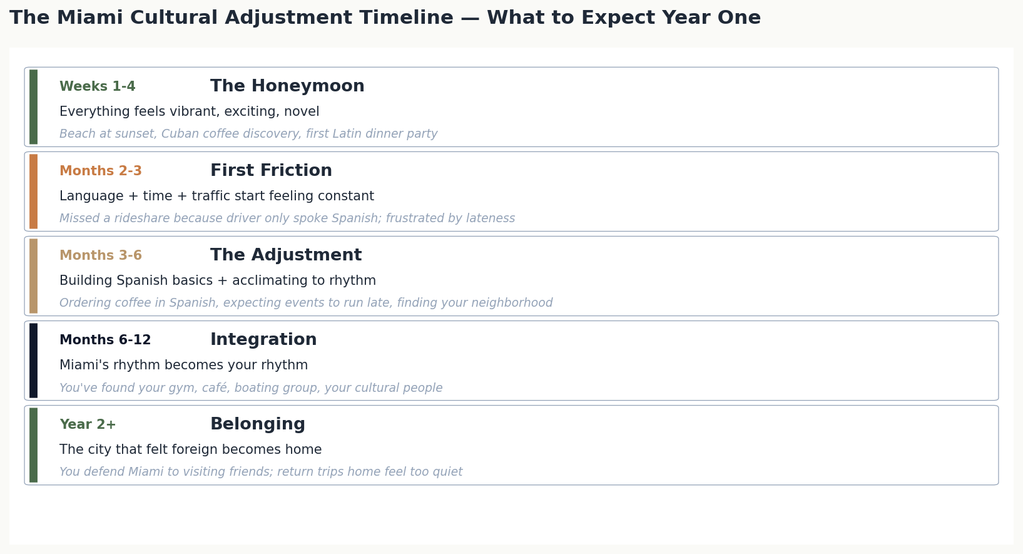
Weeks 1-4: The Honeymoon
Everything feels vibrant and exciting. The sunlight, the ocean, the food, the energy — Miami's sensory density hits newcomers positively at first. You're discovering neighborhoods, trying Cuban coffee for the first time, going to your first Latin dinner party, watching a sunset over the bay. Miami sells itself in the first month.
Months 2-3: First Friction
The novelty wears off and specific irritations start feeling constant rather than exotic:
- The rideshare driver who spoke no English
- The event you arrived at "on time" that turned out to be an hour before the actual party started
- The traffic that never gets better
- The specific frustration of trying to accomplish basic errands in Spanish-primary neighborhoods when you don't speak Spanish
- The professional meeting that ran two hours past its scheduled end
This is when a certain percentage of newcomers decide Miami "isn't for them" and start looking for exit ramps. The ones who push through find that months 3-6 get dramatically easier.
Months 3-6: The Adjustment
You start building Spanish basics (even if only 20-30 essential phrases), acclimating to time flexibility, and finding the specific neighborhoods and venues that fit your comfort level. You stop expecting Miami to operate like your old city and start operating on Miami's terms.
Months 6-12: Integration
Miami's rhythm becomes your rhythm. You've found your regular gym, coffee shop, café for weekend brunch, and social circle. You've discovered which neighborhoods you actually enjoy versus which you tolerate. You've built professional relationships. Miami stops feeling like somewhere you moved and starts feeling like where you live.
Year 2+: Belonging
The city that felt foreign becomes home. You defend Miami to visiting friends who complain about the traffic. Return trips to your old city feel too quiet, too monocultural, too slow. You've adopted Miami as your city, not just your address.
Matching Your Cultural Comfort to a Neighborhood
Here's the practical framework — different cultural preferences fit different neighborhoods:
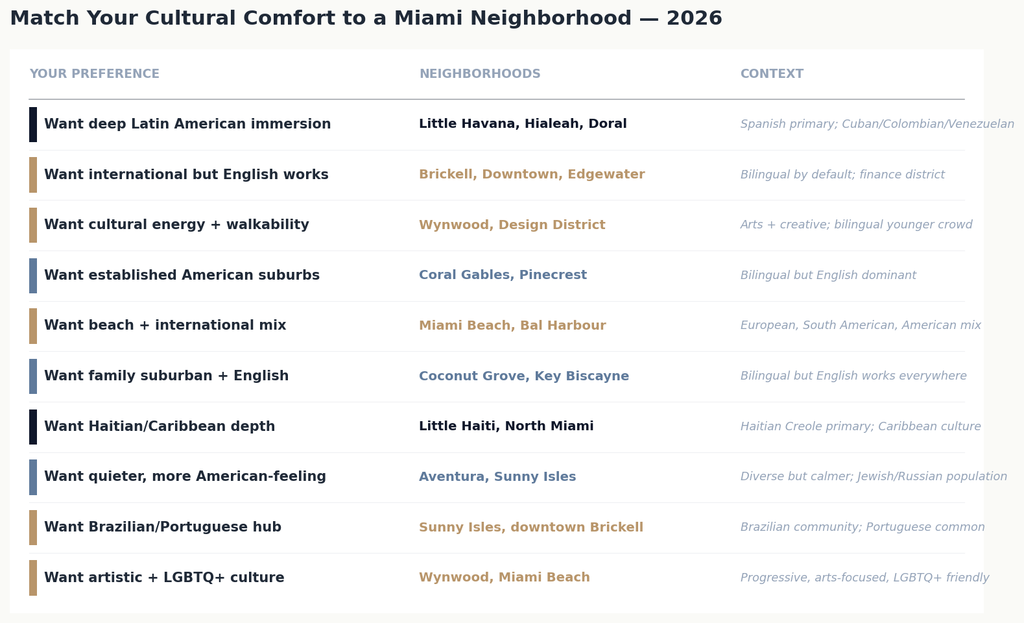
The critical decisions:
If you're a Spanish speaker or want to fully immerse in Latin American culture: Little Havana, Hialeah, Doral, and Sweetwater will feel like natural fits. You'll integrate quickly and Spanish-primary daily life will feel like a feature, not a friction point.
If you value international character but need English to work reliably in daily life: Brickell, Downtown Miami, or Edgewater. These are Miami's most bilingual-professional neighborhoods where you can operate in English while surrounded by international culture.
If you want a more American-feeling suburban experience: Coral Gables, Pinecrest, Palmetto Bay, or Key Biscayne. Still Hispanic-majority in most cases, but with English-dominant daily commerce and longer-established American family populations.
If you want beach culture with international mix: Miami Beach, South Beach, or Bal Harbour. These attract a highly international population (heavy European, South American, and American mix) with English working everywhere.
If you're a family valuing English-primary schools and neighborhoods: Coconut Grove, Pinecrest, or Key Biscayne offer the most "American suburban" feel while still being genuinely diverse.
If you're arts-focused or LGBTQ+: Wynwood, Design District, and Miami Beach are the historically most progressive and creative neighborhoods.
If you want a Haitian/Caribbean cultural depth rather than Latin American: Little Haiti and North Miami are the centers of Miami's Caribbean-Creole cultural life.
The mistake to avoid: picking a neighborhood based on its aesthetics (nice buildings, nice restaurants) without considering whether its cultural character matches your daily comfort. An American newcomer without Spanish who buys a beautiful condo in Doral will love the aesthetics for six months and then find themselves feeling isolated. The same newcomer in Coral Gables will feel much more at home despite Coral Gables being similarly Hispanic-majority.
What Actually Helps Newcomers Integrate
Based on what I see work for successful Miami relocations:
Learn 30-50 essential Spanish phrases before you arrive. You don't need fluency. You need to be able to greet, order food, give directions to a rideshare driver, and navigate basic commerce. Duolingo, Babbel, or Pimsleur for 15 minutes a day for 3 months before moving is genuinely transformational. Locals appreciate the effort even when your Spanish is bad, and it opens doors that stay closed otherwise.
Accept "Miami time" rather than fighting it. Add 30 minutes to any social event's stated start time. Assume business meetings will run over. Don't schedule back-to-back appointments with no buffer. Adopt the rhythm rather than trying to impose your old city's punctuality culture.
Find your cultural people early. Every subculture in Miami has its social infrastructure — Cuban dominoes clubs in Little Havana, Colombian restaurants in Doral, expat communities in Miami Beach, tech founder meetups in Wynwood, boating clubs across Miami-Dade, running groups on Rickenbacker Causeway. Find yours in the first 3 months.
Don't judge Miami by Miami Beach. Miami Beach is a small subset of Miami that gets disproportionate attention. It's not representative of what daily life is like for most residents. If your only Miami experience is South Beach nightclubs and Ocean Drive, you don't yet know Miami.
Understand that Miami runs on relationships more than most American cities. Business is done over long lunches. Trust is built face-to-face. Deals happen through introductions. Transactional networking that works in New York or LA has a lower hit rate here than genuine relationship-building. The Miami cliché — "everyone knows everyone" — is largely true for the upper layers of the city, and integration means participating in that relationship economy rather than treating it as transactional.
Give it a full year before deciding whether Miami is for you. The first 3 months are the honeymoon. The next 3 months are the friction. Only after 6-9 months do you actually know how you feel about the city. Making a major decision about staying or leaving before then is premature.
The Cultural Realities Most Guides Skip
Three things newcomers should genuinely understand:
1. Not knowing Spanish doesn't disqualify you from Miami, but it does narrow your Miami. English is functional everywhere in commerce and works well in most professional contexts. But your Miami will be smaller — fewer neighborhoods that feel like home, fewer people you can build genuine relationships with, more moments of exclusion from conversations happening around you. You can absolutely live successfully in Miami without Spanish. But you'll live a different, smaller version of Miami than someone who speaks it.
2. Miami's international character is a genuine business advantage. If your work touches Latin America — finance, real estate, hospitality, luxury goods, tech, media — Miami's positioning as the "Capital of Latin America" is real business infrastructure. For clients I work with in international finance, family offices, or luxury real estate, Miami operates functionally as a Latin American business hub with US infrastructure. That's an asset most other American cities can't offer.
3. The cultural energy is either the reason you thrive here or the reason you eventually leave. Miami's density, noise, motion, and social intensity is the point for people who move here. It's the thing they miss when they visit anywhere else. For people whose ideal life is quiet Sunday mornings, quiet neighborhood streets, and quiet social gatherings — Miami will always feel like it's turning up the volume beyond what they want. Know yourself before you commit to a purchase.
The Bottom Line
Miami culture isn't for everyone, and that's okay. The people who thrive here consciously chose this specific cultural experience — the Latin American character, the bilingual daily life, the flexible time norms, the physical warmth, the outdoor lifestyle, the international orientation, the constant motion. The people who struggle here were expecting a different city than the one they actually moved to.
Your success in Miami depends less on your income, your job, or even your neighborhood — and more on whether you understood what you were signing up for before you committed. That's the honest conversation I want to have with relocation clients before they close on property, not after.
That's the conversation I want to have with you: not to sell you on Miami, but to help you understand it honestly enough to decide whether it's the right cultural fit for how you actually want to live your life.
Frequently Asked Questions
Do I need to speak Spanish to live in Miami?
No, but not speaking Spanish will narrow your Miami experience. English is functional in commerce and professional settings throughout Miami-Dade — you can absolutely live successfully without Spanish. But approximately 65-70% of Miami-Dade residents speak Spanish at home, and neighborhoods like Hialeah (94% Hispanic), Little Havana (92%), Sweetwater (92%), and Doral (80%) operate primarily in Spanish for daily commerce and social interaction. Learning 30-50 essential Spanish phrases before moving genuinely improves the daily experience for non-Spanish-speaking newcomers.
What's the biggest cultural difference between Miami and other American cities?
Miami is a Latin American city that happens to sit inside the United States — not a Southern American city with Latin influence. Approximately 68% of Miami-Dade County identifies as Hispanic or Latino, the highest concentration of any major US metro area. Daily life defaults to bilingualism, time flexibility (events start 20-45 minutes late by convention), physical warmth (cheek-kiss greetings), later social rhythms (dinner at 9pm, nightlife starting at 11pm), and international orientation toward Latin America. Newcomers expecting a typical Sun Belt city are often unprepared for how genuinely Latin American Miami's cultural character is.
How long does it take to adjust to Miami culture?
Most newcomers move through a predictable arc: honeymoon (weeks 1-4), first friction (months 2-3), adjustment (months 3-6), integration (months 6-12), and belonging (year 2+). Newcomers who commit to learning basic Spanish, adopting Miami's time flexibility rather than fighting it, and finding their cultural community early tend to complete this arc successfully. Newcomers who arrive expecting Miami to operate like their previous American city often experience friction that gets worse rather than better. Most relocation decisions about staying or leaving should be delayed until at least month 6-9.
Which Miami neighborhoods are most American-feeling?
Coral Gables, Coconut Grove, Pinecrest, Palmetto Bay, and Key Biscayne offer the most "American suburban" feel with English-dominant daily commerce. These neighborhoods are still Hispanic-majority (55-60%) but were established earlier as international/wealthy areas with English as the default language of commerce. Miami Beach, South Beach, and Bal Harbour offer a heavily international mix (European, South American, American) where English works everywhere. Newcomers who value American cultural comfort should generally avoid Hialeah, Little Havana, Sweetwater, and Doral, which are Spanish-primary in daily life.
Is Miami friendly to newcomers?
Yes, Miami is remarkably warm to newcomers — but "warm" is different from "easy to integrate into." Miami is a relationship-driven city where business and social life happen through personal networks. Newcomers who invest in genuine relationship-building tend to integrate successfully within 6-12 months. Newcomers who try to build networks transactionally (New York-style networking events) have a lower success rate. Miami's cultural warmth is real, but integration requires participating in the city's relationship economy rather than treating social connection as transactional.
Ready to work through Miami's cultural fit for your specific relocation? Our team at The Carroll Group at Compass — the #1 team at Compass Florida with $9B+ in career sales — is bilingual by default and works across Miami-Dade, Broward, and Palm Beach counties. Our Florida Relocation Process is designed for exactly this kind of decision — matching your cultural preferences to specific Miami neighborhoods before you commit. If you're leaning toward leasing your first year to test cultural fit before buying, our Florida Leasing Process walks through that stage. When you're ready to buy, our Florida Buyers Guide covers the purchase side. For deeper neighborhood-by-neighborhood cultural context, our community guides break down each area in detail. Either way — I'd rather help you understand Miami honestly enough to decide whether it's the right cultural fit for you than watch you commit to a property in the wrong neighborhood for who you actually are.
Check out this article next