Every relocation buyer looking at South Florida eventually asks me some version of the same question: "Miami or Fort Lauderdale — what's the difference?"
The honest answer isn't a slogan or a sales pitch. It's this: these are two genuinely different cities that share a highway, a climate, and roughly the same tax structure — but attract completely different people for completely different reasons. Choose right and you end up in the exact life you moved to South Florida to build. Choose wrong and you spend three years feeling like you moved to the wrong place.
Miami is a major international city that happens to be on the beach. Fort Lauderdale is a really nice big beach town that happens to have serious money. Neither is objectively better. But the daily lived experience is dramatically different — and the housing math is different enough to change what your money actually buys you.
So let me walk you through the honest 2026 comparison — cost of living, real estate, lifestyle, and the specific buyer profiles that fit each city — so you can make this decision with clear eyes rather than getting halfway through your home search before you realize you've been looking in the wrong market.
If you're already working through the South Florida decision and want expert guidance from someone who works both markets, our Florida Relocation Process is designed for exactly this. Our team at The Carroll Group at Compass covers HNW clients across Miami-Dade, Broward, and Palm Beach counties — so we can give you the honest read on both markets, not just the one that pays our commission.
The Head-to-Head Numbers
Let's start with what these cities actually cost:
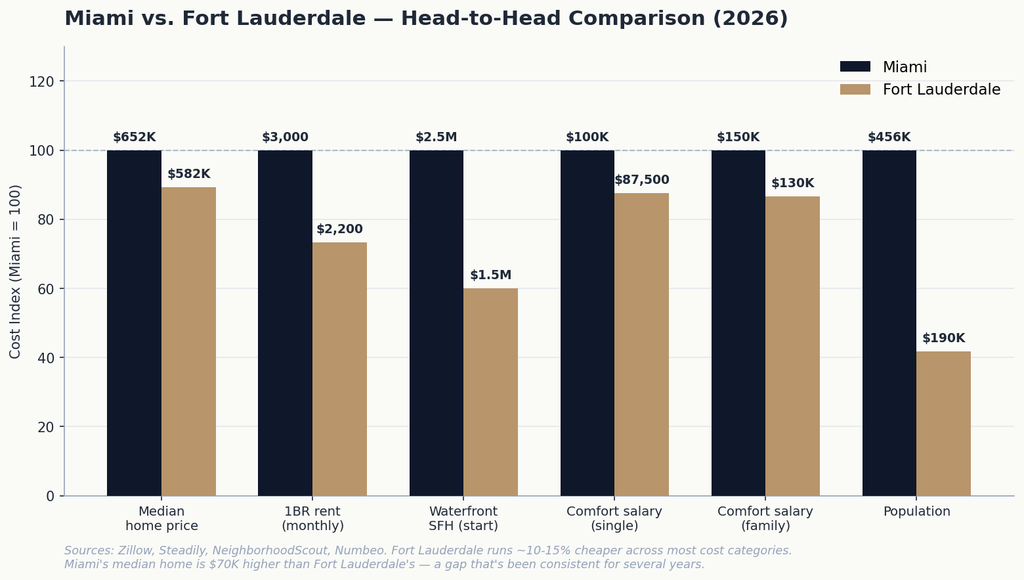
A few things to notice:
Miami's median home price runs about $70K higher than Fort Lauderdale's. Miami-Dade sits around $640-680K in 2026; Broward is $550-580K. This gap has been consistent for several years, driven by Miami's international capital inflows, higher-density luxury inventory, and larger urban core.
Rent runs 25-30% higher in Miami. A 1-bedroom in a decent Miami neighborhood (Brickell, Coral Gables, Coconut Grove) runs $2,500-$3,500/month. Equivalent Fort Lauderdale properties run $1,800-$2,600. On a 12-month lease, that's $7,000-$10,000/year in Miami's favor for Fort Lauderdale renters.
Waterfront luxury opens up dramatically earlier in Fort Lauderdale. Miami waterfront single-family homes typically start around $2.5M and climb well past $10M for premium locations. Fort Lauderdale's equivalent product — direct-ocean or deep-water canal homes with private docks — starts closer to $1.5M. That's a $1M swing for buyers whose primary lifestyle priority is waterfront living.
Fort Lauderdale needs about 87% of the Miami salary to maintain the same lifestyle. A single professional comfortable at $100K in Miami can live comparably on about $87K in Fort Lauderdale. A family comfortable at $150K in Miami needs about $130K in Fort Lauderdale. The gap is real but not enormous.
Miami is significantly larger. 456,000 residents versus 190,000. That size difference shapes almost everything — job market breadth, cultural infrastructure, dining scene, traffic, and international connectivity.
What Your Budget Actually Buys You
Different price points buy dramatically different lifestyles in each city:
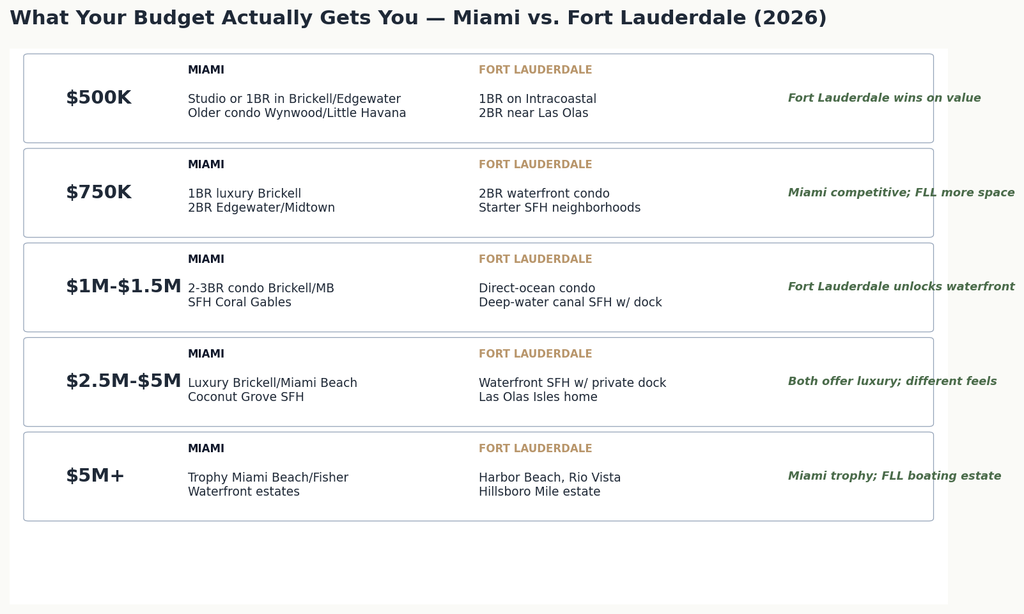
Let me walk through the tiers:
At $500K: Miami is genuinely constrained at this price. You're looking at a studio or small 1-bedroom in Brickell or Edgewater, or an older 1-bedroom in Wynwood or Little Havana. Waterfront is essentially out of reach. Fort Lauderdale at the same price gets you a solid 1-bedroom on the Intracoastal or a 2-bedroom in a well-maintained building near Las Olas. Fort Lauderdale is meaningfully better value at this budget.
At $750K: Miami opens up somewhat — 1-bedroom luxury in Brickell or 2-bedroom in Edgewater/Midtown. Fort Lauderdale gets you a 2-bedroom waterfront condo or a starter single-family home. Miami is competitive here but Fort Lauderdale gives you meaningfully more space.
At $1M-$1.5M: This is Fort Lauderdale's sweet spot. You unlock direct-ocean condos or deep-water canal single-family homes with private docks — a boating lifestyle that doesn't exist at this price in Miami proper. Miami gives you 2-3 bedroom luxury condos in Brickell or Miami Beach, or a single-family home in Coral Gables. If waterfront is your priority, Fort Lauderdale is dramatically better value.
At $2.5M-$5M: Both markets offer luxury options with completely different feels. Miami gets you luxury Brickell high-rises, Miami Beach oceanfront, or Coconut Grove single-family. Fort Lauderdale gets you waterfront single-family with private dock, or a home in Las Olas Isles. Miami's version is denser and more international; Fort Lauderdale's is more spread out and more focused on boating.
At $5M+: Both cities have serious trophy inventory. Miami's ultra-luxury sits in Fisher Island, Miami Beach's Star Island, and top Coconut Grove. Fort Lauderdale's trophy market sits in Harbor Beach, Rio Vista, and along Hillsboro Mile. Miami's version has international brand recognition and financial-district proximity. Fort Lauderdale's version is more focused on the boating lifestyle and multi-generational family estates.
The 12 Trade-Offs That Actually Matter
Beyond cost, the two cities differ across specific lifestyle categories. Here's the honest breakdown:
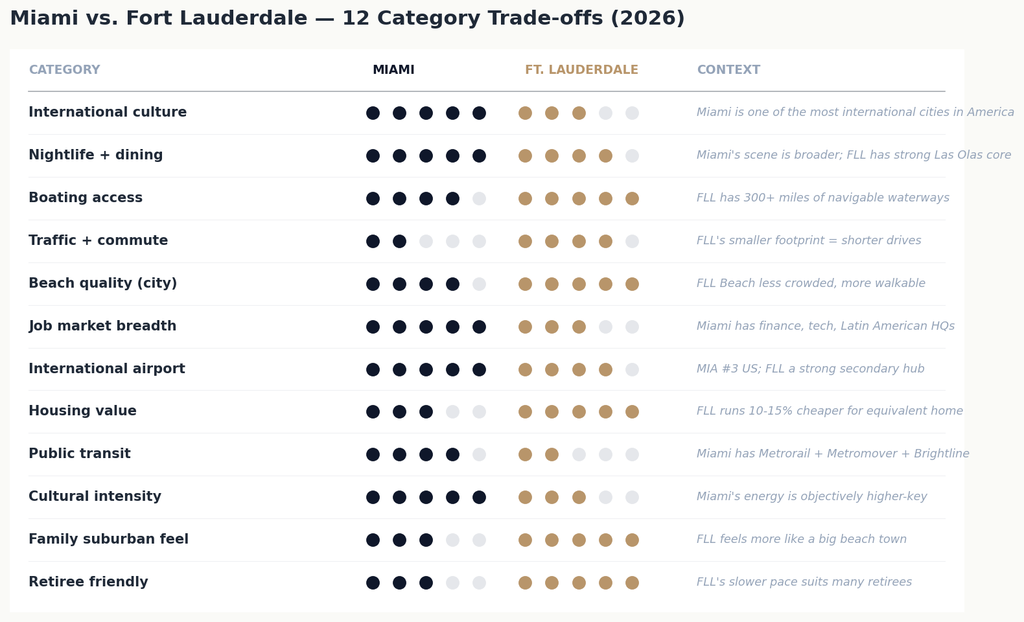
Where Miami wins:
- International culture and cultural intensity. Miami is arguably the most international city in America — deeply Cuban, Colombian, Venezuelan, Argentine, Haitian, Brazilian all at once. That international layer creates energy that Fort Lauderdale doesn't match. It also means everything in Miami operates in Spanish and English simultaneously.
- Nightlife and dining breadth. Miami's food scene is broader and deeper. Wynwood, Design District, Brickell, and South Beach each offer distinct dining ecosystems. Fort Lauderdale's Las Olas core is legitimately good but geographically smaller.
- Job market breadth. Miami has finance (Brickell), tech (Wynwood, Coconut Grove), Latin American headquarters (across the city), and luxury retail. Fort Lauderdale's job market skews more toward smaller businesses, boating/marine industries, and Broward-based corporate.
- International airport. MIA is the #3 airport in the U.S. and the largest gateway to Latin America. FLL is a strong secondary hub but not in MIA's league.
- Public transit. Miami has Metrorail, Metromover, and Brightline. Fort Lauderdale has Brightline connectivity to Miami and West Palm but limited local transit.
- Cultural events. Art Basel, Ultra, Formula 1, Miami Grand Prix. Fort Lauderdale has good local events but Miami's calendar is nationally significant.
Where Fort Lauderdale wins:
- Boating access. Fort Lauderdale bills itself as the Yachting Capital of the World for good reason. 300+ miles of navigable waterways, more marinas per capita than any US city, and the annual Fort Lauderdale International Boat Show. If serious boating is your priority, this isn't a close call.
- Traffic and commute. Fort Lauderdale is 190K people spread across a much smaller footprint. Cross-town commutes that take an hour in Miami take 20 minutes in Fort Lauderdale.
- Beach quality (for residents). Fort Lauderdale Beach is walkable, less crowded, and more accessible than South Beach. South Beach is objectively more famous but harder to live near daily. Fort Lauderdale Beach feels more like a beach you can actually use.
- Housing value. Fort Lauderdale runs 10-15% cheaper for equivalent housing quality. The gap is bigger in waterfront segments.
- Family suburban feel. Fort Lauderdale and its surrounding Broward suburbs (Weston, Coral Springs, Parkland) offer strong schools, more space, and a suburban lifestyle at prices Miami equivalents don't match.
- Retiree friendliness. Fort Lauderdale's slower pace, better boating access, and better value make it Florida's most popular affluent retiree destination. Miami skews younger and more intense.
Who Actually Picks Which City?
Here's the honest fit matrix based on the client profiles I see most often:
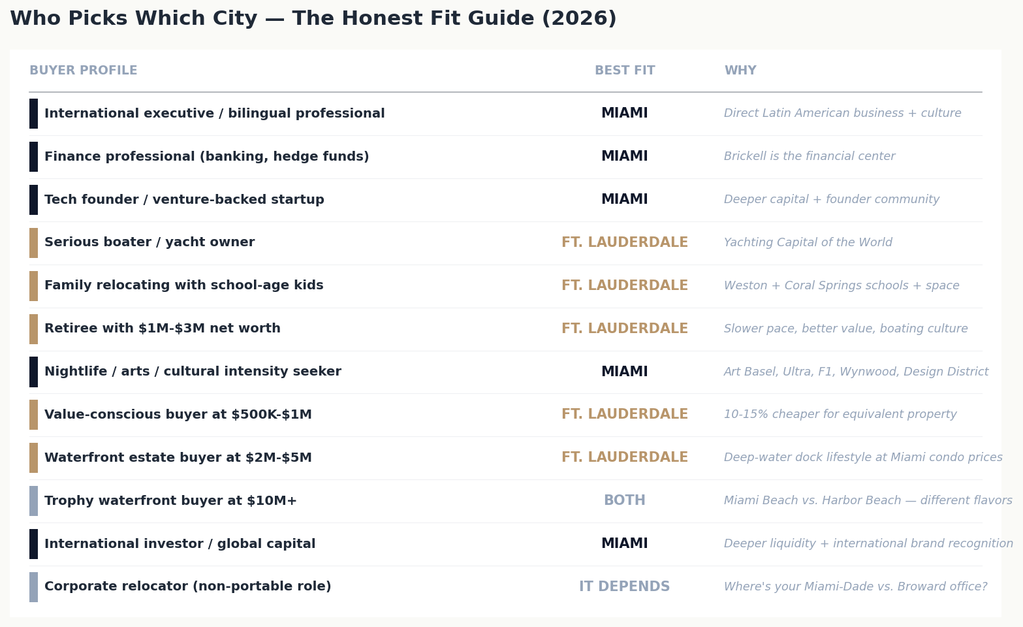
Let me walk through the profiles:
Strong Miami fit
International executives and bilingual professionals. If your work involves Latin America, Europe, or you value operating in a truly international city, Miami is essentially the only US answer. Fort Lauderdale is domestic-oriented by comparison.
Finance professionals (banking, hedge funds, private equity). Brickell is Miami's financial district and hosts Citadel, Goldman Sachs, Blackstone, and dozens of PE firms with real Miami presences. Fort Lauderdale has finance jobs but nothing at Brickell's scale.
Tech founders and venture-backed startup operators. Miami has developed a real founder ecosystem over the last five years — deep capital, established investors, and enough peer density to make network effects work. Fort Lauderdale doesn't have equivalent infrastructure.
Nightlife, arts, and cultural intensity seekers. If you moved to South Florida for Art Basel, Ultra, the Design District, Wynwood galleries, and world-class dining — Miami is the answer without hesitation. Fort Lauderdale has good culture but lower intensity.
International investors and global capital. Miami's international brand recognition means it has deeper liquidity and broader appeal to international buyers than Fort Lauderdale.
Strong Fort Lauderdale fit
Serious boaters and yacht owners. Fort Lauderdale is genuinely called the Yachting Capital of the World — deep-water canal access, superyacht marinas, and boating-first neighborhoods like Las Olas Isles, Harbor Beach, and Rio Vista. This isn't Miami's game.
Families relocating with school-age kids. Broward County's suburban school districts — Weston, Coral Springs, Parkland — offer strong public schools, more space, and lower prices than Miami-Dade equivalents. The suburban family lifestyle is meaningfully easier in Broward.
Retirees with $1M-$3M net worth. Fort Lauderdale's slower pace, better boating access, and better housing value make it consistently one of America's top affluent retirement destinations. Miami retirees can absolutely thrive, but Fort Lauderdale is the default for a reason.
Value-conscious buyers at $500K-$1M. Fort Lauderdale gives you meaningfully more house per dollar in this range. If your budget is tight and you want quality space, Fort Lauderdale wins.
Waterfront estate buyers at $2M-$5M. This is Fort Lauderdale's sweet spot. Deep-water dock lifestyle at prices that only get you a condo in Miami's waterfront market.
Depends on specifics
Trophy waterfront buyers at $10M+. Both cities have serious ultra-luxury inventory. Miami Beach vs. Harbor Beach represents completely different flavors — Miami's international status vs. Fort Lauderdale's yachting-heritage estates. It comes down to which lifestyle you actually want.
Corporate relocators without portable roles. If your job is at a specific office in either Miami-Dade or Broward, you probably need to live in that county. Beyond that, the answer depends on your specific commute tolerance and lifestyle priorities.
The Brightline Factor
One important recent development changes the calculus for some buyers: Brightline.
Brightline connects Miami and Fort Lauderdale in 35 minutes with 18+ daily round trips. Monthly commuter passes cost $250-$350 for unlimited South Florida travel. For buyers whose work is in one city but who prefer the lifestyle of the other, this genuinely opens up new options.
Practical examples I've seen work:
- Family wants Broward schools + lifestyle but parent works in Brickell → Live in Weston or Fort Lauderdale, Brightline commute to Brickell (35-40 min door-to-door).
- Retiree wants Miami's cultural events but Fort Lauderdale's daily pace → Live in Fort Lauderdale, Brightline into Miami for museums, restaurants, events.
- Corporate relocator wants Miami's job market but Fort Lauderdale's housing value → Live in Fort Lauderdale, Brightline commute.
Brightline doesn't erase the differences between the cities — the daily lived experience is still dramatically different depending on where you sleep each night. But it does make "live in one city, work in the other" a legitimate option for buyers with commute-tolerant schedules.
The Honest Bottom Line
Miami and Fort Lauderdale are both excellent cities. The families I see thrive in South Florida made this decision consciously and matched the right city to their specific priorities. The families who struggle spent months looking at properties in one city before realizing they should have been looking in the other.
Pick Miami if:
- You want international culture, energy, and intensity
- Your work is in finance, tech, or Latin American business
- You value nightlife, arts, and cultural events
- You want denser urban walkability
- You're building a bi-coastal or international lifestyle
Pick Fort Lauderdale if:
- Waterfront living or serious boating is central to your life
- You want more space and better value for the money
- You have school-age kids and want strong suburban districts
- You're a retiree seeking slower pace and better daily lifestyle
- You want a real beach town at real beach-town intensity
Consider both actively if:
- You're a trophy waterfront buyer at $10M+
- You have commute flexibility and want to use Brightline
- Your family has different priorities that don't obviously point one direction
That's the conversation I'd rather have with you before we start touring homes — figuring out which city fits your life, then finding the right neighborhood and property within that city. Because I'd rather help you make the honest South Florida decision than watch you fall in love with a property in the wrong city.
Frequently Asked Questions
Is Miami or Fort Lauderdale cheaper to live in?
Fort Lauderdale is roughly 10-15% cheaper across most cost categories. Median home prices in Fort Lauderdale (~$582K) run about $70K below Miami's (~$652K). Rent for a 1-bedroom in a decent Fort Lauderdale neighborhood runs $1,800-$2,600 vs. $2,500-$3,500 in Miami. To maintain equivalent lifestyle, single professionals need roughly $100K in Miami vs. $87,500 in Fort Lauderdale; families need $150K vs. $130K. The gap is real but not enormous.
What's the biggest difference between Miami and Fort Lauderdale?
Cultural intensity and international character. Miami is a major international city — the most international city in America by many measures, with deep Latin American cultural and business ties, world-class nightlife and arts, and a job market spanning finance, tech, and international business. Fort Lauderdale is a really nice big beach town — quieter daily pace, more focus on boating culture, more suburban feel, and a domestic (rather than international) buyer base. Both are excellent; they attract different people for different reasons.
Which city is better for families?
Fort Lauderdale generally works better for families with school-age kids. Broward County's suburban school districts (Weston, Coral Springs, Parkland) offer strong public schools, more space, and lower housing prices than equivalent Miami-Dade options. Traffic is meaningfully lighter and the daily suburban lifestyle is easier. Miami works well for families who prioritize international schools, urban living, or specific Miami neighborhoods like Coral Gables, Pinecrest, or Palmetto Bay.
Where should I buy waterfront in South Florida?
It depends on your budget and lifestyle priorities. Fort Lauderdale offers dramatically better value for waterfront living — deep-water canal homes with private docks start around $1.5M, versus $2.5M+ for equivalent Miami properties. Serious boaters and yacht owners overwhelmingly choose Fort Lauderdale (called the Yachting Capital of the World for its 300+ miles of navigable waterways). Buyers who want international brand recognition or waterfront proximity to Miami's cultural scene often still choose Miami despite the price premium.
Can I live in one city and work in the other?
Yes, especially with Brightline. Brightline connects Miami and Fort Lauderdale in 35 minutes with 18+ daily South Florida departures. Monthly commuter passes run $250-$350 for unlimited travel. This makes "live in Fort Lauderdale, work in Brickell" or "live in Miami, work in Broward" genuinely viable for commute-tolerant professionals. Many buyers use this arbitrage to get Fort Lauderdale's housing value + Miami's job market access.
Ready to work through the South Florida decision with someone who works both markets? Our team at The Carroll Group at Compass — the #1 team at Compass Florida — covers HNW clients across Miami-Dade, Broward, and Palm Beach counties. Our Florida Relocation Process is designed for exactly this decision — helping you match the right city to your specific priorities before you commit to a neighborhood. If you're leaning toward leasing your first year to experience both cities, our Florida Leasing Process covers the leasing side. When you're ready to buy, our Florida Buyers Guide walks through what changes at that stage. For deeper neighborhood-by-neighborhood context in either market, our community guides break down specific areas in detail. Either way — I'd rather help you make the honest South Florida decision than watch you spend six months looking in the wrong city.
Check out this article next