Let me tell you something that took me a while to figure out. When families ask me "what's the best Miami neighborhood for families?" they're almost never asking the actual question they need answered. They're really asking one of four very different questions — and the answer changes completely depending on which one. If you're a young family with a two-year-old and a baby on the way, you're asking about childcare access, pediatrician networks, and stroller-friendly sidewalks. If you're a family with an elementary-age kid, you're asking about school boundary lines, yard space, and neighborhood kids to grow up alongside. If you're raising a tween or teen, you're asking about high school ratings, extracurricular access, and how safely they can move around independently.
And if you're building a multigenerational household — kids plus a parent or in-laws — you're asking about entirely different things: in-law suite space, ground-floor bedrooms, elderly care access. Same city. Four completely different sets of priorities. Four different answers about which neighborhood actually fits. I've written before about Miami's family neighborhoods at a high level. This post is different. Here I'm going to walk you through each family life stage and tell you which Miami neighborhood actually fits — and which one to avoid — for that specific phase. If you're already narrowing down where to raise your family in Miami, our Florida Buyers Guide walks through what to expect when buying in top family neighborhoods. If you're leaning toward leasing your first year to test school boundaries and daily-life fit before committing, our Florida Leasing Process is built around that decision.
The Four Family Life Stages in Miami
Here's the framework I actually use with family clients: 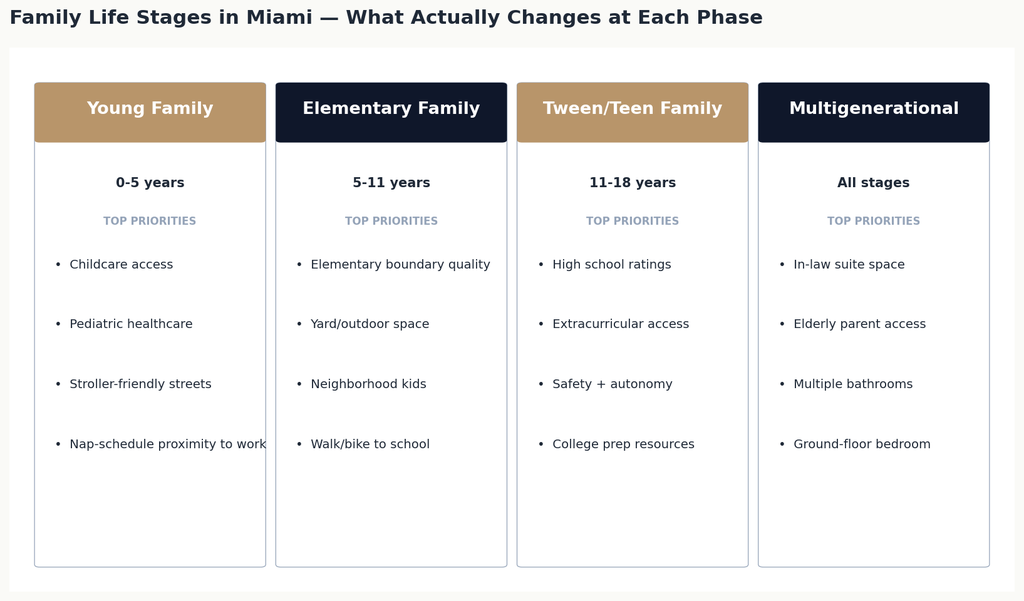 Each stage has different top priorities, which means the "best" neighborhood shifts as your family grows. Some families move once and try to pick a neighborhood that works across all stages (Coral Gables and Pinecrest are the traditional picks for this reason). Others move once as young parents and again when their oldest hits middle school. Both approaches are valid — but you need to know which one you're doing before you buy your first Miami home. Let me walk through each stage in detail.
Stage 1: Young Family (Ages 0-5)
The core reality: Everything revolves around childcare and pediatric access. You're not thinking about high schools — you're thinking about which daycare has infant openings, whether your pediatrician is 10 minutes away or 40, and whether the sidewalks in front of your building are actually stroller-friendly.
What Actually Matters at This Stage
Childcare availability, not just quality. Miami-Dade infant waitlists routinely run 3-6 months. Some top-tier centers in Coral Gables and Pinecrest have 12+ month waitlists. Start looking before your child is born, not after. Cost hits harder here than any other stage. Miami is South Florida's most expensive childcare market: 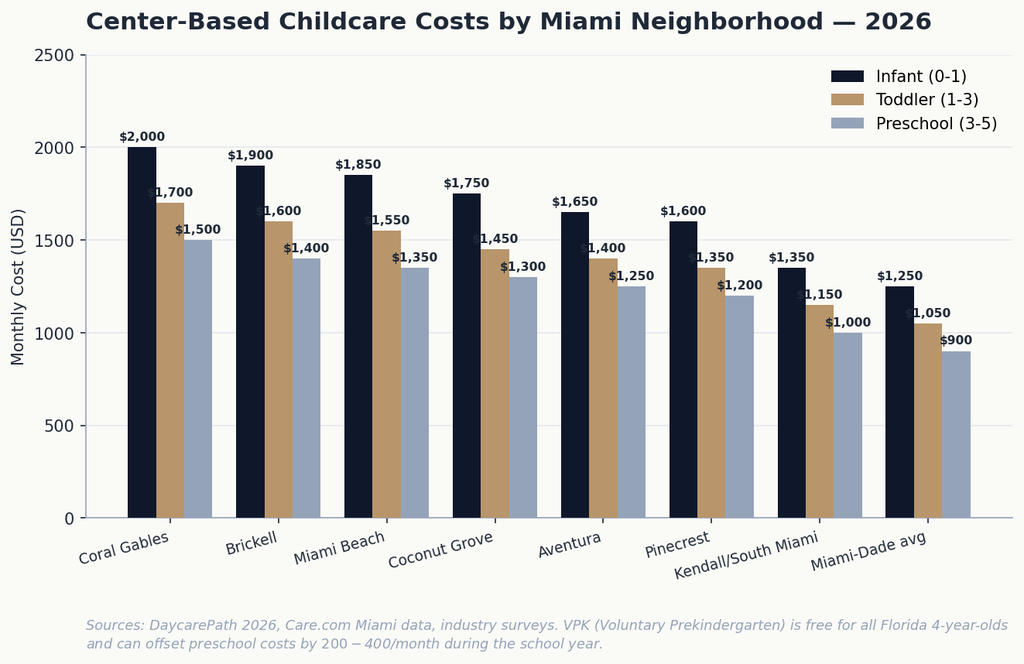 Center-based infant care in Coral Gables runs $2,000/month. In Kendall or South Miami, that same care can be $650 less. That's $7,800/year — real money for a family with a newborn. If you're planning to have 2+ kids, the neighborhood you pick during the young-family stage compounds meaningfully. Florida's VPK program helps at age 4. Florida offers free Voluntary Prekindergarten for all 4-year-olds — 540 hours during the school year. It covers roughly 40% of a standard 8-hour workday and saves families $5,000-$8,000 annually.
But it doesn't eliminate wraparound care costs, so factor $200-$400/month for the after-hours portion. Pediatric access matters more than school ratings at this age. Nicklaus Children's Hospital (the primary pediatric hospital in South Florida) is in the Coral Way/Little Havana area. Being within 20 minutes of Nicklaus is a real quality-of-life factor for the first few years — sick kids, urgent care visits, specialist appointments happen more than you expect.
Best Neighborhoods for This Stage
Coral Gables and Coconut Grove offer the best combination of childcare density, pediatric access, and stroller-friendly walkability. Coral Gables specifically has the highest density of well-established preschools and daycare centers, though at premium prices.
Aventura is genuinely strong for young families — condo living with concierge amenities, playground access, and lower childcare costs than the Gables. Underrated for this life stage.
Brickell works only if both parents are working in Brickell/Downtown and want to walk to daycare. Otherwise, apartment living with young kids gets tight fast, and the neighborhood's density doesn't add much value when you're mostly at home with a baby.
Neighborhoods to Avoid at This Stage
Miami Beach and Wynwood have almost no childcare infrastructure. The tourist churn also makes daily life with a stroller genuinely harder than it needs to be. Great for young couples without kids; challenging for young families.
Pinecrest and Palmetto Bay are exceptional for elementary and beyond, but for a young family, the suburban car-dependence makes daily life with a baby harder. If you're planning to be at this stage for less than 2-3 years, wait to move here until your oldest is starting school.
Stage 2: Elementary Family (Ages 5-11)
The core reality: School boundary lines suddenly matter more than almost anything else. You've entered the phase where your neighborhood is literally choosing your child's school — and that decision compounds year over year.
What Actually Matters at This Stage
Public school boundaries are hyper-local. Miami-Dade has 400+ schools and the quality range within a 10-mile radius can be dramatic. Two houses one block apart can be zoned for schools with GreatSchools ratings of 9 and 4. Confirm the boundary map for any address you're considering — Miami-Dade Public Schools has a boundary lookup tool, but the boundaries can shift year to year.
Yard and outdoor space become priorities. Elementary kids need places to run, bike, and be outside without supervision. This is where urban condo living starts to feel constraining and where suburban neighborhoods like Pinecrest and Palmetto Bay pull ahead of Brickell or Wynwood.
Neighborhood peer group matters. Kids form friendships that last through elementary school. Neighborhoods with lots of same-age kids on the block (Coral Gables, Pinecrest, Palmetto Bay, South Miami) offer something car-dependent suburbs or transient urban neighborhoods can't replicate.
Walkable/bikeable to school is genuinely valuable. Miami traffic makes school drop-off one of the daily stressors of family life. Neighborhoods where kids can walk or bike to elementary school — parts of Coral Gables, South Miami, Coconut Grove, and Miami Shores — save an hour a day and give kids meaningful independence early.
Best Neighborhoods for This Stage
Coral Gables leads. Multiple high-rated public elementary options (Sunset Elementary, Coral Gables Elementary, Somerset), plus proximity to top private schools including St. Philip's Episcopal and St. Thomas Episcopal Parish School. Walkable in the core village. Established residential character with lots of families.
Pinecrest delivers the "grow up with a yard" experience. Pinecrest Elementary consistently ranks among Miami-Dade's top public schools. Large lots (often over an acre) mean kids grow up with genuine outdoor space. The tradeoff is car dependence.
Coconut Grove works for elementary families who want village character over suburban space. Ransom Everglades (private, ages 6-12 lower school) is here. Public options at Coconut Grove Elementary. Walkable to CocoWalk, marinas, parks.
Palmetto Bay and South Miami offer strong public schools at lower price points than Coral Gables or Pinecrest — often 30-40% less for comparable homes. Palmetto Bay especially rewards families willing to trade some prestige for real value.
Neighborhoods to Avoid at This Stage
Brickell has essentially no residential elementary school infrastructure. Families who insist on Brickell during elementary years usually end up commuting kids to private schools in Coral Gables or the Grove, which negates most of Brickell's walkability advantage.
Wynwood and Edgewater — same issue. Great for young couples, wrong for elementary families.
Stage 3: Tween/Teen Family (Ages 11-18)
The core reality: Middle and high school ratings become the primary neighborhood driver. Extracurricular access matters. Your teen's ability to move around independently — safely — starts affecting your daily life in real ways.
What Actually Matters at This Stage
High school ratings drive property values here more than anywhere else. Miami-Dade's top public high schools are Coral Gables Senior High (A-rated) and Palmetto Senior High in Pinecrest (A-rated). Homes zoned for these schools carry meaningful premiums — sometimes 10-20% over comparable homes in other zones.
Private school access matters if you're going that route. Ransom Everglades (Coconut Grove), Gulliver Preparatory (Pinecrest), Carrollton School of the Sacred Heart (Coconut Grove), Belen Jesuit (west Miami-Dade), Palmer Trinity (Palmetto Bay), and Miami Country Day (Miami Shores) are the marquee options. Tuition runs $30K-$45K+ per year at the top schools. Bus routes and family carpools center on Coral Gables, Pinecrest, and Coconut Grove.
Independence and safety are dual priorities. Teens want to move around on their own — walking, biking, driving. You want them to do it safely. Neighborhoods with genuine walkability (Coral Gables' Miracle Mile area, Coconut Grove's village core, parts of South Miami) let teens experience independence without a car. Suburban Pinecrest is safe but requires driving, which creates its own set of complications during the driver's-permit years.
Extracurricular infrastructure matters more than you'd expect. Sports programs, arts programs, tutoring centers, driving schools, part-time job availability — the density of these varies enormously by neighborhood. Coral Gables, Pinecrest, and Miami Shores have the best combined infrastructure for teen enrichment.
Best Neighborhoods for This Stage
Coral Gables continues to lead, adding excellent high school infrastructure to strong elementary/middle school access. Coral Gables Senior High is one of Miami-Dade's top public high schools. Private school access is unmatched — a 20-minute radius from Coral Gables covers the vast majority of Miami's top private schools.
Pinecrest and Palmetto Bay are the top choices for public school families. Palmetto Senior High (Pinecrest) is one of the highest-rated public high schools in Florida. Palmer Trinity (private, Palmetto Bay) is a top private option in the area.
Coconut Grove for private school families. Ransom Everglades (K-12) and Carrollton (all-girls, K-12) are both walkable/bikeable from many Grove homes.
Neighborhoods to Avoid at This Stage
Miami Beach — beach lifestyle can feel like a losing bet for teens. Tourist environment, limited school options, transient community. Many Miami Beach families end up sending teens to private schools on the mainland, which negates Beach living's advantages.
Aventura — schools are okay but not elite. Teen social scene revolves heavily around Aventura Mall, which some families find limiting.
Brickell and Wynwood — you already know why. Wrong stage.
Stage 4: Multigenerational Households
The core reality: You're planning for a household that includes kids and elderly parents (or a parent living with you long-term). Space configuration and elderly-care access become primary — not just school ratings.
What Actually Matters at This Stage
In-law suite or guest house. Purpose-built accommodations for extended family are relatively rare in Miami condos but more common in single-family homes, especially in Pinecrest, Palmetto Bay, Kendall, and parts of Coral Gables. Look specifically for detached guest houses, "mother-in-law suites" (typically a bedroom, bathroom, and small living space with a separate entrance), or homes with a full ground-floor bedroom and bath.
Ground-floor bedroom is non-negotiable. For aging parents, being able to live entirely on one floor prevents fall risks and preserves independence. Single-story ranch homes in Kendall and Pinecrest, or two-story homes with a full ground-floor primary or guest suite, are the target inventory.
Elderly healthcare access. Miami-Dade has strong healthcare infrastructure but it's clustered — Coral Gables (Baptist Health, University of Miami), Miami Beach (Mount Sinai), Kendall (Baptist Hospital), and Aventura (Aventura Hospital). Being within 20 minutes of a major hospital your parent uses regularly matters.
Cultural fit for extended family. For Hispanic families especially, neighborhoods with strong Spanish-speaking communities (Hialeah, Kendall, Coral Gables, Doral) make daily life easier for elderly parents who may prefer Spanish for daily interactions, doctors, and social community.
Multiple bathrooms and quiet zones. More bodies in the house means more bathroom demand and more need for spaces where different generations can retreat. 3+ bathrooms in a family home becomes a functional requirement, not a luxury.
Best Neighborhoods for This Stage
Pinecrest and Palmetto Bay lead. Large single-family homes with room for detached guest houses or in-law suites. Ground-floor primary suites are common. Excellent schools for grandchildren. Proximity to Baptist Hospital South Miami and other healthcare.
Kendall is genuinely underrated for multigenerational households. Larger homes at meaningfully lower prices than Pinecrest. Strong Hispanic community for cultural fit. Good hospital access.
Coral Gables for families with means. Estate-scale homes accommodate multigenerational living, elder healthcare access is excellent, cultural amenities work for all ages.
Aventura for lock-and-leave multigenerational condo living. Concierge buildings reduce maintenance burden on elderly family members. Excellent for families where the extended family lives internationally and comes for extended visits rather than permanent residence.
Neighborhoods to Avoid at This Stage
Brickell, Wynwood, Edgewater, Miami Beach — high-rise condo living is genuinely difficult for elderly family members with mobility issues. Elevator waits, no ground-floor access to outdoor space, hurricane evacuation complications. Wrong housing type entirely for this stage.
The Deep Match: Best Neighborhoods for Each Family Stage
Pulling it all together — this is my honest recommendation matrix for Miami neighborhoods by family life stage: 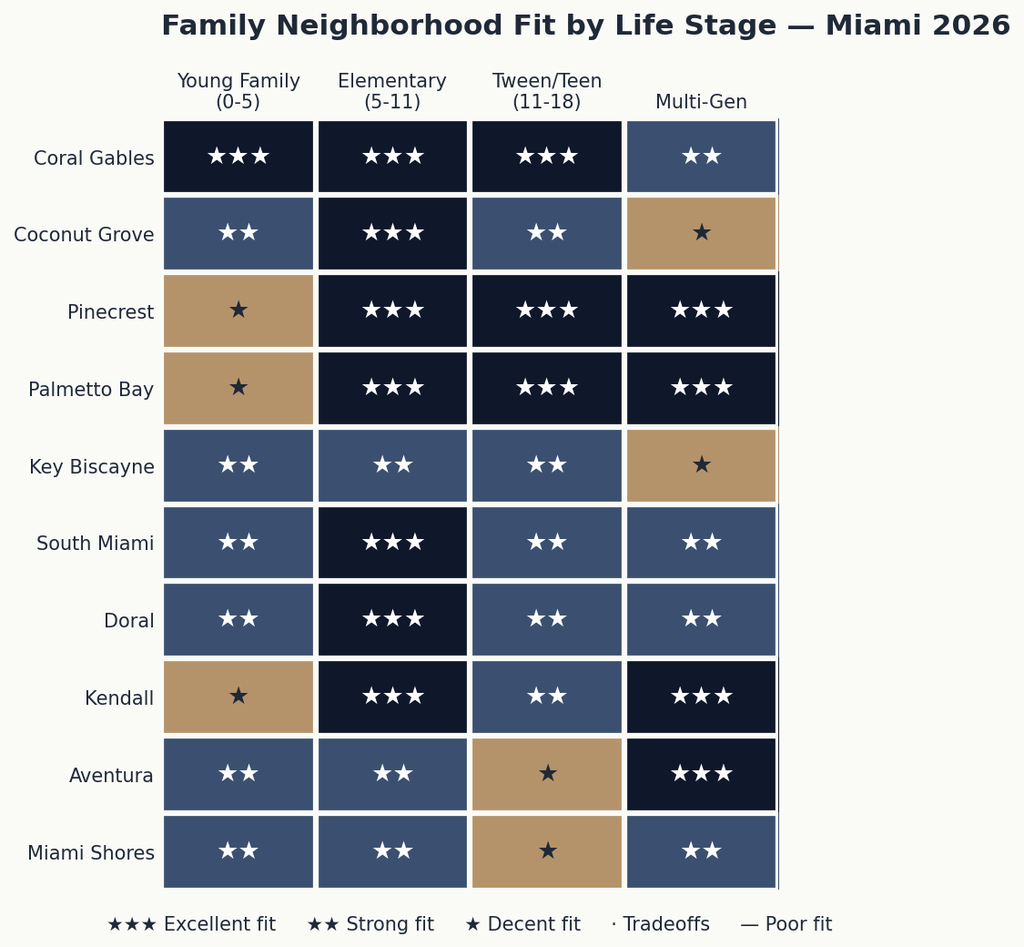 A few things worth noting from this chart:
Coral Gables and Pinecrest are the only neighborhoods that hit 3-star ratings across three or more stages. That's why they're consistently the top family relocation picks — they're the neighborhoods you can actually "grow into" without moving.
Palmetto Bay is genuinely underrated. It hits 3 stars for elementary, tween/teen, AND multigenerational stages at meaningfully lower prices than Pinecrest. If value matters to you, don't skip it.
Kendall punches above its reputation for multigenerational families. Larger homes, established Hispanic community, healthcare access — it's a real fit for extended families that gets overlooked because it's not a "prestige" name.
Doral works for elementary families with parents working in the western corridor. Strong charter school ecosystem, planned-community feel, more affordable than Coral Gables.
What Raising a Miami Kid Actually Costs
Before we wrap up, let me put a real number on what you're signing up for financially. This is the cumulative cost of raising one child in Miami from birth through age 18, before housing: 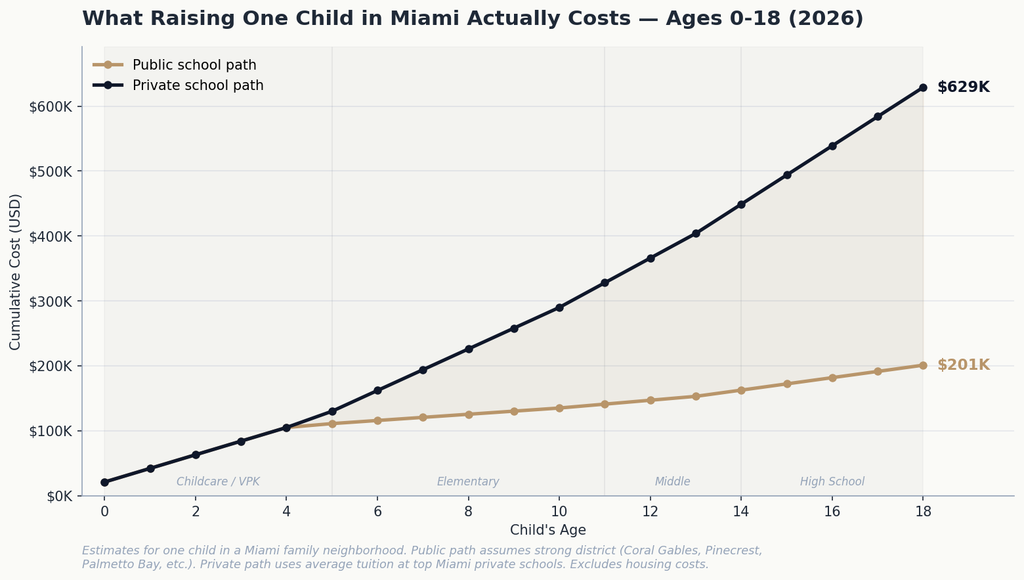
Public school path (Coral Gables, Pinecrest, or similar strong district): roughly $201,000 over 18 years. This includes childcare through preschool, aftercare and activities during elementary and middle school, and sports/prep during high school.
Private school path: roughly $629,000 over 18 years. This adds $428,000 to the total — a real family-affecting number that people often underestimate when moving to Miami for lifestyle.
Neither number includes: housing costs, healthcare, food, clothing, family vacations, or extracurricular fees beyond basics. Add all of that in and you're looking at $500K-$1.2M+ per child from birth to college — before college costs. The point isn't to scare you. It's to be honest: choosing between public-school neighborhoods (Coral Gables, Pinecrest, Palmetto Bay) versus private-school access neighborhoods (Coconut Grove, Coral Gables again) is one of the highest-stakes decisions in a Miami family relocation. Get it right, and you're saving hundreds of thousands over 18 years while your kids are still getting excellent education. Get it wrong, and you're paying private school tuition to compensate for a weak school zone.
What I Actually Recommend to Family Clients
Three specific pieces of advice I give every family relocating to Miami:
1. Buy for the stage you'll be in for the longest, not the one you're in right now. If your oldest is 3 and you'll be in Miami for 15+ years, choose the neighborhood that fits ages 5-11 and 11-18 — not the one that's optimal for a 3-year-old. Buying twice is expensive.
2. Confirm school boundaries in writing before you make an offer. School zoning maps shift, and the "assumption" that your address is zoned for Coral Gables Senior High versus a lower-rated school can be worth $150K+ in property value. Get it verified with Miami-Dade Public Schools directly, not just from a listing description.
3. Consider leasing your first year — especially if you have school-age kids. A 12-month lease in your top-choice neighborhood lets you experience the school year, the neighborhood community, and the daily-life rhythm before you commit to buying. Our Florida Leasing Process is built specifically for family relocation timing — including alignment with the Miami-Dade school calendar.
The Honest Bottom Line
There isn't one "best Miami neighborhood for families." There are best neighborhoods for each specific family stage — and the answers change as your family grows. Young families thrive in Coral Gables, Coconut Grove, and Aventura where childcare access and pediatric infrastructure are strong. Elementary families thrive in Coral Gables, Pinecrest, Coconut Grove, and Palmetto Bay where schools and neighborhood peer groups are excellent. Tween/teen families need Coral Gables, Pinecrest, or Palmetto Bay for the school ratings and extracurricular infrastructure.
Multigenerational households do best in Pinecrest, Palmetto Bay, and Kendall for the space configuration and elderly care access. The families who pick their Miami neighborhood based on the stage they're in for the longest — and stay flexible about the rest — tend to be the happiest with their long-term choice. That's the conversation I want to have with you before you buy. Not "which is the best neighborhood" — but "which neighborhood fits the family you're actually building."
Frequently Asked Questions
What is the best Miami neighborhood for families with young children? Coral Gables and Coconut Grove are the strongest fits for young families (ages 0-5) because they offer the best combination of childcare density, pediatric access, and stroller-friendly walkability. Aventura is genuinely underrated for young families — condo living with concierge amenities and lower childcare costs than the Gables. Avoid Brickell, Wynwood, and Miami Beach at this stage.
What are the top-rated public schools in Miami for families? Miami-Dade's top public schools for families are Coral Gables Senior High (A-rated), Palmetto Senior High in Pinecrest (A-rated), Pinecrest Elementary, and Palmetto Elementary. Coral Gables Elementary, Somerset, and Sunset Elementary are strong elementary options. School boundaries are hyper-local — two houses one block apart can be zoned for very different schools, so always confirm boundaries directly with Miami-Dade Public Schools.
How much does childcare cost in Miami in 2026? Center-based infant care ranges from $1,250/month (Miami-Dade average) to $2,000/month (Coral Gables). Toddler care runs $1,050-$1,700/month. Preschool for 3-5 year olds runs $900-$1,500/month. Florida's free VPK program covers 540 hours annually for 4-year-olds, saving families $5,000-$8,000/year. Family home daycare typically costs 20-30% less than center-based care.
What's the best Miami neighborhood for multigenerational families? Pinecrest and Palmetto Bay lead for multigenerational households because they offer larger single-family homes with room for detached guest houses or in-law suites, and often have ground-floor primary bedrooms. Kendall is genuinely underrated — larger homes at meaningfully lower prices than Pinecrest, strong Hispanic community for cultural fit, and good hospital access.
Should I buy for the family stage I'm in now or for the future? Buy for the stage you'll be in for the longest, not the one you're in right now. If your oldest is 3 and you'll be in Miami for 15+ years, choose the neighborhood that fits ages 5-11 and 11-18 — not the one that's optimal for a 3-year-old. Buying twice is expensive; the transaction costs alone can be 8-12% of your home value each time.
Ready to actually work through which Miami neighborhood fits your specific family stage? Our Florida Buyers Guide walks through what to expect when buying in Miami's top family neighborhoods. If you're leaning toward leasing your first year to test school boundaries and daily-life fit before committing, our Florida Leasing Process is built for exactly that. For deeper neighborhood-by-neighborhood information, our community guides go into more detail on Coral Gables, Coconut Grove, Pinecrest, and other top family areas. Either way — I'd rather help you land in the right neighborhood for your family's actual life stage than watch you buy for the wrong one and move again in three years.
Check out this article next