Let me push back on the standard framing for a second.
Most "best Miami neighborhoods for young professionals" articles give you the same three answers: Brickell, Edgewater, Wynwood. Sometimes Midtown. And technically they're not wrong. If you asked me to name the three most popular neighborhoods for 25-35 year olds in Miami, that's the list.
But here's what those articles miss: your industry matters more than your age. A 28-year-old associate at a Brickell law firm has almost nothing in common — from a location standpoint — with a 28-year-old startup engineer at a Wynwood AI company or a 28-year-old ICU nurse at Baptist Health in Kendall. Same age. Same "young professional." Three completely different sets of neighborhood priorities.
Because in Miami — more than most cities — the industries cluster geographically. Finance sits in Brickell. Tech splits between Brickell and Wynwood. Healthcare orbits Coral Gables and Kendall. Creative and media concentrate in Wynwood and the Design District. Trade and logistics live near the airport in Doral. Remote workers can be anywhere but tend to gravitate to Coconut Grove.
So instead of another "Brickell vs Edgewater vs Midtown" comparison, let me walk you through Miami by industry. Which neighborhood actually fits your specific career — not just your age bracket.
If you're already narrowing down where to live for your career in Miami, our Florida Leasing Process is built for young professionals doing exactly this — testing the neighborhood-to-job fit before committing to a purchase. If you're ready to buy, our Florida Buyers Guide walks through what changes at that stage. And if you're relocating from another city, our Florida Relocation Process handles the full transition.
Miami's Industry Hubs at a Glance
Before we go deep into each industry, here's the geographic map of where Miami's major industries actually cluster in 2026:
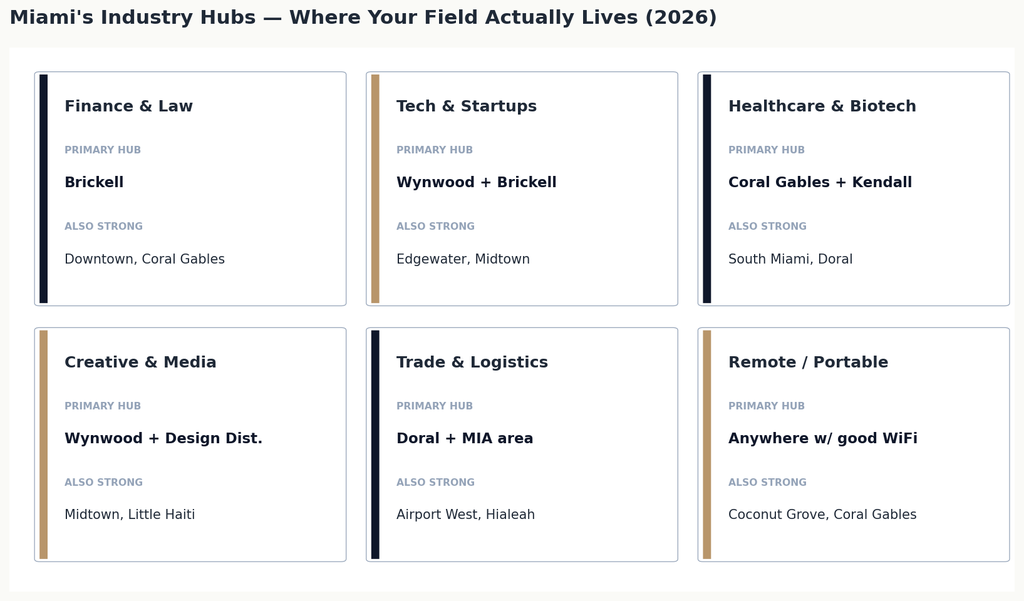
Notice something important: Miami has real industry geography now — this isn't the vacation-and-nightlife economy your parents remember. Since 2020, over 96,000 net new jobs have moved to Miami, with major relocations from Citadel (finance), Palantir (tech), Varonis (cybersecurity), Microsoft's LatAm operations, and dozens of others. Each of those companies clustered in a specific district — and understanding that geography changes where you should live if you want to walk to work.
Finance & Law: The Brickell Corridor
The industry reality: Brickell became the actual financial center of Miami over the last five years, not just aspirationally. Citadel's global headquarters is here, employing around 500 people locally. Blackstone, Goldman Sachs, and Thrive Capital have expanded operations. Microsoft consolidated its Latin America executive teams in Brickell. Every major law firm serving Latin American markets has its Miami office within a 10-block radius.
If you work in finance, law, wealth management, or consulting in Miami, you almost certainly work in Brickell or Downtown. Some senior partners work from Coral Gables offices, but the young-professional density is unmistakably Brickell.
Where to Live
Brickell itself is the obvious pick — walk to work, walk to lunch, walk to happy hour, walk to the gym. One-bedroom rents run $3,200-$3,900/month for anything modern, up to $6,000+ for luxury towers. Expensive, but the "work-life integration" is unmatched — you'll gain back 90 minutes a day compared to any drive commute.
Downtown Miami offers marginally lower rents ($2,600-$3,200) with equivalent walkability to most Brickell office buildings. Some Downtown blocks feel less residential than Brickell — walk them at night before committing — but if you want financial-district access at meaningfully lower cost, this is the play.
Coral Gables works for finance professionals who want a more established, less nightlife-heavy lifestyle. Rush-hour commute to Brickell is 18-25 minutes, which isn't nothing, but if you want quiet residential character and the same Latin American professional network, the Gables can make sense. Especially good for finance professionals with families or planning to start one.
Edgewater is the value play — 15-20 minute rush hour commute to Brickell, meaningfully lower rents ($2,900-$3,400), and newer condo inventory with bay views. If you want to save $500-700/month on rent and don't mind the drive, this is your alternative.
Where to Avoid
Aventura, Miami Beach beyond mid-Beach, Kendall. All 45+ minute rush hour commutes to Brickell. Unless you're at a senior enough level to negotiate a 3-day work-from-home schedule, the daily grind will wear on you fast.
Tech & Startups: The Wynwood-Brickell Split
The industry reality: Miami tech in 2026 has bifurcated into two distinct clusters. The startup and creative-tech side lives in Wynwood, where AI companies like Vee (global HQ), fintech startups, and Series A-B companies have set up shop in converted warehouses. The enterprise and financial-tech side lives in Brickell, where Citadel, Varonis (11th floor at 801 Brickell), Microsoft's LatAm engineering teams, and the fintech firms serving Latin American markets have concentrated.
Palantir moved its global headquarters to Aventura in early 2026 — the highest-profile HQ relocation Miami has landed to date. That's a real signal but geographically an outlier; most tech workers still cluster in the Wynwood-Brickell corridor.
Which side of the tech world you're in determines where you should live.
Where to Live
Wynwood and Midtown are the top picks for startup-side tech. Walking distance to your office, coffee shops with laptop culture, restaurants that stay open late, and a density of other startup people to build professional network with. One-bedroom rents run $2,800-$3,400/month — meaningfully cheaper than Brickell for comparable space and lifestyle. If you're at a Series A/B company or an AI/creative tech startup, this is your neighborhood.
Edgewater is the perfect middle ground — walking distance to Wynwood and Midtown, easy 15-min commute to Brickell for meetings, bay views, newer condo inventory. If you're at a company that splits between Wynwood culture and Brickell business, Edgewater optimizes for both.
Brickell works for enterprise-tech and fintech professionals whose work is genuinely in Brickell (Citadel, Varonis, Microsoft LatAm, established fintech). You'll pay a premium, but the walk-to-work value is real.
Coconut Grove is the underrated pick for tech professionals who want quiet residential character. Both Wynwood and Brickell are 15-20 minute drives off-peak, longer at rush hour. If you're at a hybrid/remote-friendly company, the Grove trades some commute for real quality of life.
Where to Avoid
Aventura, Miami Beach, Doral. Long commutes to the tech corridors, and none of them have meaningful tech community energy of their own. If tech culture matters to you socially, being far from Wynwood specifically will feel isolating.
Healthcare & Biotech: The Coral Gables-Kendall Axis
The industry reality: Miami healthcare is one of the biggest employment sectors in the region and it clusters heavily around a specific corridor. Baptist Health South Florida — the region's largest not-for-profit healthcare organization with 12 hospitals and over 30,000 employees — operates its flagship Baptist Hospital in Kendall, Doctors Hospital in Coral Gables, South Miami Hospital, and West Kendall Baptist Hospital. The University of Miami health system anchors Coral Gables. Nicklaus Children's Hospital sits in Coral Way.
If you work in healthcare — nursing, medical specialties, biotech research, healthcare administration, medical devices — you're almost certainly working in the Coral Gables-South Miami-Kendall corridor.
Where to Live
Coral Gables is the ideal pick for healthcare professionals. Doctors Hospital is here. University of Miami health system is here. Baptist Health regional headquarters is nearby. Walkable core in Miracle Mile, established residential character, top schools when you're ready for kids, and 10-minute commutes to most healthcare employers. Rents run $3,000-$3,600 for one-bedrooms.
South Miami and Coconut Grove are excellent alternatives. Both are 10-15 minutes to the major hospital corridor. Coconut Grove offers village character with more nightlife than Coral Gables; South Miami offers better value per square foot and equally strong healthcare-corridor access.
Kendall for value-focused healthcare workers. Rents are meaningfully lower ($2,200-$2,700 for one-bedrooms), and you're 5-15 minutes from Baptist Hospital and West Kendall. The tradeoff is meaningfully more suburban lifestyle — Kendall doesn't have the walkability or dining scene of Coral Gables.
Where to Avoid
Miami Beach, Aventura, Doral. All long commutes to the healthcare corridor (30-55+ minutes at rush hour), and none of them serve healthcare industry culture particularly well. Even remote nursing or admin work rarely justifies the geographic mismatch.
Creative & Media: The Wynwood-Design District Belt
The industry reality: Miami's creative economy has exploded over the last decade — Art Basel established the city as an international art capital, and the ecosystem that grew around it now includes major galleries, design firms, PR agencies, media companies, and content production studios. This cluster runs from Wynwood through the Design District, Little Haiti, and up to Little River.
If you work in advertising, PR, design, fashion, media, content production, or the art world, this belt is where your industry lives.
Where to Live
Wynwood and Midtown are the obvious picks — you're walking distance to galleries, agencies, and the coffee shops where creative business gets done. Wynwood specifically has the highest concentration of "your industry" people you'll find anywhere in Miami. Rents around $2,800-$3,400 for one-bedrooms.
Edgewater works well for creative professionals who want water views without giving up walkability to Wynwood and the Design District. 8-12 minutes to either.
Little Haiti is the emerging value play — significantly lower rents ($1,900-$2,400) with proximity to the media and art belt north of Wynwood. This is where a lot of the ecosystem's early-career people are actually living, and the neighborhood is genuinely improving year by year.
Design District proper is expensive and doesn't have much residential inventory — most workers here live in adjacent Wynwood, Midtown, or Edgewater rather than in the District itself.
Where to Avoid
Brickell, Aventura, Kendall, Doral, Coral Gables. All disconnected from the creative belt geographically and culturally. Even remote creative work benefits from being in the physical community; being far from Wynwood as a creative professional will hurt your network development.
Trade, Logistics & Aviation: The Doral-Airport Cluster
The industry reality: Miami is one of the largest international trade hubs in the United States, and that industry clusters around Miami International Airport and the surrounding Doral/Airport West/Hialeah area. Major employers include shipping and freight companies, aviation-related firms, international trade companies, and the massive cluster of Latin American-focused import/export businesses. Royal Caribbean and Carnival have their headquarters offices in the area (though not the airport itself).
If you work in aviation, shipping, freight, international trade, or airport-adjacent industries, you're almost certainly working near MIA.
Where to Live
Doral is the obvious pick — planned community feel, family-oriented, walkable to major employment centers, and lower cost of living than the coastal neighborhoods. One-bedroom rents run $2,200-$2,700, and you'll actually see coworkers at the local grocery store. Downside: it's the least "Miami" of Miami's neighborhoods — no beach access, limited nightlife, more of a suburban commuter feel.
Aventura works for trade professionals who want more nightlife and shopping but are willing to accept a 20-25 minute commute west to the airport corridor. Better lifestyle infrastructure than Doral, similar rent.
Coral Gables works if you can afford it and want the residential/professional prestige. 20-25 minute commute to the airport corridor is manageable, and you get the Gables lifestyle in your off-hours.
Where to Avoid
Miami Beach, Aventura beyond the mall area, Kendall. Long, difficult commutes across the county with lots of traffic bottlenecks. If you're in trade or logistics, the airport isn't optional — proximity matters.
Remote Workers: The Anywhere Advantage
The industry reality: Miami has become one of the top destinations for remote-work professionals in the country. The tax arbitrage (no state income tax vs. California/NY/Illinois), international connectivity, year-round outdoor lifestyle, and lower cost than coastal peer cities all compound. If your income comes from a company based elsewhere, you have maximum flexibility on where to live in Miami.
Where to Live
Coconut Grove is my top recommendation for most remote workers. Waterfront lifestyle, village walkability, cafes and coworking spaces (Building.co, various), easy airport access when you need to travel back to headquarters, and a genuine residential community rather than transient young-professional churn. Rents around $3,000-$3,600 for one-bedrooms, but you're getting a genuinely better quality of life than the equivalent price in urban Miami.
Coral Gables for remote workers who want polished residential character over village vibe. Similar quality-of-life gains, slightly more expensive.
Wynwood-Midtown-Edgewater for remote workers who want urban energy and social density. The tradeoff is more transient community, but if you want to be around startup people or creative professionals socially, this belt is where they cluster.
Brickell works for remote workers who genuinely want to be in the middle of professional action. If you're networking hard or considering starting a company, Brickell's professional density is a real asset even if your day job is remote.
Where to Avoid
Honestly, nowhere is "wrong" for remote workers — the whole point is flexibility. But avoid neighborhoods where you don't personally want to spend a random Tuesday morning. Aventura is fine if you want turnkey condo living with concierge; it's a poor fit if you want to walk to a coffee shop with laptop culture.
The Commute Math: What Rush Hour Actually Looks Like
Here's the reality that most young professionals underweight until they've lived through it:
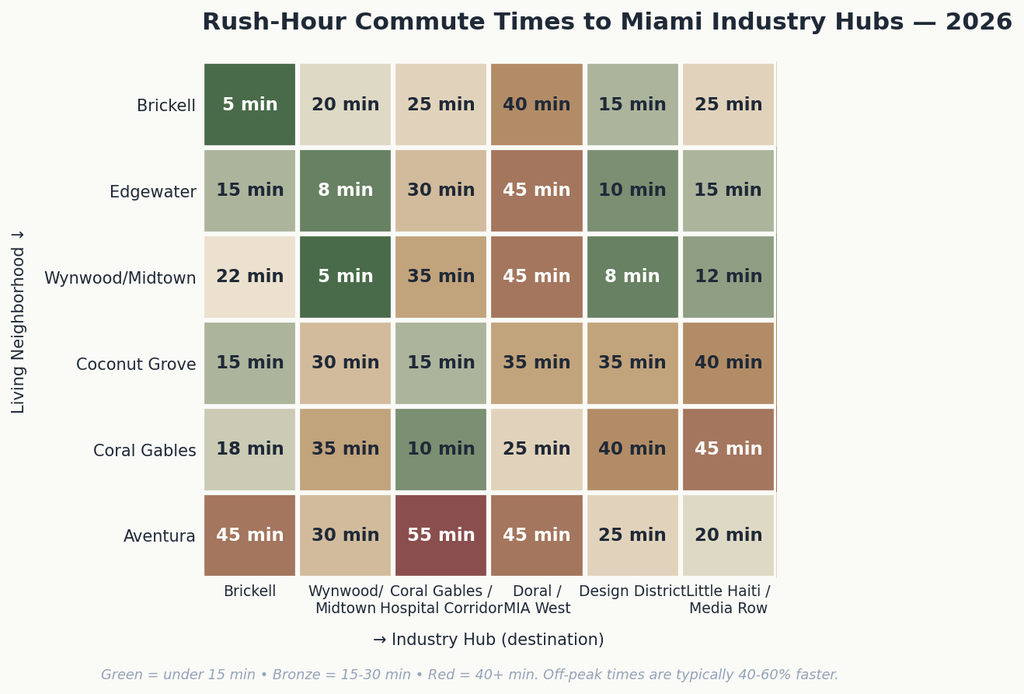
Notice a few things from this data:
Living near where your industry actually is saves hours of your week. A Brickell finance professional living in Brickell walks to work in 5 minutes. That same person living in Aventura loses 45 minutes each way — over 3 hours a day of car time. Over a year, that's 750+ hours you spent in traffic instead of at the gym, with friends, or building your career.
The mismatched combinations are especially brutal. Aventura to Coral Gables at rush hour is 55 minutes. Coral Gables to Little Haiti/media row is 45 minutes. If you're in a healthcare career and want beach nightlife energy, or a creative career and want Coral Gables schools — the daily commute reality can undo the neighborhood choice you thought you were making.
Off-peak times are 40-60% faster. If you have any control over your schedule (remote days, flex hours, early or late shifts), factor that into your decision. A hybrid worker with two days remote can absorb a longer commute much more easily than a five-day-in-office worker.
The Industry-Neighborhood Fit Matrix
Pulling it all together — this is my honest matrix for young professionals matching industry to Miami neighborhood:
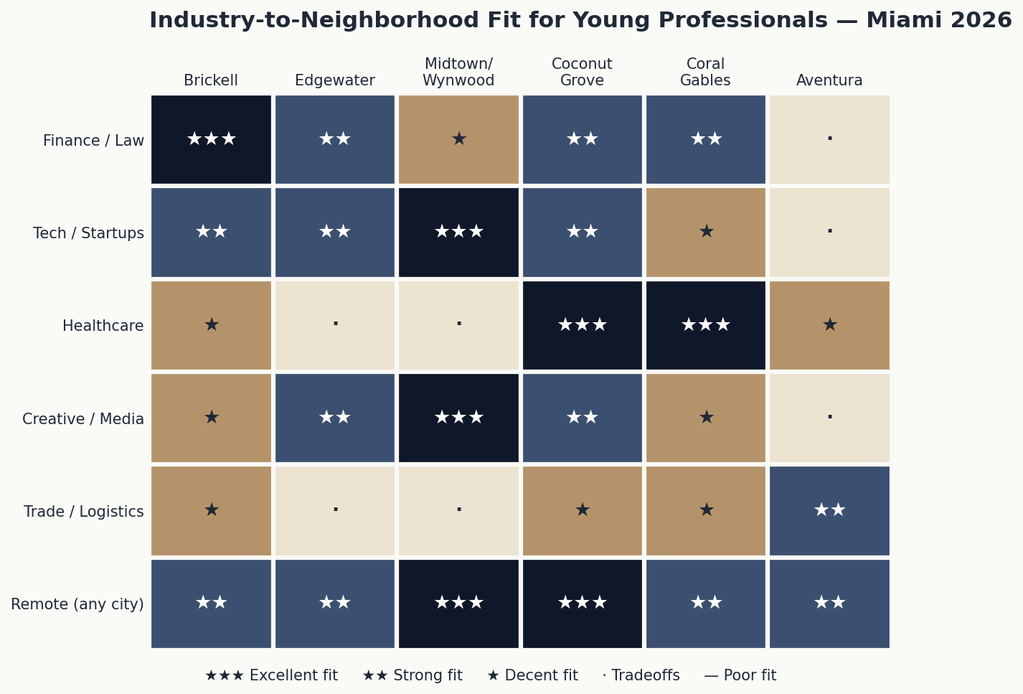
A few observations from the matrix:
Wynwood/Midtown is the strongest neighborhood for creative and tech young professionals — highest ratings for both industries because it delivers both the work-adjacent geography and the cultural density these professionals want.
Coral Gables and Coconut Grove win for healthcare — the industry actually lives there.
Brickell is exceptional for finance/law but only decent for most other industries. If you're not in finance/law/enterprise-tech, you're overpaying for lifestyle infrastructure that isn't optimized for you.
Aventura shows up as the weakest young-professional neighborhood across most industries. It's genuinely better suited for retirees and older buyers than early-career professionals. If you're a young professional and drawn to Aventura for the mall or the polish, understand you're choosing lifestyle over career fit.
What It Actually Costs to Live Near Your Industry
Here's what rent looks like at 1-bedroom pricing for young professionals near each industry hub:
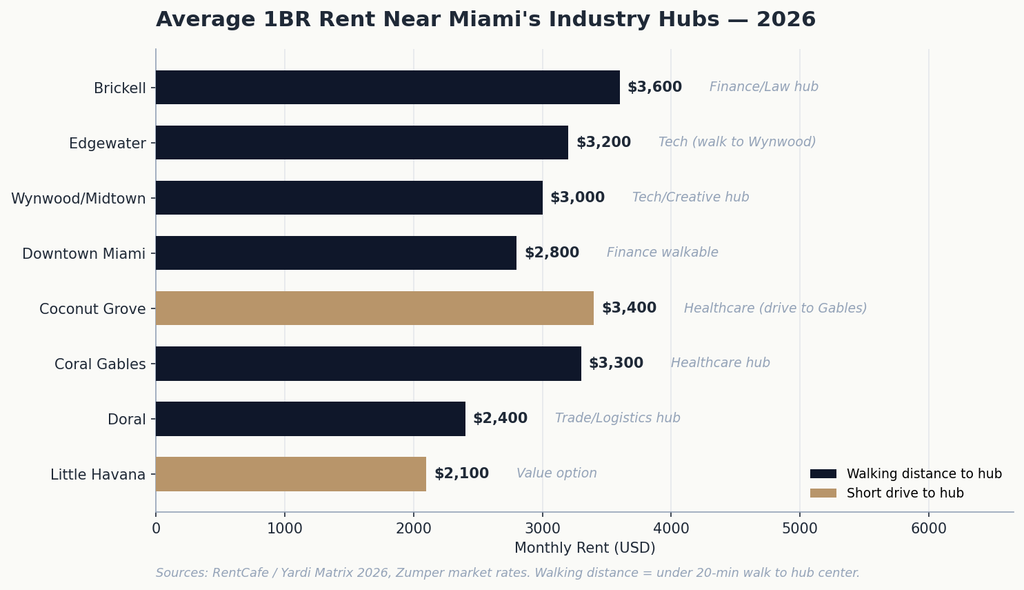
Notice the range: from $2,100 in Little Havana (as a value play) up to $3,600 in Brickell. That $1,500/month difference — $18,000/year — is real money that could go to savings, investments, or a down payment on a future purchase.
The value plays: Little Havana, Doral, and Downtown Miami all offer meaningfully lower rents than the "premium" young-professional neighborhoods, while still providing reasonable access to specific industry hubs. If saving for a down payment matters to you, these are worth considering.
The lifestyle premium: Brickell, Coconut Grove, and Coral Gables all charge premiums because you're paying for polished infrastructure, walkability, and prestige — not just square footage. Whether that premium is worth it depends on how much of your daily life happens outside your unit.
The Career-Stage Layer
One more thing worth calling out: your career stage affects the neighborhood math too.
First job in Miami (0-3 years in career): Prioritize lower rent so you can save for a future purchase, and prioritize walkability to your work so you're not spending money on car ownership. This is when Downtown Miami, Little Havana, and Doral become genuinely smart plays even if they're not the "cool" pick.
Established in your field (3-8 years in career): Prioritize lifestyle infrastructure — the walkable coffee, the professional network, the industry-adjacent restaurants. This is when Brickell, Wynwood, and Coconut Grove start to earn their premiums, and when a first-time condo purchase might make sense.
Pre-family transition (8+ years or moving toward kids): Prioritize neighborhoods that also work for your next life stage, so you don't have to move twice. Coral Gables, Coconut Grove, and even parts of South Miami work well here because they can serve both young-professional and young-family life stages.
The Honest Bottom Line
The "best Miami neighborhood for young professionals" isn't a single answer — it's a function of what you do for work, where your industry actually clusters, what you can afford, and what career stage you're in.
If you're in finance or law, Brickell is genuinely the right answer and the premium is worth it. If you're in tech or creative, Wynwood or Midtown is probably the right answer — and Brickell is arguably a mismatch. If you're in healthcare, Coral Gables or Coconut Grove is the right answer, and living in Brickell means giving up 20-30 minutes of your day for nothing. If you're a remote worker, the whole map is available to you, and I'd steer you toward Coconut Grove for most cases.
The young professionals I see thrive in Miami aren't the ones who chose the trendiest neighborhood — they're the ones who chose the neighborhood that matched their actual industry. Their commute is short. Their professional network is nearby. Their off-hours community reinforces their career, not competes with it.
That's what I'd rather help you match into upfront than watch you learn the hard way after your first Miami lease.
Frequently Asked Questions
What is the best Miami neighborhood for young professionals?
It depends on your industry, not your age. Brickell is best for finance, law, and enterprise tech. Wynwood and Midtown are best for startup tech and creative professionals. Coral Gables and Coconut Grove are best for healthcare workers. Coconut Grove is best for remote workers. Aventura and Miami Beach are generally weaker fits for most young-professional careers because they're geographically disconnected from where Miami's industries actually cluster.
Which Miami neighborhood is best for tech workers?
Wynwood and Midtown for startup and creative tech — this is where Miami's Series A-B companies and AI startups have clustered. Brickell for enterprise tech, fintech, and companies like Varonis and Microsoft's LatAm operations. Edgewater is a strong middle ground for tech workers whose lives split between Wynwood culture and Brickell business. Coconut Grove for tech professionals prioritizing residential quality of life.
Which Miami neighborhood is best for finance professionals?
Brickell is the primary answer for finance and law young professionals — every major firm (Citadel, Blackstone, Goldman Sachs, Microsoft LatAm, Miami-based fintech) has its office within a 10-block radius. Coral Gables works well for finance professionals who want more residential character. Downtown Miami offers finance walkability at lower rent than Brickell.
Which Miami neighborhood is best for healthcare professionals?
Coral Gables, Coconut Grove, and South Miami are the top choices. Baptist Health South Florida's flagship hospitals, Doctors Hospital, University of Miami health system, and Nicklaus Children's Hospital all cluster in this corridor. Kendall is a strong value option for healthcare workers who want lower rent and don't mind more suburban lifestyle.
How much does it cost to rent as a young professional in Miami?
One-bedroom rents in 2026 range from about $2,100/month in Little Havana (value option) up to $3,600/month in Brickell (premium financial district). Wynwood and Midtown run around $3,000. Coconut Grove and Coral Gables around $3,300-$3,400. Doral is a value play at $2,400 if you work near the airport. Factor in insurance, utilities, and parking on top of base rent.
Ready to work through which Miami neighborhood actually fits your career and life? Our Florida Leasing Process is built for young professionals doing exactly this — testing neighborhood-to-industry fit before committing to a purchase. If you're ready to buy, our Florida Buyers Guide walks through what changes at that stage. If you're relocating from another city, our Florida Relocation Process handles the full transition. For deeper neighborhood-by-neighborhood information as you narrow down, our community guides go into more detail on each area. Either way — I'd rather help you match to the neighborhood that fits your career upfront than watch you learn from a bad first Miami lease.
Check out this article next