Here's what most newcomers don't realize about renting in Miami: the process looks nothing like renting in New York, LA, Chicago, or any other major US city.
In most American cities, you tour an apartment on Saturday, submit an application Monday, get approved by Wednesday, and move in two weeks later. Standard. Predictable. Done.
In Miami, that same timeline is 6-11 weeks. The reason: condo association approval. Roughly 70% of Miami's rental inventory sits inside condo buildings where the HOA has to approve every tenant — not just the owner. That approval process takes 2-8 weeks on top of the standard landlord approval. It involves separate applications, separate fees, and in many cases a formal interview with the condo board.
If you don't know about this upfront, you book movers for a date you can't possibly meet, lose deposits, and end up in a lease you took in desperation because your original timeline fell apart.
If you DO know about it upfront, you plan around it, build it into your search timeline, and arrive at move-in day without stress.
Let me walk you through the complete 2026 guide to renting in Miami — the step-by-step process, what landlords actually require, the real cash you'll need to move in, and how condo rentals differ from apartment building rentals.
If you're starting a Miami rental search right now and want expert guidance, our team at The Carroll Group at Compass helps HNW relocation clients secure luxury rentals across Miami-Dade, Broward, and Palm Beach. Our Florida Leasing Process walks through exactly this. For clients evaluating the broader relocation decision, our Florida Relocation Process covers neighborhood selection and lifestyle fit.
The Miami Rental Process — 8 Steps from Search to Keys
Most Miami rental guides skip the actual sequence of events. Here's what the process looks like end-to-end, with real timing:
Step 1 — Set budget and priorities. Before touring anything, decide your monthly budget (standard rule: your gross monthly income should be at least 3x the rent), target neighborhoods, must-have amenities, and lease term. The clearer this is upfront, the less time you waste on properties that don't fit.
Step 2 — Hire a bilingual Miami rental agent. Unlike many US cities, Miami tenants don't typically pay agent commission — the landlord does. This means working with an agent costs you nothing and gets you access to inventory not always publicly listed. For luxury rentals especially, 30-40% of properties are shown by agent referral before they hit public portals.
Step 3 — Tour 5-10 properties. Miami's rental market moves fast at the lower end and slower at luxury. Tour in-person when possible; virtual tours work for out-of-state searches but miss building condition details.
Here's the full 8-step process with realistic timing:
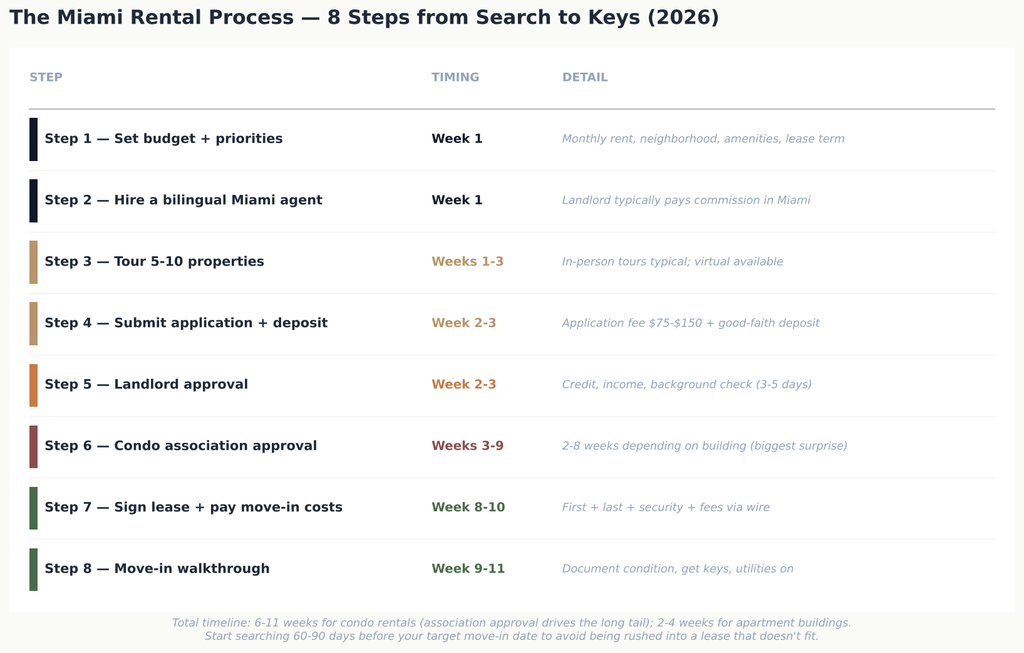
Step 4 — Submit application and good-faith deposit. Once you find the right property, submit the formal application (bringing all documents from the checklist below) along with a good-faith deposit (typically $500-$2,000) that holds the unit while the landlord reviews.
Step 5 — Landlord approval. The landlord runs credit, verifies income, checks background and prior rental history. This typically takes 3-5 business days for straightforward applications; longer for complex ones (self-employed, foreign applicants, lower credit).
Step 6 — Condo association approval (if applicable). This is where Miami diverges from other markets. If you're renting a condo, the condo association now runs its own review. This includes a separate application, separate fees ($100-$250), separate background check, and often a formal interview with the condo board. Timeline: 2-8 weeks depending on the building. Older/stricter buildings take the longest. Luxury buildings and newer condos generally approve faster.
Step 7 — Sign lease and pay move-in costs. Once both approvals are in, you sign the lease, wire first + last + security deposit (typically all three months) plus any outstanding fees. Funds generally need to be in certified check or wire form — personal checks aren't accepted for move-in costs.
Step 8 — Move-in walkthrough. On move-in day, document the property's condition thoroughly (photos + written list signed by both parties), receive keys and parking passes, and set up utilities (electric with FPL, internet with Xfinity or AT&T Fiber).
What Miami Landlords Actually Require
Miami rental applications ask for more documentation than most American cities. Being prepared with everything upfront dramatically speeds the process:
Credit score 650+ — Standard minimum for most properties. Luxury buildings in Brickell, Miami Beach, and Coconut Grove typically want 700+. Below 650, you may need to pay additional security deposit or find landlord-friendly buildings.
Income 3x monthly rent — Standard across virtually all Miami rentals. For a $3,000/month rental, you need $9,000+/month gross income (or $108K annually). Verified via pay stubs (last 2-3 months), tax returns (last 2 years), or an offer letter from a new employer.
2-3 months of bank statements — Shows funds for move-in costs plus financial stability. Luxury buildings may want 6-12 months of reserves documented.
Employment verification letter — On company letterhead, signed by HR, confirming job title, start date, salary, and status. If you're a new hire, an offer letter works.
Prior landlord references — Contact info for your last 2 landlords (prior 2+ years of rental history). First-time renters in the US can use college housing, parents' home, or guarantor arrangements instead.
Here's the full application checklist Miami landlords expect:
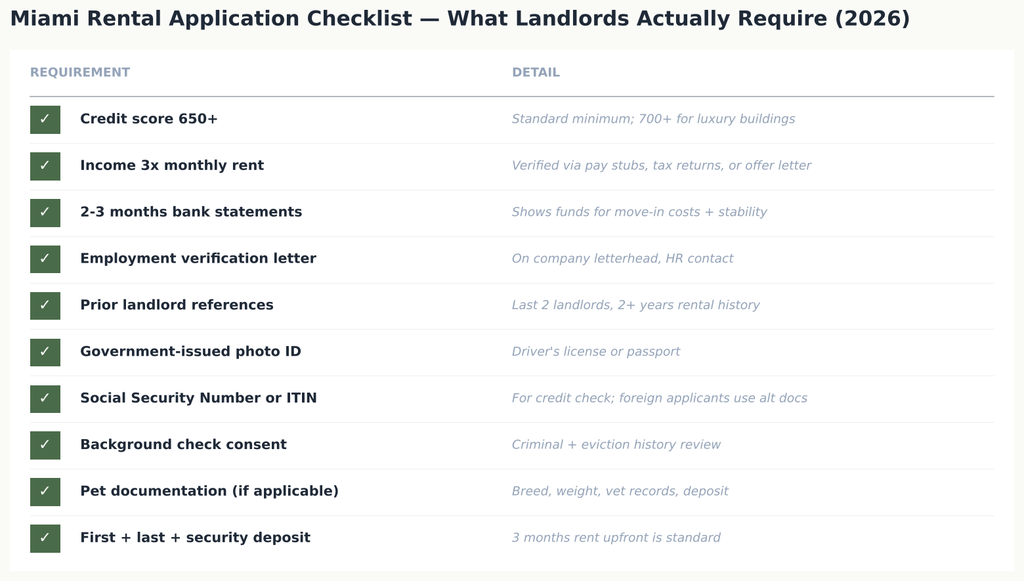
Government-issued photo ID — Driver's license, passport, or state ID.
Social Security Number or ITIN — Required for credit check. Foreign applicants without SSN can use ITIN (Individual Taxpayer Identification Number) or provide alternative documentation (international credit report, home-country bank references, international employment verification).
Background check consent — Written authorization for the landlord to run criminal history and eviction history checks. Miami landlords are especially cautious about eviction history — a single prior eviction can disqualify you from most buildings.
Pet documentation (if applicable) — If you have pets, you'll need breed documentation, weight, vaccination records, and often photos. Pet deposits run $300-$500 non-refundable plus $25-$50/month pet rent. Breed restrictions are common — pit bulls, Rottweilers, Doberman mixes often prohibited in condo buildings.
Move-in costs ready to wire — First month, last month, and security deposit (equal to one month) is the Miami standard. On a $3,000/month rental, that's $9,000 in cash required at lease signing, plus application fees ($75-$150) and condo approval fees ($100-$250).
The Real Cost of Moving Into a Miami Rental
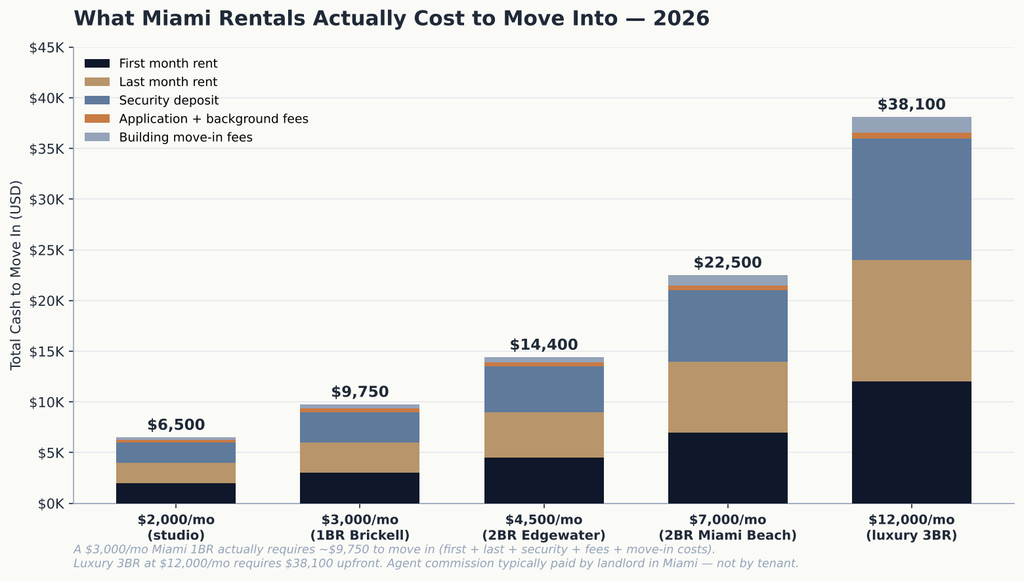
Most newcomers underestimate what they'll actually need to write a check for on lease-signing day. Here's the honest breakdown by rent level:
$2,000/month studio: Total move-in cost ~$6,500 ($2K first + $2K last + $2K security + $500 in app/building fees).
$3,000/month 1BR Brickell: Total move-in cost ~$9,750. This is Miami's most common new-renter scenario.
$4,500/month 2BR Edgewater: Total move-in cost ~$14,400. Mid-market renters crossing into luxury condo territory.
$7,000/month 2BR Miami Beach: Total move-in cost ~$22,500. Luxury condo territory with higher building move-in fees.
$12,000/month luxury 3BR: Total move-in cost ~$38,100. HNW luxury rentals in Fisher Island, Bal Harbour, Star Island.
Here's the full breakdown:
The specific line items:
First month rent — Due at lease signing, covers your first calendar month.
Last month rent — Held by landlord against your final month in the property. Returned to you (as rent credit) when you give notice.
Security deposit — Held against damage, cleaning, unpaid rent. Returned within 15-60 days after move-out per Florida law (depending on whether you file timely dispute).
Application + background fees — $75-$150 per adult applicant for standard apartment buildings; $200-$450 total for condos (which add condo association app fee + separate background check).
Building move-in fees — Common in Miami condo buildings and luxury apartments. $250-$1,500 non-refundable, covers elevator reservations, loading dock access, and move-in coordination with the building. Expect this at any Miami property above $3,000/month.
What's NOT in this chart (and good news for Miami renters): Agent commission. Unlike NYC where tenants pay 10-15% of annual rent to the broker, Miami landlords typically pay the full agent commission (typically half-month rent or 6-8% of annual rent). This means working with a rental agent costs you nothing but gets you access to better inventory and professional representation during the process.
Condo Rental vs. Apartment Building — The Critical Distinction
One of the most important decisions in a Miami rental search is choosing between a condo rental (where you're renting from an individual condo owner) versus an apartment building (where a corporate owner manages all units). These are fundamentally different experiences:
Condo rental advantages: Often more character and architectural variety, individual owner relationships can be more flexible on terms, often furnished options available, broader geographic distribution (every neighborhood has condo rentals).
Condo rental challenges: The condo association approval adds 2-8 weeks to timeline. Pet rules are governed by condo bylaws (often more restrictive than individual landlord preferences). Owner-landlord quality varies — some are highly responsive, others are hard to reach. Lease terms set by the owner, which can be unusual (24-month minimums, no sublet, etc.).
Apartment building advantages: Faster approval (3-7 days typical). Standardized lease terms. Professional maintenance team with 24/7 response. Clear building-wide policies. Often shorter minimum lease terms (12 months, sometimes 6).
Apartment building challenges: Less character/architecture variety. Less lease negotiation flexibility. Often less generous square footage per dollar than owner-landlord condos. Pet rules may be strict building-wide (no large dogs, etc.).
The complete side-by-side comparison:
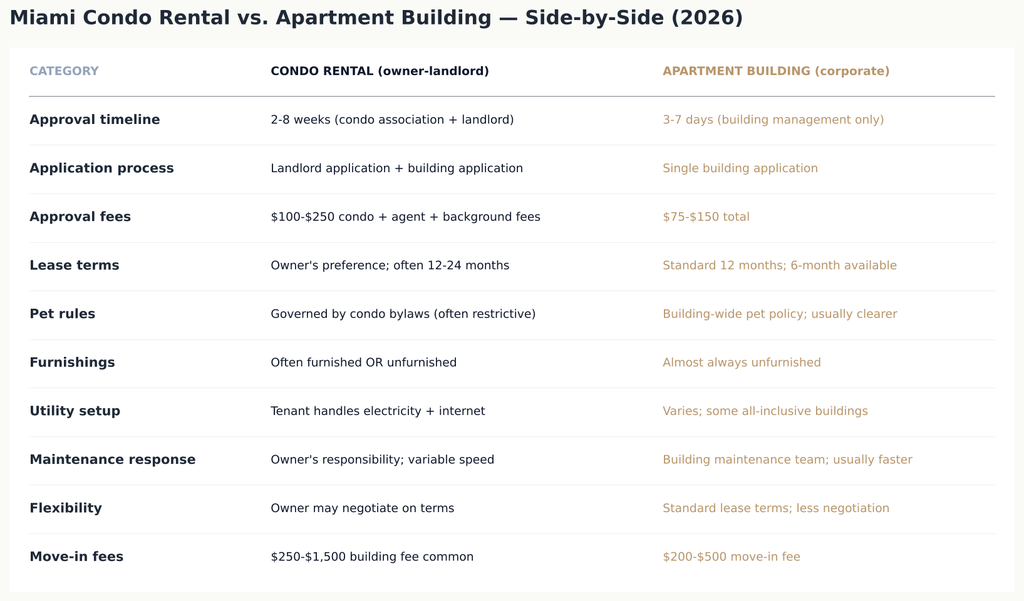
My practical recommendation for newcomers: If you have time flexibility (60-90 days before target move-in), condo rentals often offer better value and more interesting properties. If you need to move in 30 days or less, apartment buildings are the realistic option.
Where Miami Rents Actually Fit Each Budget
A quick reality check on 2026 Miami rents by neighborhood:
Under $2,000/mo: Studio apartments in Little Havana, Allapattah, Flagami, parts of Little Haiti. Older buildings, no amenities, inland locations. First-year renters on budgets.
$2,000-$2,800/mo: Studios and 1BRs in Midtown, Edgewater (older buildings), Wynwood (converted spaces), Coconut Grove (older stock). Entry-level urban Miami.
$2,800-$4,000/mo: 1BR in Brickell, Midtown, Edgewater (modern buildings). 2BRs in Coral Gables (older), Coconut Grove (older), Little Havana. This is where most relocating professionals land.
$4,000-$6,500/mo: Luxury 1BR in Brickell high-rises, 2BR Edgewater waterfront, 2BR Coral Gables (modern), 1-2BR Miami Beach (South Beach to Mid-Beach).
$6,500-$12,000/mo: 2-3BR luxury Brickell, Miami Beach waterfront, Coconut Grove waterfront, Coral Gables luxury homes, Pinecrest larger homes.
$12,000+/mo: Luxury waterfront condos (Fisher Island, Star Island adjacent, Bal Harbour), luxury SFHs across Coconut Grove, Pinecrest, Coral Gables. HNW relocation territory.
Common Mistakes Miami Renters Make
1. Not budgeting for the condo approval timeline. Booking movers for 3 weeks out when you're renting a condo requires getting lucky on fast condo approval. Build buffer time.
2. Submitting applications without a good-faith deposit. Miami landlords often get multiple applications on desirable units. Submitting without deposit means your application sits behind applicants who did.
3. Not shopping multiple properties. The first property you tour rarely ends up being the right fit. Tour 5-10 before deciding.
4. Signing a 24-month lease without negotiating. Many condo owners prefer longer leases. On a 12-month vs 24-month ask, you can often negotiate rent reduction (3-7%) or amenity concessions.
5. Not photographing move-in condition thoroughly. Security deposit disputes almost always come down to documentation. Photograph EVERY room, every surface, every existing scratch or stain on move-in day. Email the photos to yourself with timestamp.
6. Underestimating utilities. Miami electric bills average $150-$300/month depending on unit size and AC usage (summer runs higher). Internet $70-$120/month. Budget $250-$400/month in utilities on top of rent.
7. Not asking about building rules on short-term rentals. Many Miami condo buildings prohibit Airbnb and short-term rentals entirely. If you're planning to rent your unit out for parts of the year, verify this with the condo bylaws BEFORE signing.
The 2026 Timing Advice That Actually Matters
Best months to rent in Miami: June-August. Lower demand (snowbirds have left), more inventory, best negotiating leverage on rent and terms. Trade-off: summer heat and start of hurricane season.
Most expensive months: December-February. Peak snowbird demand. Rents run 10-18% above annual average. Minimal availability. Avoid signing a new lease in this window if you have flexibility.
Best balance: March-April or October-November. Decent inventory, workable pricing, excellent weather, movers readily available.
Start searching: 60-90 days before target move-in. For condo rentals specifically, 90 days gives you buffer for the association approval timeline.
The Bottom Line
Miami rental process isn't harder than other cities — it's just different. The two biggest surprises for newcomers (condo association approval and higher upfront cash requirements) are entirely manageable if you know about them upfront and plan accordingly.
The renters I see navigate Miami successfully are the ones who prepare documentation before starting their search, work with a bilingual rental agent (free to tenants here), build 60-90 days of search runway, and understand the condo vs. apartment building distinction. The ones who struggle try to force a 2-week timeline that works in other cities but doesn't work here.
That's the conversation I'd rather have with you before you start your search than after you've lost deposits on condos that didn't approve in time.
Frequently Asked Questions
How long does it take to rent an apartment in Miami?
The Miami rental process takes 6-11 weeks for condo rentals (where condo association approval drives the long tail) and 2-4 weeks for apartment buildings (where only building management approval is required). The breakdown: 1-3 weeks for property search and application, 3-5 days for landlord approval, 2-8 weeks for condo association approval if applicable, 1-2 weeks for lease signing and move-in prep. Start searching 60-90 days before your target move-in date to avoid being rushed into a lease that doesn't fit.
What documents do I need to rent an apartment in Miami?
Miami landlords typically require: government-issued photo ID (driver's license or passport), Social Security Number or ITIN, 2-3 months of pay stubs showing income of 3x monthly rent, 2-3 months of bank statements, employment verification letter on company letterhead, prior landlord references (last 2 landlords), credit check consent (650+ score standard, 700+ for luxury), background check consent, and pet documentation if applicable. Foreign applicants without US credit can use alternative documentation: ITIN, international credit reports, home-country bank references, international employment verification.
How much money do I need upfront to rent in Miami?
Total move-in cost is typically 3-4x monthly rent plus fees. For a $3,000/month Miami 1BR, expect ~$9,750 cash required at lease signing: first month ($3K), last month ($3K), security deposit ($3K), application and background fees ($350), and building move-in fees ($400). Luxury rentals scale proportionally — a $12,000/month 3BR requires ~$38,100 upfront. Agent commission is typically paid by the landlord in Miami (not by tenant), unlike NYC where tenants pay broker fees.
Should I rent a condo or an apartment building in Miami?
Depends on your timeline and priorities. Condo rentals offer more character, architectural variety, often furnished options, and broader neighborhood distribution — but approval takes 2-8 weeks and pet rules can be restrictive. Apartment buildings offer faster approval (3-7 days), standardized lease terms, professional maintenance teams, and clearer policies — but less flexibility and often less value per square foot. For newcomers with 60-90 days of search runway, condos often provide better value. For those needing to move in under 30 days, apartment buildings are the realistic option.
When is the best time of year to rent in Miami?
June-August offers the best rental deals in Miami — rents run 10-12% below annual average and inventory peaks (snowbirds have left). Trade-off is summer heat and start of hurricane season. December-February is the most expensive window — snowbird demand drives rents 10-18% above average with minimal availability. The best balance is March-April or October-November — reasonable pricing, excellent weather, decent inventory, movers readily available. If you're relocating with flexibility, aim to sign your Miami lease between June and August for best financial terms.
Ready to start your Miami rental search with expert guidance? Our team at The Carroll Group at Compass — the #1 team at Compass Florida with $9B+ in career sales — specializes in HNW luxury rentals across Miami-Dade, Broward, and Palm Beach counties. Our bilingual team works routinely with relocation clients from Latin America, Europe, and the US. Our Florida Leasing Process walks through the full rental process including building vetting, application prep, and condo approval navigation. For clients evaluating the broader relocation decision, our Florida Relocation Process covers neighborhood selection and lifestyle fit. If you're testing Miami before committing to a purchase, our Florida Buyers Guide walks through the next step. For deeper neighborhood-by-neighborhood rental context (price ranges, building quality, cultural fit), our community guides break down each area. Either way — I'd rather help you find a Miami rental that fits your life than watch you take the first thing available because you got rushed by Miami's unique approval timelines.
Sources:
- Renting in Miami: The Ultimate Condo Rental & Apartment Guide
- Miami Renter's Guide: How to Rent an Apartment in Miami (2026)
- The Definitive Guide to Renting a Condo or Apartment in Miami, Florida
- Rental Application Checklist for Miami
- Ultimate Guide to Renting a Condo in Miami - Brickell.com
Check out this article next