Let me tell you the moment most Miami buyers realize they didn't prepare for something important. They found the property. They ran the numbers. Mortgage payment looks fine. Property tax looks manageable. They're excited. Then they get their first insurance quote — and their monthly payment suddenly jumps by $500-$1,500 more than they modeled. That's not an outlier. That's the standard Miami buyer experience. Home insurance in Florida averages $8,458 per year in 2026, roughly 2.8x the national average. Miami-Dade specifically averages around $6,045 after the recent Citizens 14% rate cut, but coastal single-family homes routinely quote $9,000-$18,000+. On the mortgage payment for a typical Miami condo, insurance eats 8-11% of your total monthly cost — versus 2-3% in most US markets. Add flood insurance if you're in a flood zone (many Miami properties are) and the number climbs further.
This isn't a footnote. This is the single most important financial factor most Miami buyers underestimate before they make an offer. So let me walk you through what's actually happening with Miami home insurance in 2026, what it really costs, and — critically — how to shop it before you buy so it doesn't blow up your budget. If you're already working through a Miami home purchase and want expert guidance on insurance strategy, our Florida Buyers Guide walks through the full financial picture. For real numbers on your specific price point, our Miami Mortgage Calculator lets you plug in Miami-realistic insurance costs — not the lender's default estimate.
The Miami Insurance Reality: Real 2026 Numbers
Here's what buyers are actually paying in 2026: 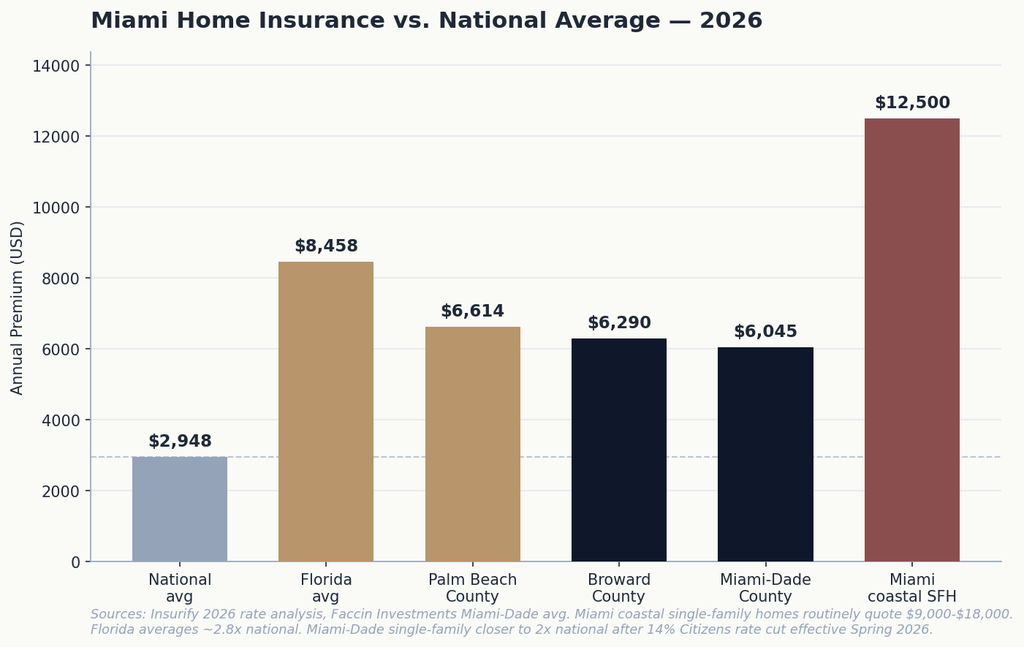 A few things to notice:
Miami-Dade averages $6,045 for a standard home. That's after the 14% average Citizens rate cut approved in Spring 2026 — the first meaningful rate relief Florida homeowners have seen since 2015.
Broward is $6,290 and Palm Beach is $6,614. All three counties are meaningfully higher than the national average of $2,948, but the direction has shifted for the first time in a decade.
Coastal single-family homes are a different universe. If you're buying in Miami Beach, Key Biscayne, or coastal Coconut Grove, you're looking at $9,000-$18,000+ annual premiums. Homes on the water can hit $20,000+.
Florida overall averages $8,458 because the Panhandle, Keys, and coastal exposure inflate the number. Inland Florida counties are meaningfully cheaper than Miami-Dade.
The direction matters. For the first time in 14 years, Florida homeowners insurance rates are actually decreasing. Citizens is cutting rates, 20 new insurers have entered the market since 2022, and the tort reform legislation from 2022 has finally reduced the litigation costs that were driving premiums. This is stabilization, not a return to pre-crisis pricing — but it's real.
Why Is Miami Insurance So Expensive?
Four factors combined to create the current Miami insurance market:
1. Hurricane exposure. Miami-Dade sits in a Category 5 hurricane zone. Any hurricane forecast that includes Florida spikes reinsurance costs, which insurers pass through to policyholders. Even years with no direct hits (like 2025) don't reset the pricing model.
2. Litigation. Florida had a specific legal environment through 2022 where minor claims often turned into major lawsuits. The 2022 SB 2-A tort reform bill addressed most of this, but the cost impact took 3-4 years to work through the system.
3. Insurer failures. Between 2021-2024, more than 15 Florida insurers went insolvent or exited the state. That collapsed capacity in the market and pushed most policies to Citizens Property Insurance (the state-backed insurer of last resort) or non-admitted carriers with less regulation and higher rates.
4. Reinsurance costs. Insurance companies buy their own insurance (reinsurance) against catastrophic losses. Global reinsurance costs spiked 40-70% between 2022-2024. That cost flows directly to your premium. The good news: all four factors are now improving. Reinsurance costs stabilized in 2025. Tort reform is working. New insurers are entering. And Citizens has moved 600,000+ policies back to the private market since 2024.
What Actually Drives Your Specific Premium
Not every Miami property costs the same to insure. Here are the factors that actually move your quote: 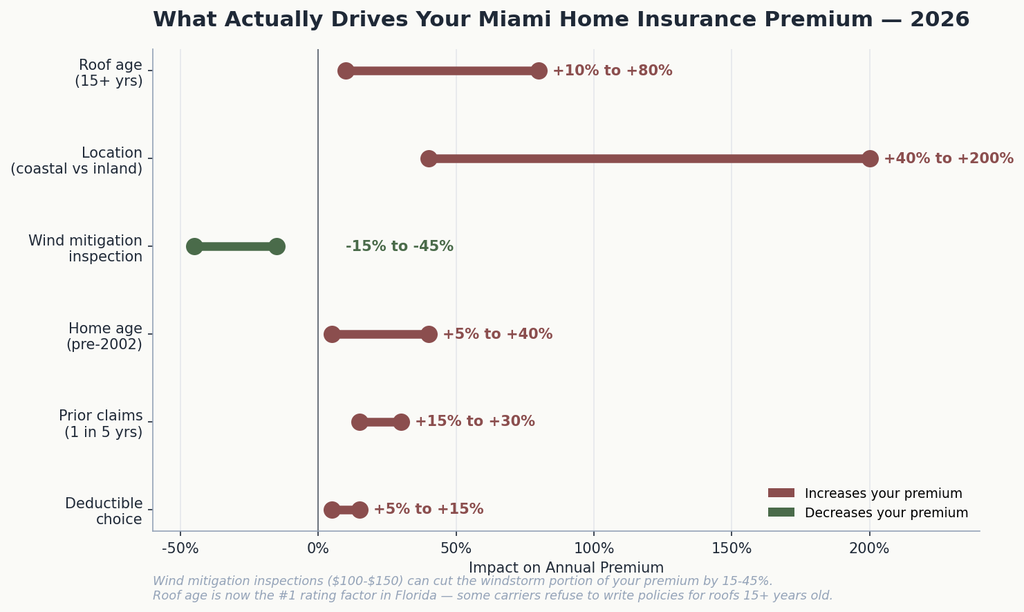 Let me walk through each:
Roof age is now the #1 rating factor in Florida. Since 2022, roof age carries more weight than any other single factor. Roofs 15+ years old can add 10-80% to your premium. Some carriers refuse to write policies for roofs older than 15 years, especially in coastal counties. Post-hurricane Ian, insurers can now apply actual cash value (depreciated value) instead of replacement cost to older roofs — meaning if your roof is destroyed, you may only receive 40-60% of what it costs to replace.
Location matters enormously. A Miami-Dade coastal property costs 40-200% more to insure than an inland property in the same county. This isn't just about being on the water — it's about wind exposure, flood zone designation, and Category 3+ storm surge risk. Buildings east of I-95 typically pay significantly more than buildings west of it.
Wind mitigation inspections are your biggest savings lever. A $100-$150 wind mitigation inspection documents storm-resistant features: hurricane straps, impact windows, hip roof shape, secondary water barrier, roof deck attachment. Every one of these can reduce the windstorm portion of your premium. Total savings range from 15-45%. This is the single most cost-effective insurance move you can make.
Home age (pre-2002) increases premiums. Miami-Dade updated its building code significantly in 2001-2002 after Hurricane Andrew. Homes built before this code update pay 5-40% more in insurance because they weren't built to the current wind standards. Some pre-2002 homes are difficult to insure at all without retrofits.
Prior claims history follows you. File one claim in five years and your premium jumps roughly $1,650 on average across Florida. Two claims push you to $3,000+ above baseline. This is why insurance professionals recommend paying small claims out of pocket if possible.
Deductible choice matters. Higher hurricane deductibles (5% instead of 2%) can cut your premium meaningfully, but you're on the hook for that first chunk when a named storm hits. On a $500K home, a 2% deductible is $10K out of pocket before coverage kicks in.
The Three Insurance Policies Miami Buyers Actually Need
Here's where most newcomers underestimate the scope. Miami home insurance isn't one policy — it's typically three: 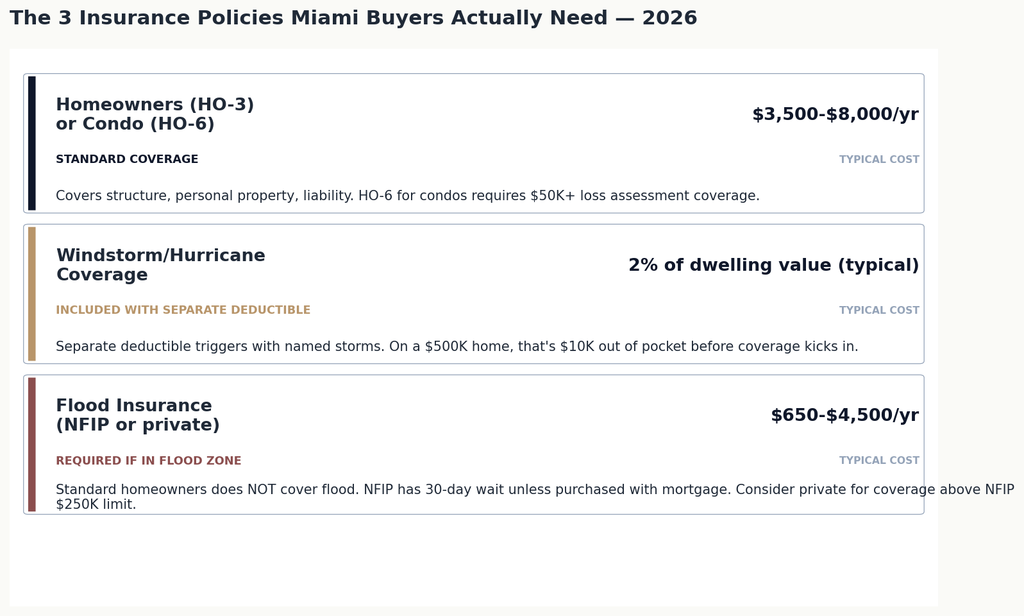 Policy 1: Homeowners (HO-3) or Condo (HO-6). This is your primary policy. It covers structure (or your unit interior for condos), personal property, and liability. For condos, you MUST include loss assessment coverage of at least $50,000 — some 2026 special assessments have exceeded $100,000 per unit in older buildings dealing with the post-Surfside inspection requirements. Standard HO-6 policies often have loss assessment limits of only $1,000, which is dangerous in Miami.
Policy 2: Windstorm/Hurricane Coverage. This is usually built into your homeowners policy but has a separate deductible that only triggers during named storms. In Miami, that deductible is typically 2% of your dwelling value. On a $500K home, that's $10,000 out of pocket before coverage kicks in for hurricane damage. Some carriers offer 3-5% deductibles for premium savings.
Policy 3: Flood Insurance (NFIP or private). This is where most buyers get blindsided. Standard homeowners insurance does NOT cover flood damage. If you're in FEMA-designated flood zone AE, VE, or A (many Miami properties are), your lender will require flood insurance. NFIP policies cost $650-$4,500/year depending on elevation and zone. If your home's value exceeds NFIP's $250,000 dwelling limit, you'll need supplemental private flood insurance. NFIP has a 30-day waiting period before coverage starts — UNLESS you purchase it as part of your mortgage, in which case the waiting period is waived. Miami has hundreds of thousands of properties in flood zones. Before you make an offer, check FEMA's Flood Map Service Center for the exact address and get a flood insurance quote in parallel with your homeowners quote.
What Insurance Actually Adds to Your Monthly Payment
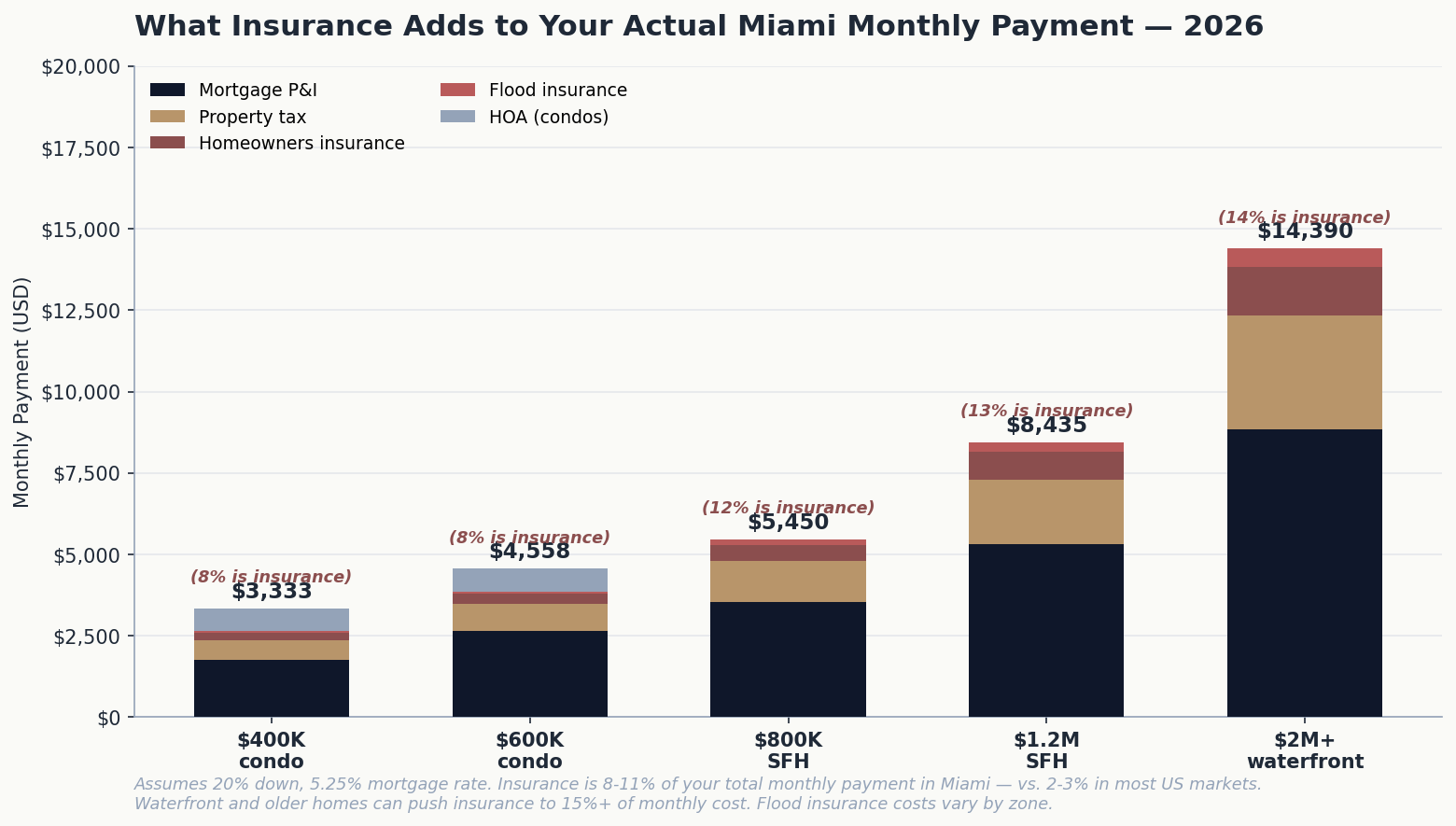
Let me make this concrete. Here's what your total monthly payment actually looks like in Miami with insurance factored in: 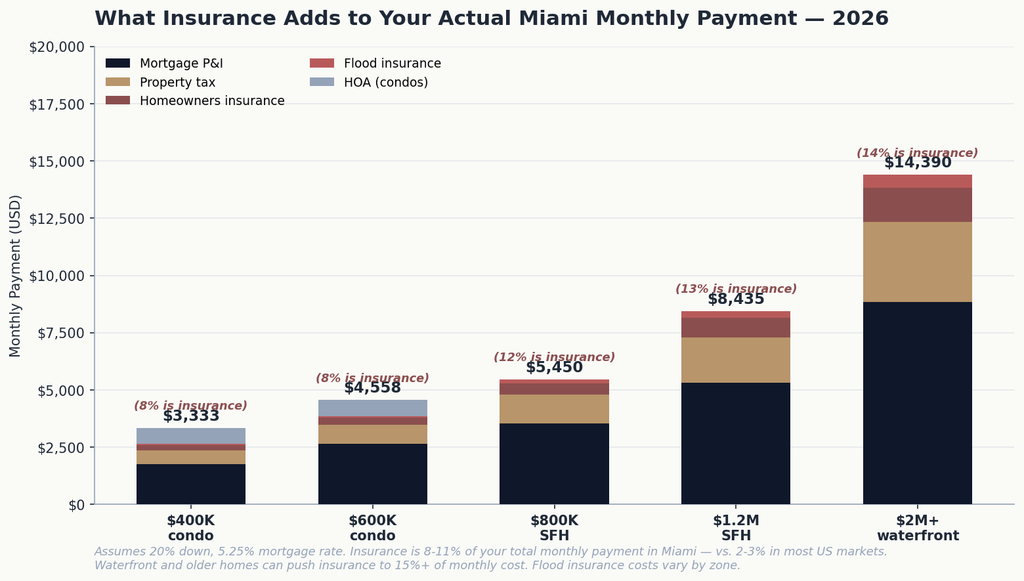 A few takeaways:
A $600K Miami condo isn't a $2,650/month decision. It's a $4,558/month decision once you add property tax ($833), homeowners insurance ($300), flood insurance ($75), and HOA fees ($700). Your monthly out-of-pocket is 72% higher than the mortgage payment alone.
Insurance is 8-11% of your monthly payment in Miami. In most US markets, insurance runs 2-3% of monthly housing costs. Miami is 3-4x that ratio. The absolute dollar amount matters more than the percentage — an extra $300-$1,500/month over the life of a 30-year mortgage adds up to $108,000-$540,000.
Waterfront homes push insurance to 15%+ of monthly cost. That $2M waterfront property isn't just $8,840/month in mortgage. It's $14,390/month total, with $2,050 of that going to insurance. Over 30 years, that's $738,000 in insurance costs alone.
Older single-family homes can double the insurance line. The numbers above assume modern homes with wind mitigation. A 1970s Coral Gables home without impact windows could push the insurance line significantly higher.
What Newcomers Should Actually Do Before Buying
Here's the concrete playbook I walk relocation buyers through:
1. Get real insurance quotes BEFORE you write an offer, not after. This is the single biggest mistake I see. Most buyers get insurance quotes during the option period, after they're emotionally committed to a specific property. By then, if the quote comes back at $12,000 instead of the $5,000 you'd budgeted, you're stuck either backing out (losing option fees) or eating the extra $7,000/year for the life of ownership. Request quotes from 3-5 carriers on the specific address you're considering. Use an independent Miami insurance broker, not a captive agent (State Farm, Allstate, etc.). Independent brokers can shop 20+ carriers at once, which matters in Florida's fragmented market.
2. Pull the CLUE report on the property. For about $20, you can pull the Comprehensive Loss Underwriting Exchange report on any property — it shows insurance claims history for the last 5-7 years. Properties with recent claims are harder and more expensive to insure. If a home has three claims in the past five years, walk away.
3. Check the roof age and condition. Ask for the roof permit records and installation date. Anything over 10 years old is a warning; anything over 15 years is a serious problem for insurability. Some carriers now require roof certifications from a licensed inspector before writing a policy on any home with a roof over 10 years old.
4. Get a wind mitigation inspection during your due diligence period. It costs $100-$150 and can save you 15-45% on the windstorm portion of your premium. This is the highest ROI inspection you can pay for.
5. Understand your flood zone exposure. Look up the property at FEMA's Flood Map Service Center. If it's in an AE, VE, or A zone, your lender requires flood insurance and it's expensive. If it's in an X zone (preferred), you don't need it but should still consider it — many "X zone" Miami properties have flooded in the last decade.
6. Verify HO-6 loss assessment coverage if you're buying a condo. After Surfside, Miami condo buildings are under pressure to properly fund reserves. Special assessments have hit $100,000+ per unit in some older buildings. Standard HO-6 policies cover only $1,000 in loss assessments. You want at least $50,000.
7. Don't rely on the seller's insurance quote. Sellers who've owned the home for 5+ years are grandfathered into legacy rates. Your quote as a new buyer will almost always be higher — sometimes dramatically higher. Never model your budget based on the seller's premium.
8. Get quotes with and without a hurricane deductible. Cheaper quotes may hide the fact that hurricane damage isn't covered without a separate deductible. Read the declaration page carefully.
Where This Fits in Your Budget Model
The buyers I see thrive in Miami are the ones who model insurance realistically from day one. The buyers who struggle are the ones who assumed $5,000/year and discovered $10,000/year after they were already emotionally committed to a property. Your realistic Miami insurance budget:
- $400-$600K condo (modern building): $2,700-$4,500/year
- $600K-$1M condo (older building, coastal): $3,600-$7,200/year
- $800K-$1.2M single-family home (inland): $5,000-$8,500/year
- $1M-$2M single-family home (established neighborhood): $6,500-$12,000/year
- $2M+ waterfront: $10,000-$25,000+/year
- Flood insurance if applicable: Add $650-$4,500/year on top
Plug these ranges into our Miami Mortgage Calculator to see your realistic monthly payment before you fall in love with a property.
The Bottom Line
Miami home insurance in 2026 is expensive but not the crisis it was in 2023. Rates have stabilized. The market has more carriers. Citizens cut rates 14% in Miami-Dade this spring. If you shop smart, get wind mitigation inspections done, buy properties with newer roofs, and understand flood zones, you can budget for insurance realistically and buy with confidence. But you have to do the work before you make an offer. Getting an insurance quote after you're under contract is how buyers end up in properties they can't actually afford to insure. That's the conversation I want to have with you before you write your first Miami offer — not after.
Frequently Asked Questions
How much does home insurance cost in Miami in 2026? Miami-Dade home insurance averages $6,045 per year in 2026 after the 14% Citizens rate cut effective Spring 2026. Broward averages $6,290 and Palm Beach $6,614. Coastal single-family homes routinely quote $9,000-$18,000. These numbers are roughly 2-3x the national average of $2,948. Florida overall averages $8,458 due to Panhandle and Keys exposure.
Why is Miami home insurance so expensive? Four factors: hurricane exposure (Miami sits in a Category 5 zone), litigation costs (mostly resolved by 2022 tort reform), insurer failures between 2021-2024, and elevated reinsurance costs. All four are now improving — Citizens cut rates 14% in Miami-Dade for Spring 2026, 20 new insurers have entered the market since 2022, and reinsurance costs stabilized in 2025.
Do I need flood insurance in Miami? If your property is in FEMA-designated flood zones AE, VE, or A, your lender requires flood insurance. Many Miami properties are in these zones. NFIP flood insurance costs $650-$4,500/year and has a 30-day waiting period — unless purchased with your mortgage, in which case the wait is waived. Homes above NFIP's $250,000 dwelling limit need supplemental private flood insurance.
What is a wind mitigation inspection and why does it matter? A wind mitigation inspection ($100-$150) documents your home's storm-resistant features: hurricane straps, impact windows, hip roof shape, secondary water barriers, roof deck attachment. Each feature reduces the windstorm portion of your Miami insurance premium. Total savings range from 15-45%. This is the highest-ROI inspection Miami buyers can pay for.
How much does insurance add to a Miami monthly mortgage payment? In Miami, home insurance is typically 8-11% of your total monthly housing payment, versus 2-3% in most US markets. On a $600K Miami condo with a $2,650 mortgage payment, insurance adds $300-$400/month plus $75/month flood insurance if applicable. Waterfront and older homes can push insurance to 15%+ of your monthly cost. Always get real insurance quotes on the specific address before writing an offer.
Ready to work through the real numbers for a Miami property you're considering? Our Florida Buyers Guide walks through the full financial picture including insurance strategy. For realistic monthly payment modeling with Miami-specific insurance costs, our Miami Mortgage Calculator is built to include the numbers other calculators skip. If you're not yet at the buying stage and want expert help sorting out the neighborhood-and-cost decision first, our Florida Relocation Process is designed for exactly that. Either way — I'd rather help you get accurate numbers upfront than watch you get blindsided by an insurance quote after you've already committed to a property.
Check out this article next