Let me tell you what I actually think, because I know it's not what most real estate advisors will tell you.
For most people relocating to Miami, the right first move is to rent. Not because renting is inherently better than buying — it's not. But because Miami is one of the highest-stakes real estate markets in America right now, and the cost of picking the wrong neighborhood, the wrong building, or the wrong price point is measured in hundreds of thousands of dollars.
I'm going to walk you through the actual math on when buying makes sense, when renting is smarter, and — most importantly — which specific type of relocation client you are and what that means for your decision.
But before we get into it, let me flag something you might be thinking: yes, I'm a real estate advisor. Yes, my business benefits when clients buy. And yes, I'm still going to tell you honestly when I think you shouldn't. Because the clients I've worked with who leased their first year and bought later are, without exception, more satisfied with their eventual purchase than the ones who bought immediately. That's the pattern. That's what this post is built on.
If you want expert guidance through the leasing decision specifically, our Florida Leasing Process is designed for exactly this — relocation clients using year one to test-drive Miami. When you're ready to buy, our Florida Buyers Guide covers what changes for that stage.
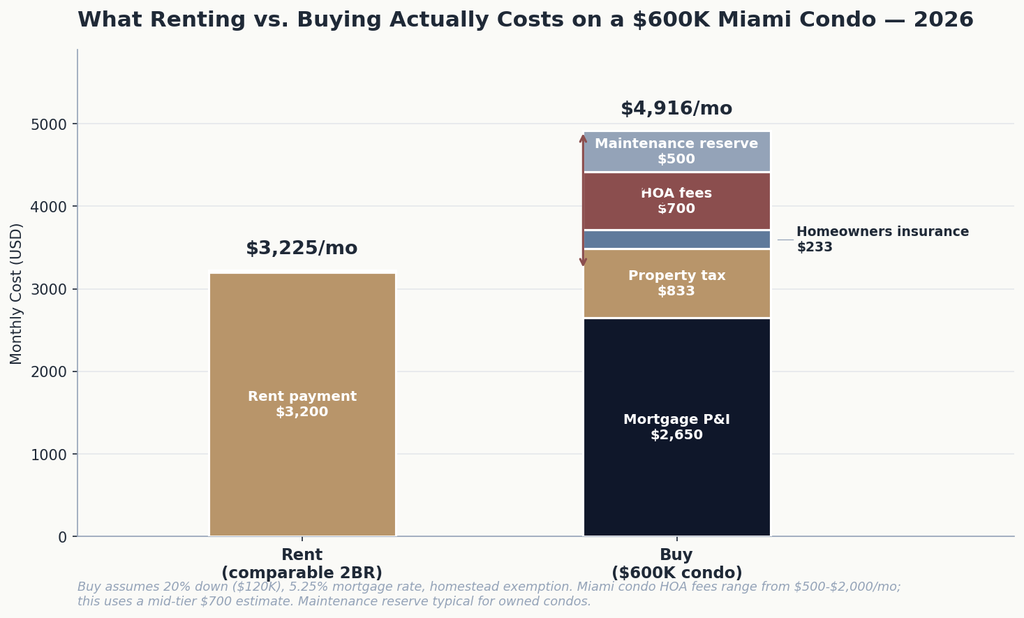 Renting the same unit runs about $3,225/month. Owning it costs $4,916/month once you stack property tax, homeowners insurance, HOA fees, and a realistic maintenance reserve on top of the mortgage.
That's a $1,691/month premium to own — over $20,000/year in extra cash out the door before you build a dollar of equity.
Now, some of that premium comes back to you: mortgage principal payments build equity, and Miami property has historically appreciated over time. But the piece most first-time buyers underestimate is the cash flow difference. That extra $1,691/month has to come from somewhere. If your income doesn't have room for it — or if your emergency fund isn't already 6-12 months deep — buying at this price point genuinely stresses your finances in a way that renting doesn't.
That's before we even talk about the down payment. To buy this $600K condo with 20% down, you need $120,000 in cash for the down payment alone, plus closing costs of another $15,000-$18,000. That's $135,000+ tied up in a single asset in a single Miami building.
Renting the same unit runs about $3,225/month. Owning it costs $4,916/month once you stack property tax, homeowners insurance, HOA fees, and a realistic maintenance reserve on top of the mortgage.
That's a $1,691/month premium to own — over $20,000/year in extra cash out the door before you build a dollar of equity.
Now, some of that premium comes back to you: mortgage principal payments build equity, and Miami property has historically appreciated over time. But the piece most first-time buyers underestimate is the cash flow difference. That extra $1,691/month has to come from somewhere. If your income doesn't have room for it — or if your emergency fund isn't already 6-12 months deep — buying at this price point genuinely stresses your finances in a way that renting doesn't.
That's before we even talk about the down payment. To buy this $600K condo with 20% down, you need $120,000 in cash for the down payment alone, plus closing costs of another $15,000-$18,000. That's $135,000+ tied up in a single asset in a single Miami building.
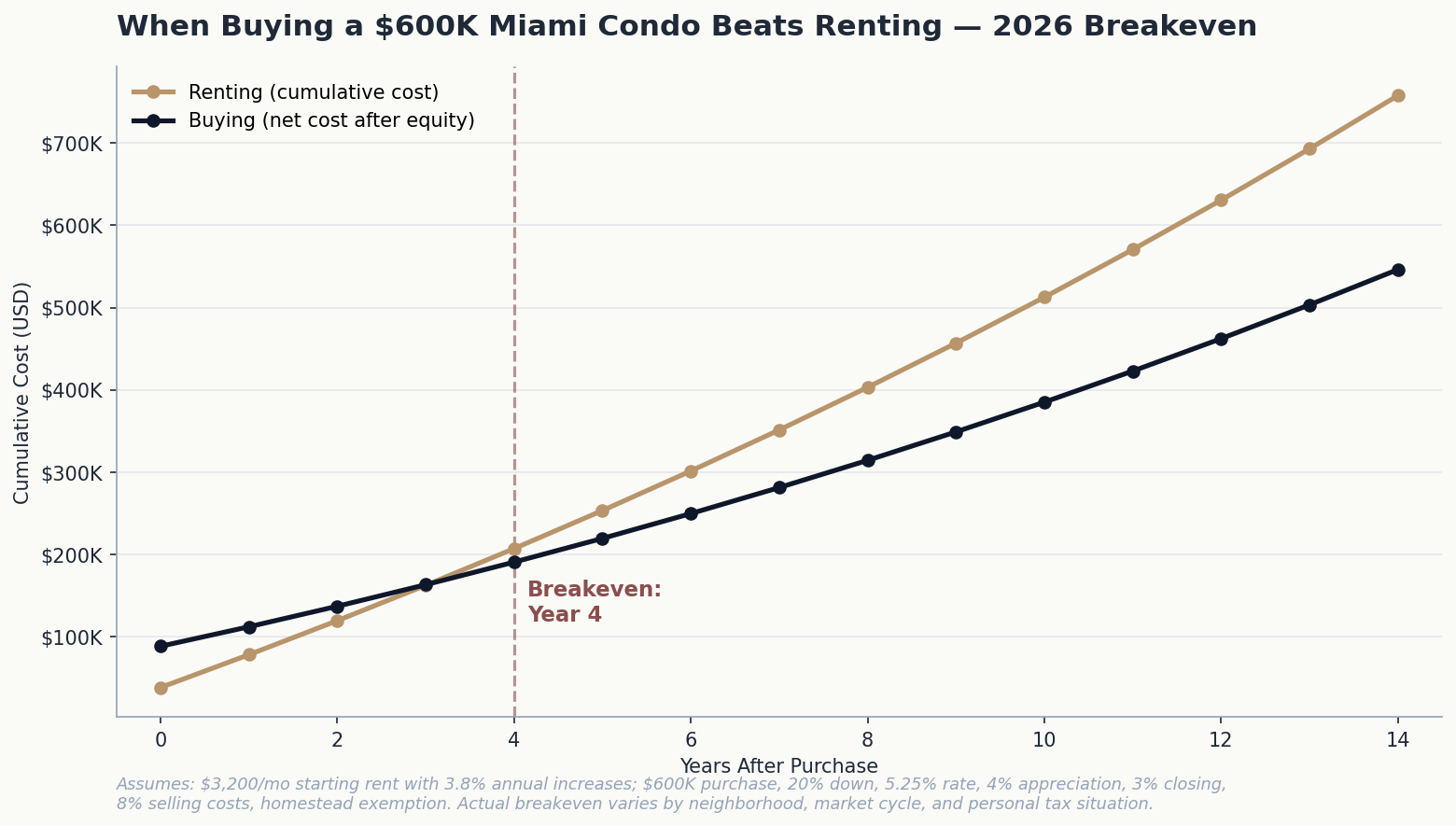
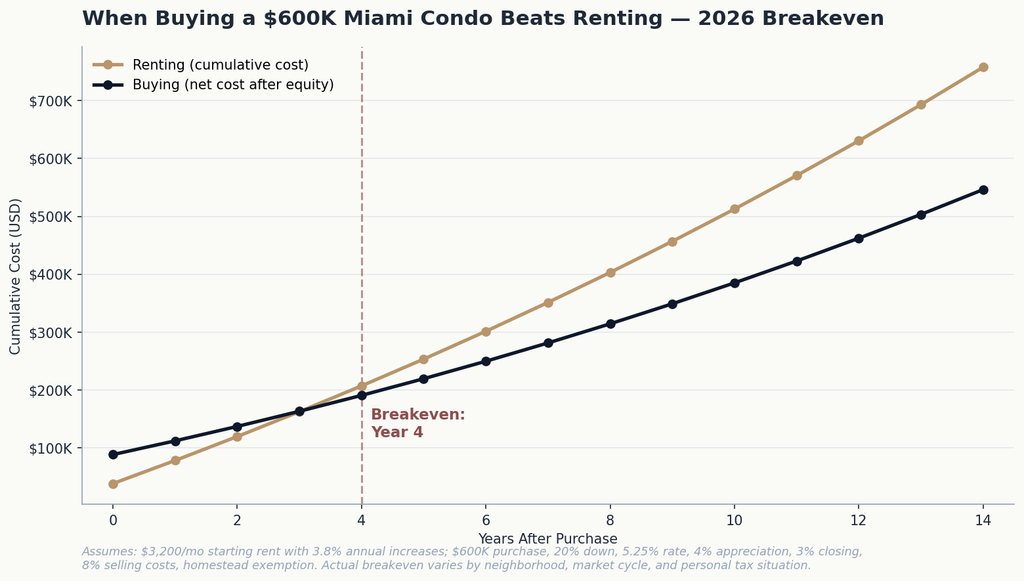 Under 2026 Miami assumptions — $3,200/month starting rent with 3.8% annual increases (Yahoo Finance's forecast for Miami rent growth), a $600K purchase at 5.25% mortgage rate, 4% property appreciation, standard closing costs, and 8% selling costs when you eventually sell — buying beats renting somewhere around year 4.
Before year 4, you're actually spending more owning than renting when you factor in all costs and eventual selling expenses. After year 4, ownership starts to pull ahead as equity accumulates and rent inflation eats renters' savings.
A few important caveats on this math:
Under 2026 Miami assumptions — $3,200/month starting rent with 3.8% annual increases (Yahoo Finance's forecast for Miami rent growth), a $600K purchase at 5.25% mortgage rate, 4% property appreciation, standard closing costs, and 8% selling costs when you eventually sell — buying beats renting somewhere around year 4.
Before year 4, you're actually spending more owning than renting when you factor in all costs and eventual selling expenses. After year 4, ownership starts to pull ahead as equity accumulates and rent inflation eats renters' savings.
A few important caveats on this math:
 If you buy that $600K condo and sell it in 2 years:
 Let me walk through each scenario in detail.
Ready to work through the rent-or-buy decision for your specific situation? Our Florida Leasing Process is built specifically for relocation clients using year one to test-drive Miami before committing to a purchase. When you're ready to buy, our Florida Buyers Guide covers what to expect at that stage. If you want to explore specific neighborhoods first, our community guides go into more detail on each area. Either way — I'd rather help you make the honest decision for your specific situation than push you toward a purchase you're not ready for.
The Real Monthly Math: What Renting vs. Buying Actually Costs
Let me start with the piece almost every generic rent-vs-buy calculator gets wrong for Miami. Here's what a $600K condo actually costs to own each month vs. renting a comparable 2-bedroom in the same building:
Renting the same unit runs about $3,225/month. Owning it costs $4,916/month once you stack property tax, homeowners insurance, HOA fees, and a realistic maintenance reserve on top of the mortgage.
That's a $1,691/month premium to own — over $20,000/year in extra cash out the door before you build a dollar of equity.
Now, some of that premium comes back to you: mortgage principal payments build equity, and Miami property has historically appreciated over time. But the piece most first-time buyers underestimate is the cash flow difference. That extra $1,691/month has to come from somewhere. If your income doesn't have room for it — or if your emergency fund isn't already 6-12 months deep — buying at this price point genuinely stresses your finances in a way that renting doesn't.
That's before we even talk about the down payment. To buy this $600K condo with 20% down, you need $120,000 in cash for the down payment alone, plus closing costs of another $15,000-$18,000. That's $135,000+ tied up in a single asset in a single Miami building.
When Does Buying Actually Beat Renting in Miami?
The honest answer isn't a slogan like "buy as soon as you can." It's a specific number of years.
Under 2026 Miami assumptions — $3,200/month starting rent with 3.8% annual increases (Yahoo Finance's forecast for Miami rent growth), a $600K purchase at 5.25% mortgage rate, 4% property appreciation, standard closing costs, and 8% selling costs when you eventually sell — buying beats renting somewhere around year 4.
Before year 4, you're actually spending more owning than renting when you factor in all costs and eventual selling expenses. After year 4, ownership starts to pull ahead as equity accumulates and rent inflation eats renters' savings.
A few important caveats on this math:
- Your specific breakeven varies. If you buy in a neighborhood with faster appreciation (Coral Gables, Coconut Grove, top Pinecrest addresses have posted 5-6% annual gains recently), your breakeven might come in year 3. If you buy in a neighborhood with more inventory pressure (Downtown Miami condos, some new Edgewater buildings), it might not come until year 6-7.
- Insurance surprises can push breakeven back. Florida homeowners insurance has volatile pricing. A property that quotes at $2,800/year today might renew at $4,500 in year 3. That doesn't happen to you as a renter.
- HOA special assessments are the biggest wildcard. Miami condo buildings routinely hit owners with special assessments of $5,000-$50,000+ for structural work, roof replacements, or reserve fund shortfalls. A single major assessment can push your effective ownership cost past renting for years.
Why Buying and Selling Within 2 Years Almost Always Loses
This is the piece I want every relocation client to understand before they consider a purchase in year one:
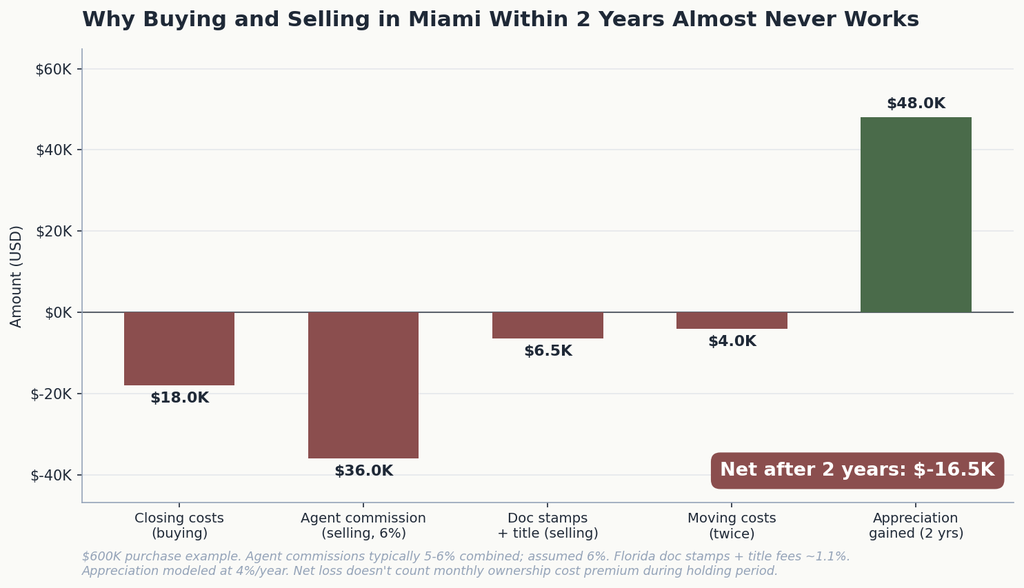
If you buy that $600K condo and sell it in 2 years:
- Closing costs at purchase: $18,000
- Agent commission at sale (6%): $36,000
- Florida doc stamps + title fees at sale: $6,500
- Moving costs (twice): $4,000
- Total transaction costs: $64,500
- Appreciation gained at 4%/year: $48,000
- Net loss on the transaction: about $16,500
The Scenario-by-Scenario Breakdown
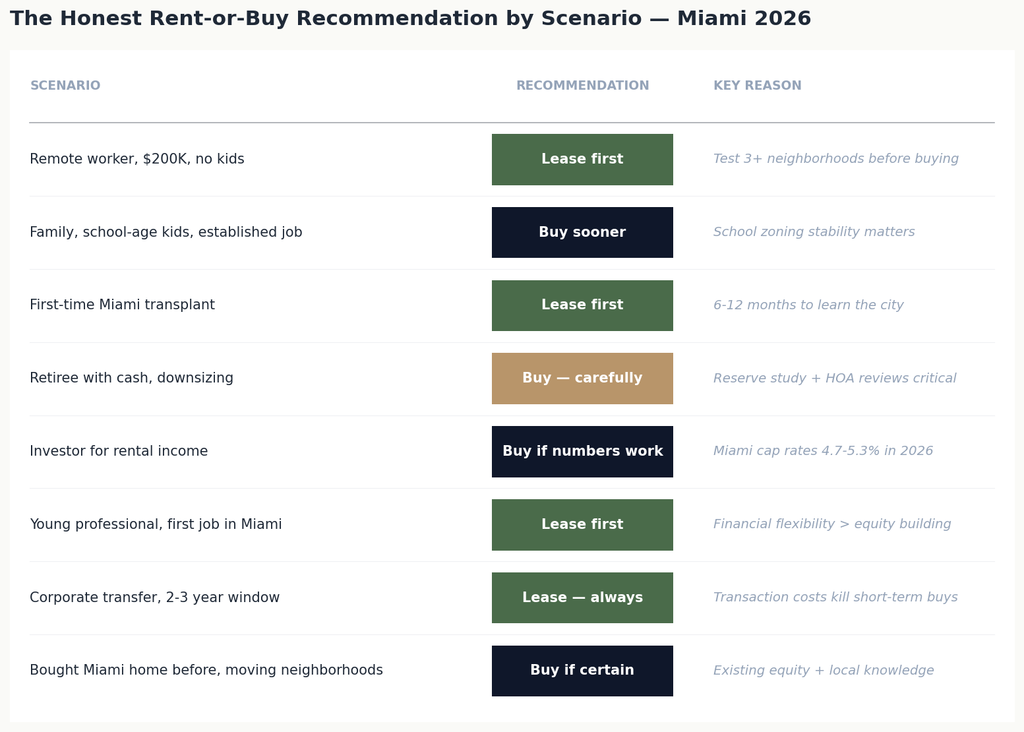
Now let me tell you which specific type of Miami relocation client you are — and what that means for your decision.
Let me walk through each scenario in detail.
Scenario 1: Remote Worker Earning $200K+ with No Kids
Recommendation: Lease first, at least 12 months. You have the least urgency of any relocation client type. Your income is portable, you don't have school-district considerations, and you have time. The single best use of your first Miami year is to actually experience 2-3 neighborhoods and buildings before committing $150K+ of cash to one. The trap: high-income remote workers often assume they can "buy right the first time" because they can afford to. What they can't buy is the ground-truth knowledge of what living in Brickell feels like at 11pm on a Tuesday vs. what Coconut Grove feels like at that same hour. That knowledge is worth more than the difference in closing costs between year 1 and year 2 of your Miami relocation. If you lease first, you also get to be a smarter buyer when you eventually purchase — you'll know what building rules matter, what HOA fees really run, and which specific views and elevations get flood insurance premiums that others don't.Scenario 2: Family with School-Age Kids and an Established Job
Recommendation: Buy sooner, once you've nailed the school district. This is one of the few scenarios where buying quickly can genuinely make sense. School zoning stability matters — you don't want your kids in one district for a year and then having to change schools when you buy in the "right" neighborhood. But the discipline matters even more. Before you buy: confirm the exact address is zoned for the school you want, verify with Miami-Dade Public Schools directly, and understand that boundaries can shift year to year. I've had families relocate for a specific Coral Gables Senior High zoning and then find out the address was actually zoned for a different school. Buying before verifying is how families end up in the wrong school district for the next decade. Once you've done the diligence, buying makes sense because families are the most stable long-term residents — you'll almost certainly be in that home for 5+ years, past the breakeven point where owning wins.Scenario 3: First-Time Miami Transplant (Any Income Level)
Recommendation: Lease first, 6-12 months minimum. If you've never lived in Miami, you don't know Miami. That's not a criticism — it's just true. There are things you can't research online:- What summer humidity actually feels like when you're commuting daily
- How much hurricane season disrupts your specific work routine
- Which neighborhoods have hidden traffic patterns that don't show up on Google Maps
- How specific condo buildings actually behave (loud upstairs neighbors, weekend party culture, deferred maintenance you can't see from a tour)
- Whether the Latin American cultural dimension of Miami is invigorating or isolating for you personally
Scenario 4: Retiree with Cash, Downsizing to Miami
Recommendation: Buy carefully, with obsessive due diligence. Retirees moving to Miami with cash are the group where buying immediately can make sense — but only with meticulous diligence on the building and the neighborhood. The specific things I want retirees to verify before signing anything:- The building's reserve study. Post-Surfside, buildings are required to have reserves for structural work. If reserves are underfunded, you're buying into a future special assessment.
- The 40-year recertification status. Miami-Dade requires buildings to be recertified at 40 years and every 10 years after. Buildings behind on recertification carry meaningful hidden risk.
- The HOA operating budget. Is it sustainable? Are fees increasing 8-10% annually?
- Elder-accessibility features. Ground-floor bedrooms, walk-in showers, elevator reliability, medical facility access.
Scenario 5: Investor Buying for Rental Income
Recommendation: Buy if the numbers work — cap rates, not appreciation. Investors are the other group where buying quickly can make sense. Miami cap rates in 2026 are 4.7% in Brickell/Downtown and 5.3% in outer neighborhoods like Doral or Kendall. If you can find a specific building where the numbers hit your threshold, buy. But don't confuse investment purchases with primary residence purchases. Investment analysis needs:- Real cash flow modeling with realistic vacancy, maintenance, and management fees
- HOA increase scenarios (Miami condo fees are increasing 6-10% annually in many buildings)
- Insurance renewal scenarios
- Exit strategy pricing under different appreciation assumptions
- Understanding that Miami condo inventory is currently at 12 months of supply — this is a buyer's market for condos, so you have leverage
Scenario 6: Young Professional, First Job in Miami
Recommendation: Lease first — usually for 2-3 years. If you're 25-30 and just started your career in Miami, buying is almost never the right move. Not because you can't afford it (some of you can) — but because your life is still forming. Your job may move. Your relationship status may change. Your income will likely grow significantly, which changes what you can afford. And your neighborhood preferences will evolve as you learn Miami. Renting during this phase gives you optionality that's worth more than the equity you'd build. The exception: young professionals with clear multi-year plans, stable relationships, established industries, and specific neighborhoods they've already lived in and know they love. For that subset, buying at this age can work — but it's the minority case.Scenario 7: Corporate Transfer with a Defined 2-3 Year Window
Recommendation: Lease. Always. Not even close. If your company is bringing you to Miami for a fixed 2-3 year assignment, buying is a financial mistake. Every time. The transaction costs alone will consume any appreciation you'd earn, and you'll be a forced seller when your assignment ends — potentially into a slower market, potentially at a loss. The only exception is if your company covers relocation costs both ways and you'd genuinely stay in Miami even if the assignment ends. That's rare. Lease furnished if possible, get your company to cover the premium, and enjoy Miami for what it is: a specific chapter, not a permanent home.Scenario 8: Previous Miami Homeowner Moving Neighborhoods
Recommendation: Buy if you're certain. If you already own in Miami and are moving neighborhoods within the region — say, moving from Brickell to Coral Gables as your family grows — the calculus is different. You have existing equity, you understand Miami-specific ownership dynamics (insurance renewals, HOA behavior, hurricane preparation), and you likely already know the specific neighborhood you're targeting. The main risk here is over-leveraging into the new purchase. Miami-Dade property appreciation has slowed in 2026 — Zillow estimated a 1.6% decline over 12 months in some segments. Rolling equity from one Miami property into another at peak-ish prices carries more risk than it did in 2021.The Deeper Question: What Does Renting First Actually Buy You?
Beyond avoiding transaction cost losses, renting your first year gives you information that no amount of research or touring provides: Neighborhood ground truth. How does Wynwood actually feel at 8am on a Wednesday? Does the causeway commute from Miami Beach genuinely stress you out? Is the Coconut Grove village vibe real or manufactured? You cannot answer these questions from an out-of-state tour. Building-specific intel. Which units flood during king tides. Which floors have the AC problem. Which HOA is well-run vs. dysfunctional. Which specific investment property in your building has an out-of-town owner and rents to short-term guests. This is priceless. Insurance and cost reality. After you've paid a full year of Florida car insurance, Miami utilities in summer, and grocery bills at Publix, you have actual data — not estimates — on what your Miami cost of living really is. Hurricane season experience. Living through one full hurricane season (June-November) tells you whether Miami's climate reality works for you. Some people find it manageable and even exciting. Others find it wears on them in ways they didn't expect. Better to know before you own. Your actual budget for buying. After 12 months in Miami, you'll know what you can genuinely afford — not what a mortgage calculator says you can afford. That difference is often $200-$500K in purchase price.When Renting First Is Genuinely a Mistake
Fair balance. There are specific situations where renting first is actually worse than buying immediately:- Family with kids in a specific school district, where a year of school district uncertainty causes real harm.
- Mortgage rate arbitrage — if you can lock a specific mortgage rate today that will be meaningfully higher in 12 months, immediate buying might beat renting. But this is genuinely rare and requires accurate rate forecasting.
- You're moving into an existing family home — inheriting a Miami property or moving into a spouse's family home. Renting to test isn't relevant.
- You're an established investor with specific inventory identified — buying a building you know because you've analyzed it deeply, and rental income covers your cost.
What I'd Actually Do
Here's my honest recommendation for a typical Miami relocation client — say, a couple in their late 30s moving from another city with $250K household income and no kids yet: Year 1: Lease a 2-bedroom in your top-choice neighborhood ($3,200-$4,000/month). Use the year to actually experience the city. Watch how insurance renewals behave. Learn the neighborhoods your friends actually live in vs. the ones you thought would be right. Year 2: Start seriously looking. By now you know 2-3 buildings you'd genuinely want to own in, you understand HOA dynamics, and you have hard cost data on your Miami lifestyle. Purchase from a position of knowledge, not from a position of urgency. Year 3+: Enjoy your home. Miami rewards long-term owners who bought right — the equity compounds, the tax benefits accrue, and the lifestyle you built around a specific property becomes irreplaceable. That's the pattern I want you in. Not the "buy immediately because you can" pattern. The "buy right because you did the work" pattern.The Honest Bottom Line
Renting first is the right move for most Miami relocation clients. Not because renting is inherently better, but because Miami is a market where the cost of an uninformed purchase is dramatically higher than the cost of a year of rent. The specific exceptions — families needing school stability, retirees with cash and confidence, investors with numbers-based plans — are real. If you're in one of those categories, buying quickly can genuinely make sense. But if you're not — if you're a remote worker, first-time transplant, young professional, corporate transfer, or someone who's just excited about the idea of owning in Miami — the smart play is patience. Lease your first year. Get the knowledge. Then buy with confidence. That's what I'd rather help you do than watch you learn expensive lessons the hard way.Frequently Asked Questions
Should I rent or buy first when moving to Miami? For most relocation clients, renting first for 6-12 months is the smarter move. Miami has high transaction costs (roughly 8-10% total when you factor in commissions, doc stamps, and moving costs), and the cost of buying in the wrong neighborhood or wrong building can easily exceed $50,000 within 2 years. Exceptions include families with school-age kids needing district stability, retirees with cash who have done meticulous building diligence, and investors with numbers-based purchase criteria. How long do I need to own a Miami home before it beats renting? Under 2026 Miami market assumptions ($3,200 starting rent with 3.8% annual increases, $600K purchase at 5.25% mortgage, 4% appreciation), buying beats renting somewhere around year 4. Your specific breakeven can be shorter in top-appreciating neighborhoods like Coral Gables or Coconut Grove, and longer in neighborhoods with more inventory pressure like Downtown Miami or new Edgewater buildings. Plan to stay 5+ years to be safely on the buy-wins side. What does it actually cost to own a $600K Miami condo? Monthly costs typically run $4,900-$5,200/month for a $600K condo with 20% down, including mortgage ($2,650), property tax ($833), homeowners insurance ($233), HOA fees ($700), and maintenance reserve ($500). That's about $1,700/month more than renting a comparable unit in the same building. Miami HOA fees vary widely — from $500 to $2,000+ per month depending on building — and can change year to year. Why is buying and selling within 2 years in Miami almost always a bad idea? Transaction costs on a $600K purchase and sale total roughly $64,000 (closing costs, agent commissions, doc stamps, moving twice), while 2 years of appreciation at 4% only generates about $48,000. That's a net loss of $16,000 before even counting the monthly premium you paid to own vs. rent. Short-term Miami real estate almost never works financially unless you're getting exceptional appreciation. Should families buy right away or lease first? Families with school-age kids and established jobs generally should buy sooner than other client types, because school district stability matters and families are typically long-term residents. The critical step is verifying school zoning at the exact address before making an offer — boundaries can shift year to year, and buying in the wrong district for the school you want is one of the most expensive mistakes in Miami family relocation.Ready to work through the rent-or-buy decision for your specific situation? Our Florida Leasing Process is built specifically for relocation clients using year one to test-drive Miami before committing to a purchase. When you're ready to buy, our Florida Buyers Guide covers what to expect at that stage. If you want to explore specific neighborhoods first, our community guides go into more detail on each area. Either way — I'd rather help you make the honest decision for your specific situation than push you toward a purchase you're not ready for.
Check out this article next