Most Miami commute guides make the same assumption: you'll drive. And to be fair, they're not wrong about most people. Roughly 80% of Miami-Dade commutes still happen by car. If your only frame of reference is driving, the game is neighborhood-picking to minimize rush-hour I-95 exposure. But that framing misses something important that's changed in Miami over the last five years. There are actually five real ways to commute here now — and the neighborhood that's optimal for you looks completely different depending on which one fits your life.
If you're driving, you want to live near your work. If you're taking Metrorail, you want to live near a specific station. If you're commuting to Fort Lauderdale on Brightline, your neighborhood decision is dramatically different. If you're in the Metromover core zone, you can genuinely live car-free downtown. And if you're a walker or biker in one of Miami's six actually-walkable neighborhoods, you can eliminate transportation costs almost entirely. I'm going to walk you through each mode — how it actually works in 2026, which specific neighborhoods it makes sense from, and what the trade-offs look like.
Then you can figure out which mode fits your life and let that drive your neighborhood decision, rather than the other way around. If you're already working through where to live in Miami and want expert guidance, our Florida Relocation Process is designed for exactly this decision. If you're leaning toward leasing your first year to test the commute reality before committing to a purchase, our Florida Leasing Process covers what to expect.
The 5 Miami Commute Modes at a Glance
Here's the full picture of how Miami actually gets around in 2026: 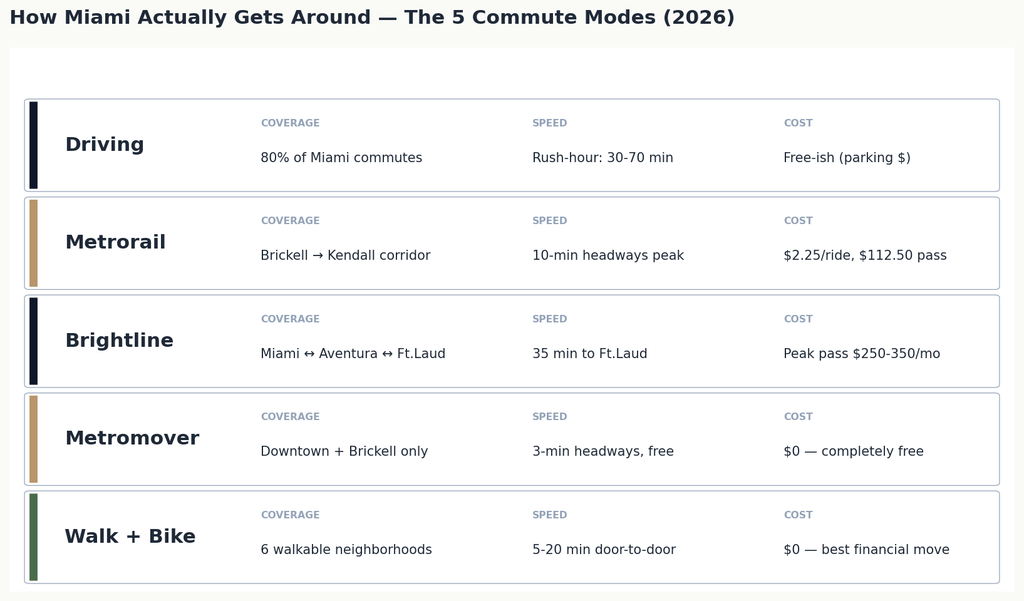 Each of these deserves its own analysis, because the "right" neighborhood depends entirely on which one fits your work situation. Let me go through them one at a time.
Mode 1: Driving — The Default (and How to Do It Right)
What it actually looks like: Miami traffic isn't gradual, it's binary. You either beat rush hour by leaving before 7:30 AM (or after 9:30 AM), or you sit in it. Same afternoon: leave before 4 PM or after 6:30 PM. There's very little in-between. Weather compounds it — a 20-minute afternoon thunderstorm can back up major arteries for two hours. Average Miami car ownership runs about $700/month all-in (insurance, gas, maintenance, depreciation, parking), per AAA. Miami car insurance specifically runs 50%+ above the Florida state average. Where to live if you're driving:
- If you work in Brickell/Downtown: Live in Brickell itself (walk to office), Edgewater (15-20 min rush hour), Coconut Grove (15-20 min), or Coral Gables (18-25 min). Avoid Aventura (45+ min) and Miami Beach (25-55 min with causeway variability).
- If you work in Coral Gables/UM/Baptist Hospital: Coral Gables itself, Coconut Grove, South Miami, or Pinecrest. Avoid Miami Beach, Aventura, and Doral.
- If you work in Doral or near the airport: Doral itself, Coral Gables (25 min), or Miami Springs. Avoid coastal neighborhoods.
- If you work in Miami Beach: Live on Miami Beach itself. Trying to commute across a causeway daily is a specific kind of self-inflicted stress.
The critical driving insight most transplants miss: rush-hour time swings by 30-40 minutes each way based on when you leave. If you have any schedule flexibility, that alone is worth more than any specific neighborhood choice. Hybrid workers with 2-3 remote days can absorb a longer commute much more comfortably than 5-day-in-office workers.
Mode 2: Metrorail — Miami's Actual Rapid Transit Corridor
Most transplants don't realize Miami has legitimate rapid transit. Metrorail is a 25-mile elevated heavy-rail system with 23 stations, 10-minute peak headways, and $2.25 per ride or $112.50/month for unlimited use. 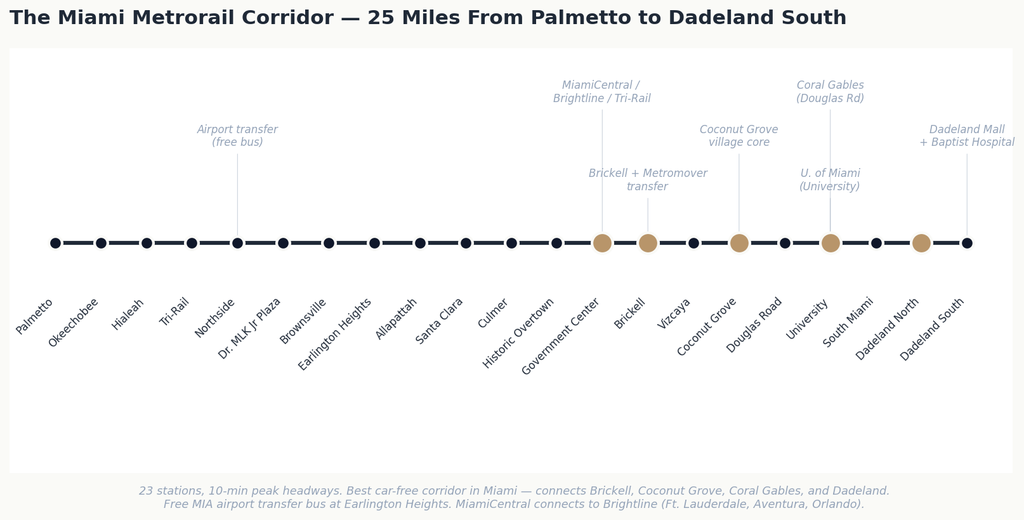 The line runs north-south, connecting Palmetto and Hialeah in the north through Downtown Miami and Brickell down to Coconut Grove, Coral Gables (Douglas Road station), the University of Miami, and Dadeland Mall in the south. Where to live if Metrorail fits your commute:
- Brickell station — Live in Brickell itself. You walk to Metrorail and Metromover simultaneously, plus you're in the financial district's walkable core.
- Coconut Grove station — Live in the Coconut Grove village core. Walk to Metrorail, walk to the marina, walk to restaurants. This is one of the best car-optional lifestyles in Miami.
- Douglas Road station (Coral Gables) — Live in Coral Gables. The station is at Ponce de Leon and Douglas, walkable to Miracle Mile and the residential core.
- University station — Live in the UM/Coral Gables edge. Walkable to campus, hospitals, and shopping.
- Dadeland North/South stations — Live in Kendall near Dadeland. You can commute to Downtown or Brickell without dealing with US-1 traffic.
Why Metrorail matters more than transplants realize: If both your home and your work are near stations, you can genuinely live in Miami without a car. That saves roughly $8,400/year in car ownership costs, plus the mental cost of Miami rush-hour driving. For young professionals, first-year transplants testing the city, or anyone who values reading time in the morning, this is a real quality-of-life win. The catch: Metrorail is a single corridor. If your work is off the corridor (Miami Beach, Doral, Aventura, most of Kendall, Homestead), Metrorail doesn't help you. The connection you should know about: Metromover connects to Metrorail at Government Center and Brickell stations, extending your car-free range through all of Downtown Miami and the entire Brickell area.
Mode 3: Brightline — The Fort Lauderdale Corridor Game-Changer
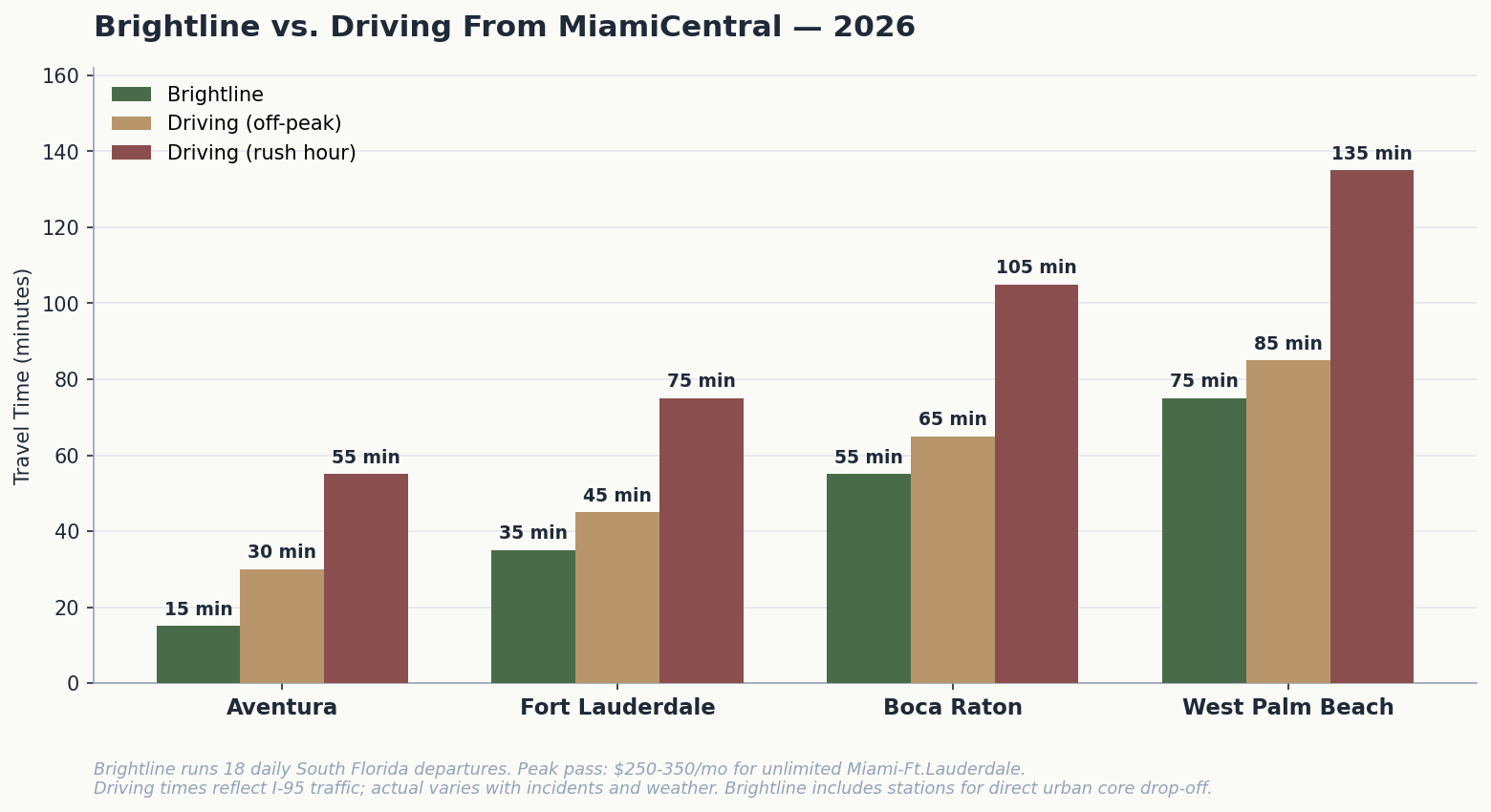
This is the mode almost no one factors into their Miami neighborhood decision, and that's a mistake. Brightline is a legitimate high-speed rail service (up to 130 mph) connecting Miami's MiamiCentral station to Aventura, Fort Lauderdale, Boca Raton, West Palm Beach, and Orlando. As of the October 2025 schedule change, it runs 18 daily South Florida departures with fixed peak/off-peak commuter pricing. 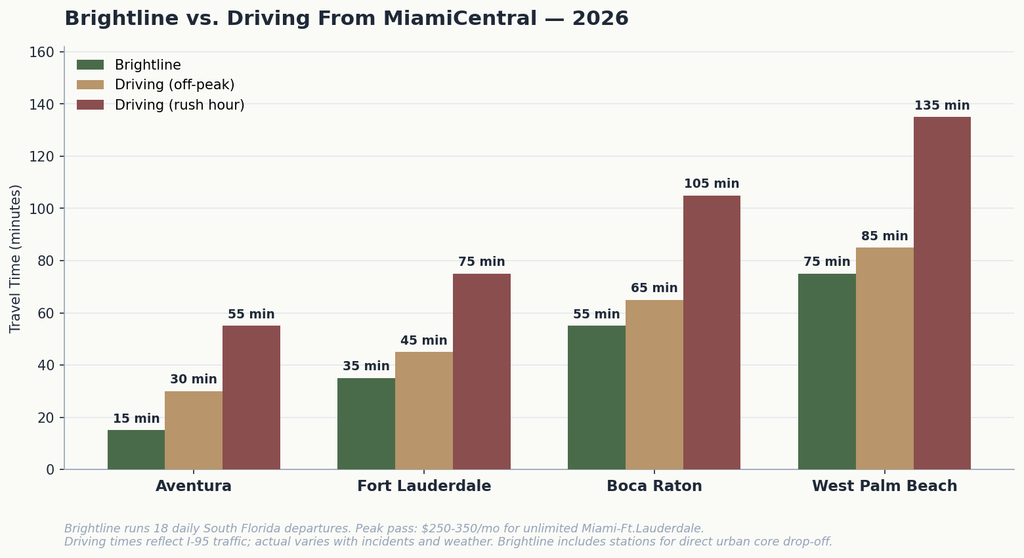 Why this matters for Miami neighborhood decisions: If you work in Fort Lauderdale but want to live in Miami, Brightline changes everything. The 35-minute Miami-to-Fort Lauderdale ride is faster than most Miami cross-town driving commutes. A monthly peak pass runs $250-350 for unlimited Miami-Fort Lauderdale trips. That's dramatically cheaper than the daily fuel + wear + parking cost of driving I-95, plus you get 35 minutes each way to read, work, or sleep instead of white-knuckling through traffic. Where to live if you're commuting on Brightline:
- Downtown Miami / Park West — Walk to MiamiCentral. This is the ideal Brightline-commuter neighborhood.
- Brickell — Metromover to Government Center → 2-minute walk to MiamiCentral. Adds ~5 minutes to your commute vs. living Downtown.
- Wynwood-Edgewater — Bike or Uber to MiamiCentral (10-15 min). Not as tight as Downtown but works well.
- Aventura — Live near the Aventura Brightline station. If your work is in Ft. Lauderdale, this puts you 15 minutes from the office by train.
The financial calculus: Brightline monthly commuter passes ($250-350) plus the cost of getting to/from stations still comes in dramatically cheaper than car ownership plus daily I-95 tolls plus parking in Fort Lauderdale. For anyone whose work is in Fort Lauderdale or points north, Brightline should be seriously evaluated before assuming you need to live in Broward. The Aventura-Brightline arbitrage: This is a genuinely underrated Miami relocation play. Aventura offers turnkey condo living at meaningfully lower prices than Miami's core, and the Brightline station puts you 15 minutes from Fort Lauderdale and 35 minutes from Miami's downtown. Retirees and semi-remote workers with occasional Broward business have quietly discovered this over the last two years.
Mode 4: Metromover — Downtown Miami's Free Circulator
Metromover is one of Miami's genuine treasures that most transplants completely overlook. It's a free, fully automated elevated people mover with 21 stations across Downtown Miami, Brickell, Park West, and the Arts & Entertainment District. Trains run every 3 minutes during peak hours. It's completely free — no fare, no card, no app required. Where Metromover matters:
- Brickell residents — You can move throughout Brickell without walking or driving. Free.
- Downtown Miami residents — Same. Complete Downtown coverage on foot alternative.
- Anyone working in Downtown Miami without a Downtown home — Take Metrorail to Government Center, transfer to Metromover, get to your specific building without touching a car.
Where to live if Metromover is your primary mover: Any building within a 5-minute walk of a Metromover station — which covers most of Brickell, all of Downtown, Park West, and Arts & Entertainment. That's genuinely dozens of condo and rental options at every price point. The Metromover isn't a full commute system — it's a Downtown circulator. But combined with Metrorail (for corridor travel) and walkability (for the last mile), it makes car-free living genuinely viable in the Downtown/Brickell/Park West triangle. The tax-free ride matters more than you'd think: Over a year of daily commuting, saving even $2-3 per trip on transit adds up to $500-750/year. Metromover eliminates that entirely for anyone doing Downtown-to-Brickell trips.
Mode 5: Walk + Bike — Miami's Underrated Car-Optional Neighborhoods
This is the mode I most want relocation clients to understand, because it's the one that saves the most money and radically changes what "living in Miami" feels like. Miami is the 6th most walkable large city in the U.S. That's not a boast — that's Walk Score data. Six specific neighborhoods offer genuinely car-optional living. 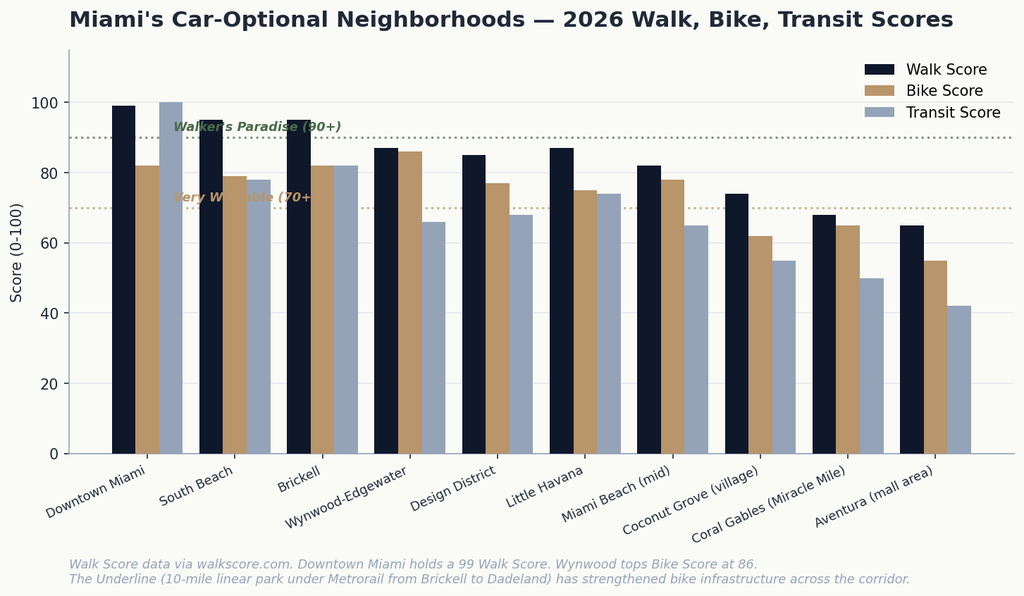 The car-optional neighborhoods, ranked:
- Downtown Miami — Walk Score 99. Miami's most walkable neighborhood, period. Plus the Metromover, plus Metrorail transfer at Government Center. If you can accept a residential feel that's still evolving, this is genuinely car-free living at Miami prices.
- South Beach — Walk Score 95. Ocean, restaurants, gyms, groceries, nightlife all within walking distance. If you don't need to commute to the mainland daily, this is one of the best walkable lifestyles anywhere in Florida.
- Brickell — Walk Score 95. Financial district walkability plus every amenity in your building. Corporate transplants without cars regularly live here for years without buying one.
- Wynwood-Edgewater — Walk Score 87, Bike Score 86 (highest in Miami). The creative district's warehouse conversions plus the newer residential inventory make this an excellent walk/bike hub.
- Design District — Walk Score 85. Smaller residential inventory than the others, but the walkability itself is real.
- Little Havana — Walk Score 87. The value play — significantly lower rents than the coastal neighborhoods with real walkability if you can navigate the cultural adjustment.
The Underline — Miami's linear park game-changer: Under the Metrorail line from Brickell to Dadeland (10 miles total), Miami has built a dedicated bike and pedestrian corridor called The Underline. This has made bike commuting from Coral Gables, Coconut Grove, and the University area to Brickell genuinely practical for the first time. If you're a bike commuter or bike-curious, this changes your calculation on the southern corridor neighborhoods entirely. Where to live if walking/biking is your primary mover: For pure walking: Downtown, South Beach, Brickell, or Wynwood. For biking + walking hybrid: Wynwood-Edgewater, Design District, or any neighborhood along The Underline corridor (Coconut Grove village, Coral Gables near Douglas Road, near any Metrorail station). The financial reality: Eliminating a car in Miami saves roughly $8,400/year in ownership costs plus another $2,000+ in parking, tolls, and depreciation. That's $10,000/year that can go to rent premium, savings, or investment. Over 10 years, that's $100,000+ — enough to change what price point you can afford when you eventually buy.
The Mode-to-Neighborhood Matching Framework
Let me pull this together into a decision framework. If your work is in Brickell/Downtown and you drive: Live Brickell, Edgewater, Coconut Grove, or Coral Gables. If your work is in Brickell/Downtown and you want car-free: Live Brickell (walk + Metromover), Downtown (walk + Metromover), or anywhere along Metrorail (Coconut Grove, Coral Gables at Douglas Road, University, Dadeland). If your work is in Coral Gables/UM/Baptist Hospital corridor: Live Coral Gables, Coconut Grove, South Miami, or Pinecrest (if you drive). Metrorail options exist but the corridor doesn't perfectly serve every hospital location. If your work is in Miami Beach: Live on Miami Beach itself. Fighting the causeway daily is a losing game. South Beach specifically is walkable and works well. If your work is in Doral/Airport/West Miami-Dade: Live in Doral or Coral Gables. Metrorail can help via airport transfer if you're at MIA specifically. If your work is in Fort Lauderdale: Use Brightline. Live near MiamiCentral (Downtown, Brickell) or the Aventura Brightline station. If your work is in West Palm Beach or Boca Raton: Brightline still works, but daily 75-minute-each-way rides get tiring. Consider whether living in Broward or Palm Beach County with occasional Miami trips makes more sense than the reverse. If your work is remote: Choose based on lifestyle preference. Coconut Grove, Coral Gables, and Wynwood-Edgewater lead for most remote workers because the neighborhood quality-of-life matters more than commute optimization.
What Most Miami Transplants Get Wrong About Commuting
Three common mistakes I see relocation clients make:
1. They optimize for their initial job without considering job changes. If you take a job in Brickell but plan to be in Miami for 10+ years, your next job may not be in Brickell. Metrorail-adjacent neighborhoods (Coconut Grove, Coral Gables, near Downtown) preserve commute flexibility better than neighborhoods that only work for one specific job location. 2
. They underestimate Miami Beach causeway variance. People assume "20 minutes to Brickell" from Miami Beach and it can hold true off-peak. Then a boat gets stuck under the drawbridge or an accident happens on the causeway and you're two hours late for a meeting. Every Miami Beach resident has this story. Factor it into your neighborhood decision if daily mainland commuting matters.
3. They dismiss Metrorail and Brightline because "no one takes transit in Miami." That's changing rapidly. Metrorail carries 50,300 weekday riders. Metromover carries 25,600 daily. Brightline has become a genuine commuter service for Miami-Fort Lauderdale professionals. The stigma is outdated; the utility is real.
How I Help Clients Match Commute to Neighborhood
When I'm walking a relocation client through this, we do a few specific things:
We test-drive the actual commute at real rush hour. Not what Google Maps predicts — the actual drive from the actual property at the actual time you'll do it daily. This has changed more client decisions than any research ever will.
We ride the Metrorail and Brightline together if either is potentially relevant. Fifteen minutes on a transit system tells you more than fifteen minutes of research.
We think about the 3-year job trajectory, not just the current one. Where might you actually work in year 3? Which neighborhood serves both your current and likely future commute?
We often recommend leasing your first year specifically to test commute reality. A 12-month lease in your target neighborhood exposes you to every day of Miami traffic, one hurricane season of weather disruption, and the actual pattern of your work schedule. That's the best investment you can make before buying. Our Florida Leasing Process is built around exactly this test-drive framing.
The Honest Bottom Line
The best Miami neighborhood for your commute isn't a single answer — it depends on which of the five commute modes fits your life. If you're driving to Brickell, you have obvious choices. If you're taking Metrorail or Metromover, your choices change completely. If you're using Brightline to Fort Lauderdale, Downtown or Aventura suddenly become optimal. If you're walking or biking, the six car-optional neighborhoods each offer a different lifestyle at very different prices. Most transplants pick their neighborhood first and figure out the commute later. That's backwards. Pick your commute mode first — the one that fits your work, your income, and your quality-of-life priorities — then let that determine where you live. That's the conversation I want to have with you before you sign a lease or write an offer. Not "which is the best neighborhood" — but "which commute mode fits your life, and which neighborhood serves that mode best."
Frequently Asked Questions
How do most people commute in Miami? Roughly 80% of Miami-Dade commutes happen by car. But five real commute modes exist: driving, Metrorail (Miami's 25-mile heavy rail corridor), Brightline (high-speed rail to Fort Lauderdale/Aventura/Boca Raton/West Palm Beach/Orlando), Metromover (free Downtown circulator), and walking/biking in six genuinely car-optional neighborhoods. Which mode fits your life should drive your neighborhood decision, not the other way around.
Can you live in Miami without a car? Yes, in specific neighborhoods. Downtown Miami (Walk Score 99), South Beach (95), Brickell (95), Wynwood-Edgewater (87, top Bike Score at 86), Design District (85), and Little Havana (87) all support genuinely car-free living. Metrorail extends the car-free zone to Coconut Grove, Coral Gables (near Douglas Road station), University area, and Dadeland. Eliminating car ownership saves roughly $10,000/year in Miami.
What's the best Miami neighborhood if you take Metrorail? Brickell (walk to station + Metromover transfer), Coconut Grove (village core walkable to station), Coral Gables (Douglas Road station is walkable to Miracle Mile), University area (walkable to campus and station), and Dadeland (walkable to two stations near Baptist Hospital and Dadeland Mall). All these neighborhoods let you commute car-free along the Metrorail corridor.
Does Brightline work as a Miami commuter train? Yes, especially for Miami residents working in Fort Lauderdale, Aventura, Boca Raton, or West Palm Beach. The Miami-to-Fort Lauderdale trip runs 35 minutes with 18 daily South Florida departures. Monthly commuter passes cost $250-350 for unlimited South Florida travel. The Aventura station specifically has become a strategic living location for anyone with Broward County work.
Which Miami neighborhoods are most walkable? Downtown Miami (Walk Score 99), South Beach (95), and Brickell (95) top the list. Wynwood-Edgewater, Design District, and Little Havana all rate 85+. Miami is officially the 6th most walkable large city in the United States per Walk Score data.
Ready to work through which Miami commute mode fits your life and which neighborhood serves it best? Our Florida Relocation Process is designed for exactly this decision. If you're leaning toward leasing your first year to test commute reality before committing, our Florida Leasing Process covers what to expect. When you're ready to buy near a specific station or in a specific walkable neighborhood, our Florida Buyers Guide walks through what changes at that stage. For deeper neighborhood-by-neighborhood information, our community guides go into more detail on each area. Either way — I'd rather help you match commute to neighborhood upfront than watch you learn the hard way after a lease you regret.
Check out this article next