Moving to Miami: The Honest Pros, Cons, and Trade-Offs
I want to have a different kind of conversation with you than most real estate content does. Most articles about moving to Miami either sell you the dream (beaches, tax savings, “it’s paradise!”) or they scare you off with worst-case scenarios (hurricanes, insurance nightmares, sea level rise). Neither is honest. The truth is more useful than either extreme: Miami is a real place with real trade-offs. It offers some genuine advantages you can’t find anywhere else in the country — and some real costs that get glossed over in the sales pitch. Whether it’s the right move for you depends entirely on whether the specific trade-offs make sense for your specific life. I have this conversation with almost every relocation client. Some of them stay and love it. Some of them leave after two years because the trade-offs weren’t what they thought. What separates the two groups isn’t luck — it’s how honestly they thought about the balance sheet before they moved. So let me walk you through the actual balance sheet. Every pro I mean it. Every con I mean it. No sugar coating, no scaremongering. If you’re already thinking through this decision, our Florida Relocation Process is designed to work through exactly these trade-offs before you commit. Or if you want to explore how specific neighborhoods weigh against your priorities first, our community guides go deeper on that piece.The Balance Sheet, Up Front
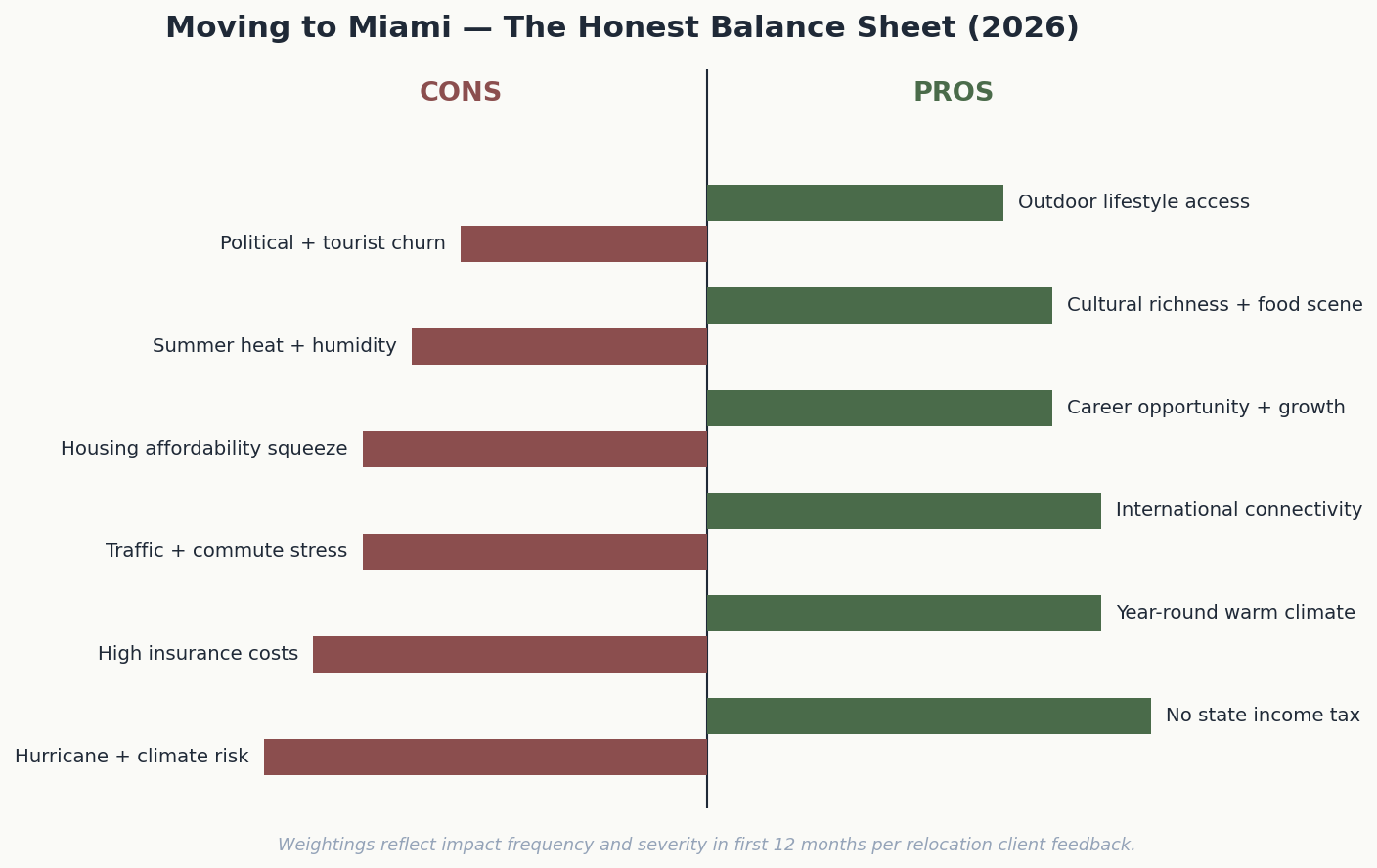
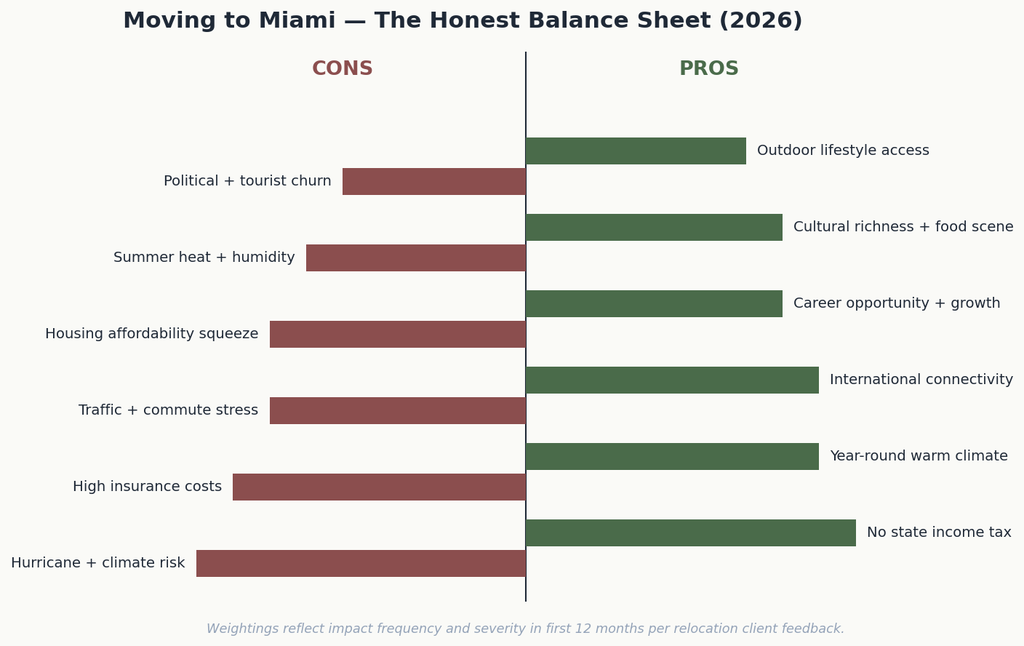 Here’s how I actually weight the pros and cons based on what I’ve seen matter most to relocation clients in their first 12 months here. Notice something: the top pro and the top con are roughly the same weight in my experience. That’s not an accident. Moving to Miami isn’t a slam dunk in either direction. It’s a real trade — you’re getting genuine benefits and paying genuine costs, and whether the trade makes sense depends on which side of the balance sheet hits home harder for you personally. Let me break each side down.
The Real Pros of Moving to Miami
1. No State Income Tax — But Only If You Actually Move Here
This is the single biggest financial advantage of Miami over most origin cities, and it’s real.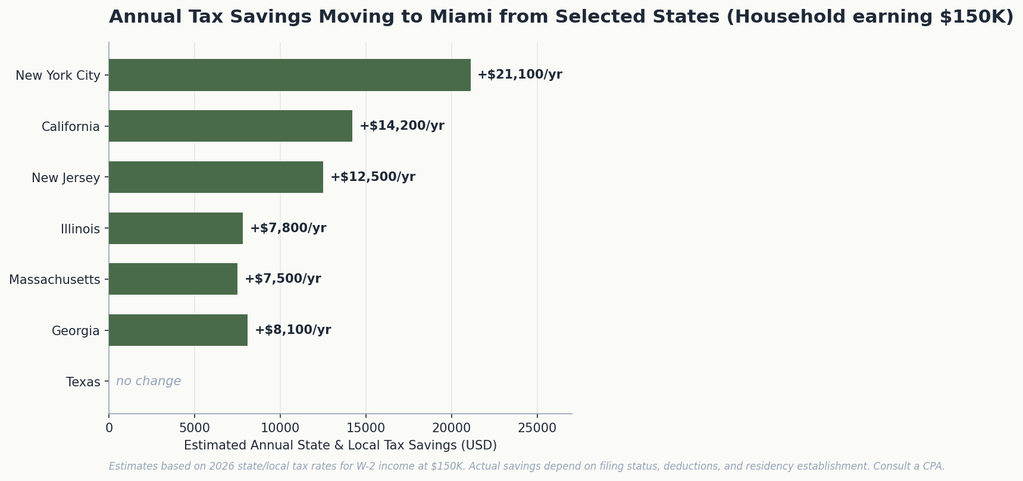 A household earning $150K captures somewhere between $7,500 and $21,100 in annual tax savings by moving from a high-tax state to Florida — depending on where you’re coming from. From NYC, it’s dramatic. From Texas, there’s no benefit (Texas also has no state income tax). If you’re moving from a state without income tax already, this pro doesn’t apply to you. The catch: owning Florida property doesn’t establish Florida residency. States you’re leaving — particularly New York and California — get aggressive about auditing high earners who claim they moved. Real Florida residency means spending the majority of the year here, registering vehicles here, voting here, shifting your primary financial and family life here. If you’re maintaining a home in your origin state and only spending the winter in Miami, expect scrutiny. I always tell clients: talk to a CPA before moving for tax reasons, and get the paperwork right in year one. The savings are real. The savings-with-an-audit are not fun.
2. Year-Round Warm Climate
Miami’s climate is genuinely different from anywhere else in the continental U.S. You’re outdoors 12 months a year. December mornings are t-shirt weather. There’s no winter blues, no shoveling, no coats. For clients coming from Northeast or Midwestern cities, this is often the single quality-of-life shift they underestimate the most — in a good way. Six months in, they’ll tell me they had no idea how much the northern winter was affecting them until they didn’t have to deal with it anymore. The catch: August and September are brutal. Not “hot” — brutal. 90°F+ with 90% humidity for weeks at a time, plus hurricane season on top. I’ll get to the summer heat in the cons section, but the year-round climate pro is genuine as long as you understand it’s not evenly distributed across the calendar.3. International Connectivity
Miami International Airport is a genuine strategic advantage — direct flights across Latin America, the Caribbean, Europe, and every major U.S. hub. If your work or family involves international travel, Miami removes hours of connections from your life. The city’s cultural connection to Latin America runs even deeper than the airport. If you have business, family, or cultural ties to Central and South America or the Caribbean, no other U.S. city compares. This isn’t just “diversity” — it’s a functional advantage for a specific kind of life and business.4. Career Opportunity and Business Growth
Miami has quietly become one of the most active business markets in the country. Google, Microsoft, Citadel, Palantir, Blackstone — the list of major firms expanding here since 2020 keeps growing. Tech, finance, venture capital, and international trade all have genuine centers of gravity now. For entrepreneurs, remote workers, and people in industries that value network density, Miami offers real professional infrastructure that didn’t fully exist 10 years ago. Business events, investor networks, and hiring markets have all deepened significantly. The catch: if you work in an industry with limited Miami presence — heavy manufacturing, certain government sectors, some parts of tech — you may be trading one strong job market for a weaker one. Do the real check on your specific field before you assume the career pro applies to you.5. Cultural Richness and Food Scene
Miami’s food scene is genuinely among the best in the country now — up there with New York, LA, and San Francisco for the depth and international range of what’s available. Cuban, Colombian, Peruvian, Argentine, Haitian, Israeli, Japanese, and pan-Latin fusion cuisine all thrive here at price points from taco truck to Michelin. The cultural scene extends past food into music, dance, arts, and neighborhood identity. Every part of Miami has a distinct personality — Little Havana feels nothing like Coconut Grove which feels nothing like Aventura. That variety is a real quality-of-life gain if you value cultural immersion.6. Outdoor Lifestyle Access
Boating, fishing, beaches, marinas, parks, biking, kayaking, waterfront dining — Miami’s built for outdoor life in a way most U.S. cities aren’t. Even in urban Brickell, you’re 10 minutes from Biscayne Bay. In Coconut Grove and Key Biscayne, water access is part of daily life. If your lifestyle values being outside — or you want it to — Miami delivers year-round in a way that even other warm-climate cities (LA, Phoenix, Dallas) can’t quite match.The Real Cons of Moving to Miami
Now the honest side. If a real estate advisor won’t tell you these things upfront, you should be suspicious.1. Hurricane and Climate Risk
This is the con I take most seriously with clients, because most people underweight it.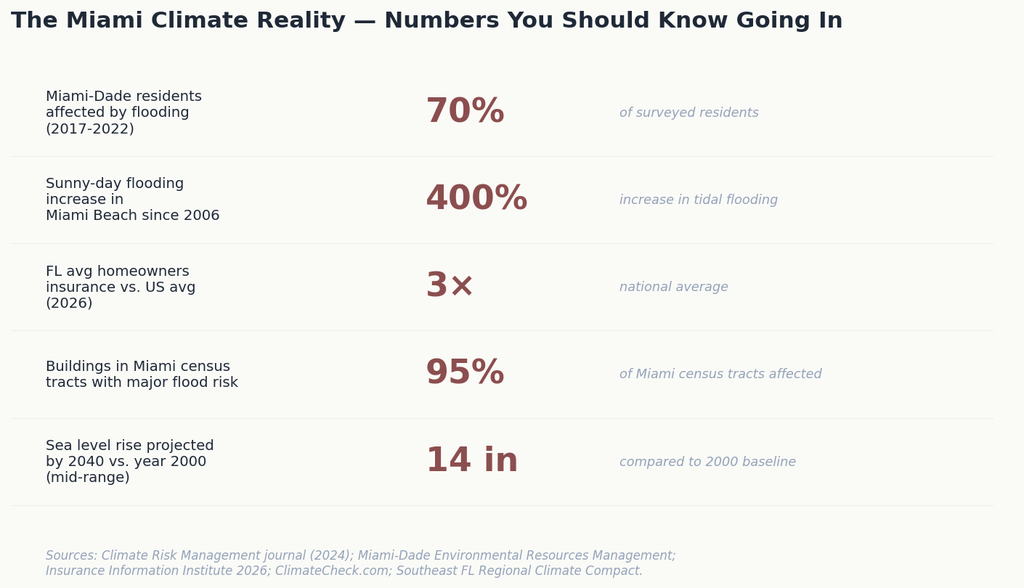 The numbers are what they are. About 70% of Miami-Dade residents surveyed reported being affected by flooding between 2017 and 2022. Sunny-day tidal flooding in Miami Beach is up over 400% since 2006. 95% of Miami census tracts have buildings with significant flood risk. Sea level in Southeast Florida is projected to be 10-17 inches higher than 2000 levels by 2040. None of this is speculation. This is Miami-Dade County’s own data, published in official documents. What it means practically: hurricane season is a real annual event that requires planning. Insurance costs are the highest in the country and driven partly by these risks. Flood zones affect financing, insurance, and long-term property values. Specific neighborhoods and specific buildings have very different risk profiles. Not every part of Miami is equally exposed — Coral Gables and Pinecrest sit at higher elevations, some Brickell high-rises are engineered above surge levels, others aren’t. This is why the property-specific insurance quote and flood zone check matter more here than almost anywhere else in the country. If you’re 30 years old and buying, you’re taking on 30 years of climate exposure. If you’re 65 and buying, you’re taking on 20. It’s not a reason to skip Miami, but it’s not a reason to pretend it doesn’t exist either.
2. High Insurance Costs
Directly tied to the climate risk above. Florida homeowners insurance now averages roughly 3× the national average. Miami-Dade coastal homes routinely land in the $6,000–$10,000+ per year range. Car insurance runs 50%+ above the Florida state average in Miami. HO-6 condo insurance adds another $1,800–$2,800 per year on any condo purchase. There’s some good news — after years of increases, 2026 is the first year the trend actually bent. Citizens filed rate cuts. New carriers re-entered the market. But “getting less expensive” and “cheap” are different things. If you’re comparing Miami-Dade to Ohio, you’re still paying 3-4x on insurance alone. Practical impact: insurance can and does make individual properties uninsurable or unfinancable. Getting quotes on specific addresses during due diligence — not general averages — is non-negotiable here.3. Traffic and Commute Stress
Miami traffic is different from bad traffic in other cities. It’s not gradual; it’s binary. You either beat rush hour by leaving before 7:30 AM (or after 9:30 AM), or you sit in it — 30 minutes for what should be a 12-minute drive. Weather compounds it. A 20-minute afternoon thunderstorm can back up major arteries for two hours. Accidents on the causeways can trap Miami Beach residents on the mainland for hours. For hybrid workers with flexible schedules, this is manageable. For anyone locked into a fixed 9-to-5 in-office job with rush-hour commuting, expect an extra 45-60 minutes of daily driving stress you didn’t have in most origin cities.4. Housing Affordability Squeeze
Miami’s cost of living sits about 21% above the national average, and housing is the primary driver — Miami-Dade’s median home price runs north of $573,000, average rent is $2,753, and condo HOA fees now median above $1,900 a month in high-rises. For higher-income relocators from expensive coastal cities, this may still be a step down. For anyone moving from a middle-cost or lower-cost market, Miami will feel expensive fast. Here’s the honest comparison: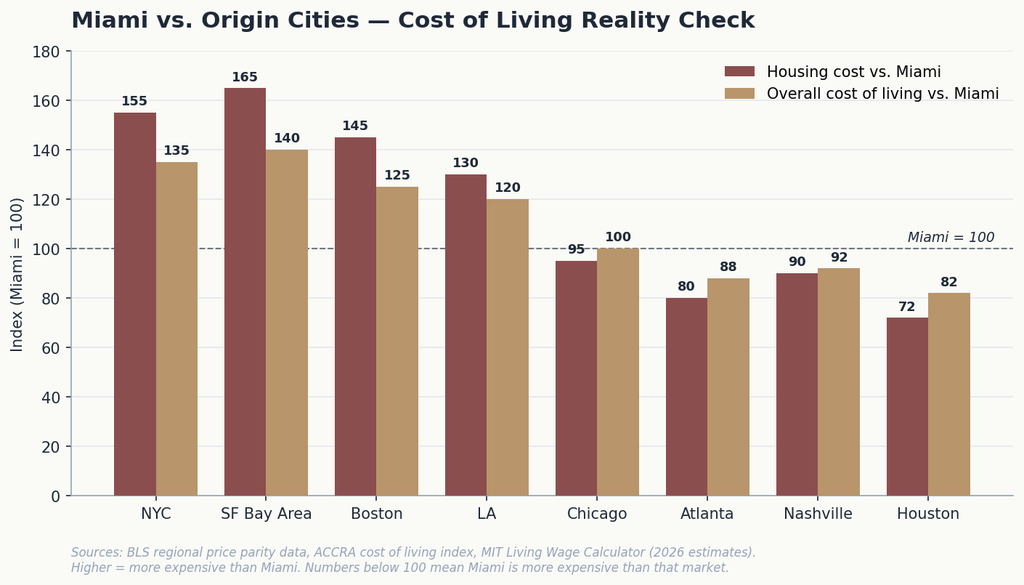 If you’re moving from NYC, SF, Boston, or LA, Miami is still cheaper overall — the tax and housing savings are real. If you’re moving from Chicago, Miami is a wash. If you’re moving from Atlanta, Nashville, or Houston, Miami will feel like a step up in cost you may or may not have budgeted for. I’ve written more on this in The Real Cost of Living in Miami — but the short version: run the specific numbers on your specific situation before assuming Miami will feel affordable.
5. Summer Heat and Humidity
I mentioned this in the pros section too, because it cuts both ways. May through October in Miami is genuinely difficult if you’re not adapted to it. Not just hot — the combination of temperature and humidity creates a physical stress most Americans have never experienced. Air conditioning becomes not a comfort but a survival tool. Electric bills spike. Outdoor time gets restricted to mornings and evenings for months. Most people adapt. Some don’t. And nearly every relocation client I’ve worked with tells me the first Miami summer was harder than they expected.6. Political and Tourist Churn
Miami’s a transient city. People come, people go — and it can be harder to build lasting community than in cities where people stay for decades. Some neighborhoods feel especially transient (South Beach, parts of Brickell), while others feel more rooted (Coral Gables, Coconut Grove). The tourist economy also affects daily life differently in different neighborhoods. Miami Beach in Spring Break week is one experience; Miami Beach in September is another. Some neighborhoods absorb tourism seamlessly; others feel dominated by it during peak seasons. The political climate is also more polarized here than in many origin cities — Miami-Dade politics has shifted rightward significantly in recent years, and Florida state politics may or may not align with what you’re used to. This is neither a pro nor a con inherently — it’s just a factor most relocators don’t think about until they’re paying attention to local news.The Trade-Offs That Actually Matter (In My Experience)
When I distill client conversations down to the trade-offs that actually determine whether people are happy here after 2-3 years, three come out on top: Trade-off #1: Financial upside vs. hidden costs. You’re likely saving on state income tax and paying more on insurance, HOA, and daily living costs. Whether the net is positive depends heavily on your income level (higher = better) and where you’re coming from. Do the actual math on your actual situation before you move. Trade-off #2: Weather quality vs. climate risk. You’re gaining nine months of extraordinary weather and losing three months to brutal heat and hurricane season — plus taking on long-term climate exposure that will affect insurance, financing, and property values over time. This trade only makes sense if you weight lifestyle now and can absorb risk later. Trade-off #3: Career opportunity vs. commute and lifestyle friction. Miami’s business market has never been stronger, but daily life friction (traffic, insurance, HOA drama) is higher than most cities. This trade works for entrepreneurs, remote workers, and higher earners; it works less well for lower-paid, in-office workers who bear the friction without capturing the upside. Most people who thrive in Miami are on the right side of two out of three of these trades. Most people who leave after a few years are on the wrong side of two out of three.Who Miami Is Genuinely Great For
Based on the relocation clients I’ve worked with, these are the profiles that thrive here:- High-income remote workers — they capture the tax arbitrage, avoid the commute, and can afford the insurance and housing costs without stress.
- Entrepreneurs and business owners — the network density, tax environment, and international connectivity all compound.
- Families with school-age kids in the right neighborhoods — Coral Gables, Coconut Grove, and Pinecrest deliver a genuinely excellent family lifestyle when the budget supports it.
- Retirees with financial resources — the healthcare access, year-round outdoor life, and no state income tax on retirement income work well.
- Anyone with strong Latin American cultural or business ties — no other U.S. city compares.
Who Miami Probably Isn’t Great For
The honest counterpoint:- Fixed-income households at mid-to-lower incomes. Miami’s cost structure will squeeze you, and the tax advantages don’t offset it below certain income levels.
- People who need lots of walkable green space. Miami’s urban neighborhoods are walkable but hardscape-heavy. If you need trees and parks for daily well-being, only Coconut Grove and parts of Coral Gables really deliver.
- Anyone with severe heat intolerance. Summers are genuinely difficult, and no amount of AC fully substitutes for being able to spend time outdoors year-round.
- People who want deep-rooted community. Miami’s transience makes some communities feel superficial. This isn’t universal — some neighborhoods are exceptions — but it’s a real pattern worth acknowledging.
- In-office workers with rigid 9-to-5 schedules from lower-cost markets. The traffic, cost of living, and lack of tax offset can add up to a worse quality of life than what you had before.
How I Actually Help Clients Work Through This
If you’re seriously considering Miami, this is what the real conversation looks like when I’m walking someone through the decision: We map your specific pros and cons, not the generic ones. Your income level, industry, family situation, and origin city all change which items on this list matter most. We test the biggest cons against real properties. Insurance quotes on specific addresses. Commute drives at real rush hour. HOA reserve studies on specific buildings. This is where the abstract trade-offs become concrete decisions. We often recommend leasing first for exactly this reason. A 12-month lease gives you the real Miami experience — one hurricane season, one summer, one full year of insurance and traffic and lifestyle friction — before you commit to a purchase. Our Florida Leasing Process is built around exactly this idea. We keep the buying conversation honest. Some clients discover after a year that Miami isn’t the right long-term home. That’s a legitimate outcome. Better to learn it in a lease than to be locked into a purchase you regret.The Bottom Line
Miami is not the paradise the sales pitch makes it out to be. It’s also not the sinking, storm-ravaged nightmare that other narratives sometimes suggest. It’s a real city with a specific set of trade-offs. If those trade-offs match your specific life, Miami is one of the most rewarding places to live in America. If they don’t, no amount of sunshine and no state income tax will make up for the friction. The honest question isn’t “Is Miami a good place to live?” It’s “Are the specific pros and cons of Miami the right trade for me right now?” That’s a question I’d rather help you answer clearly upfront than watch you learn the hard way six months in.Frequently Asked Questions
Is Miami actually a good place to live in 2026?
For the right person, yes. For the wrong person, no. Miami works genuinely well for high-income remote workers, entrepreneurs, families with means, retirees with resources, and anyone with Latin American ties. It’s a poor fit for lower-income households, people with heat sensitivity, in-office workers on rigid schedules, and anyone who prioritizes deep-rooted community.Is Miami cheaper than New York or California?
Overall cost of living is roughly 25-30% cheaper than NYC or SF for a comparable lifestyle, and the no-state-income-tax adds significant savings on top for high earners. But housing, insurance, and everyday costs are still expensive by U.S. standards, and Miami is significantly more expensive than most Southern markets like Atlanta, Nashville, or Houston.How bad is hurricane risk really?
It’s a real annual risk that requires planning, but with modern building codes, proper insurance, and neighborhood/building selection, it’s manageable. About 70% of Miami-Dade residents reported flooding impacts between 2017-2022 per Climate Risk Management journal data. Some neighborhoods and buildings are far more exposed than others — this is a property-specific and location-specific risk, not a blanket one.Should I rent first before buying in Miami?
For most relocation clients, yes. A 12-month lease exposes you to one hurricane season, one summer, and a full year of real Miami lifestyle friction before you commit to a purchase. It’s the single best way to test whether the trade-offs actually work for your specific life.What kind of income do you need to live comfortably in Miami?
Roughly $100K for a single professional, $155K for a couple, and $230K for a family of four to live comfortably under the 50/30/20 budget rule. Below those numbers, you can still live here but expect real tradeoffs on housing, lifestyle, or savings. Trying to figure out if Miami is genuinely the right move for your specific situation? That’s exactly the conversation our Florida Relocation Process is designed to work through. Want to explore how specific neighborhoods weigh against your priorities first? Our community guides go deeper on that piece. Or if you’re leaning toward leasing before committing, our Florida Leasing Process is built for exactly that. Either way — I’d rather help you make this decision with clear eyes than watch you learn the hard way whether the trade-offs actually work.Check out this article next