What Salary Do You Need to Live Comfortably in Miami in 2026?
I'll give you the honest answer up front, then explain it.
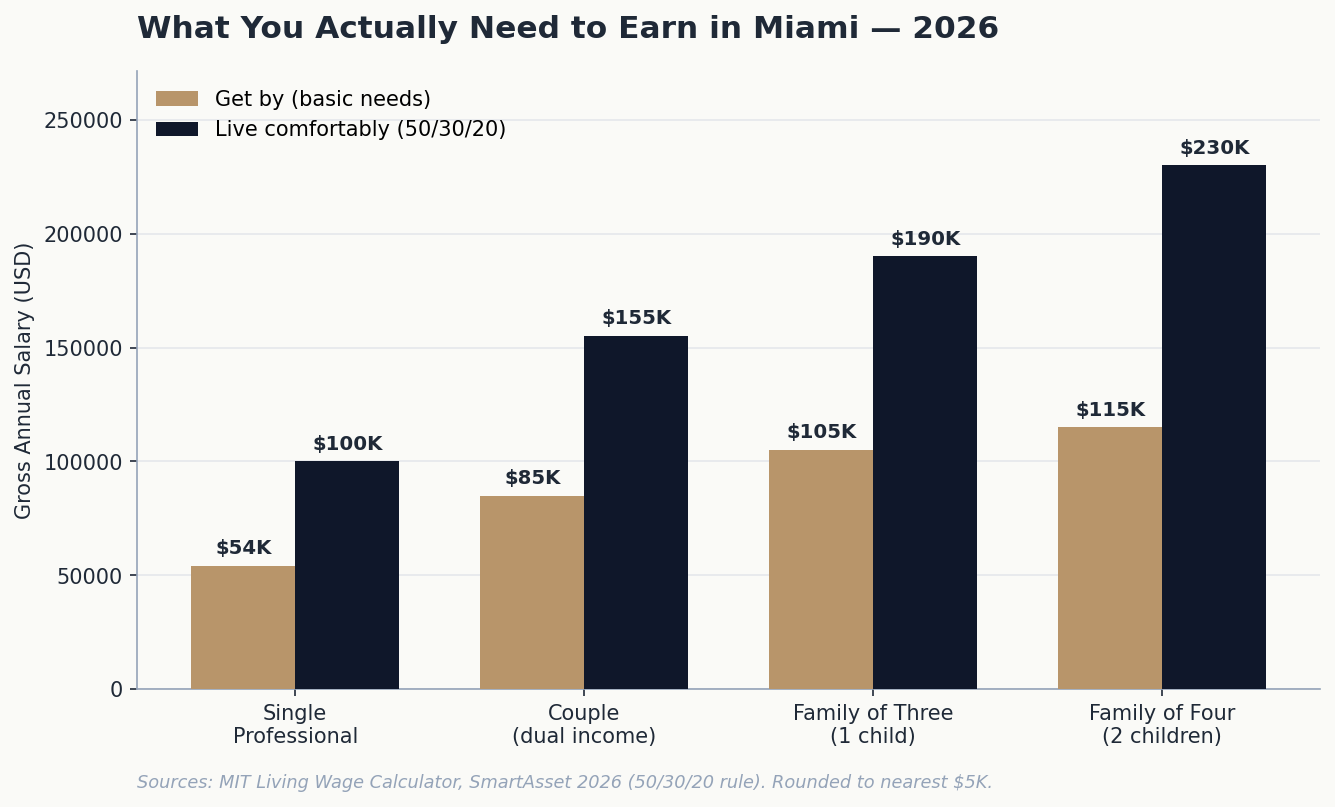
For a single professional, you're realistically looking at $100,000 a year to live comfortably in Miami in 2026. For a couple, $155,000 combined. For a family of four, the number climbs to around $230,000 — and that's not a luxury number, that's what SmartAsset's latest analysis says you need to follow the standard 50/30/20 budget rule in this city.
For context: Miami's actual median household income is $62,462 (U.S. Census, ACS 2024).
That gap between what people earn here and what it costs to live here comfortably is one of the biggest reasons my relocation clients are surprised by their first six months in Miami. Not because Miami is unaffordable — plenty of people build good lives here — but because the number in your head from watching YouTube videos is almost always low by $30,000 to $50,000.
So let me walk you through what "comfortable" actually means at each income level in Miami, what changes when you go from renting to buying, and how to figure out where your own number needs to land.
If you're already deep into planning a move, our Florida Relocation Process covers the full walkthrough. And if you want to model your own numbers against real Miami pricing, the Florida Mortgage Calculator is the fastest way to see how your target salary maps to what you can actually afford here.
The Numbers, Straight Up
Two different benchmarks matter here, and most articles blend them together in a way that hides the truth.
The first is the living wage — bare basic needs, no comfort, no savings. The MIT Living Wage Calculator puts that at around $54,000 for a single adult in Miami-Dade, and roughly $115,000 for a family of four with two working adults. That's what it costs just to keep the lights on, food on the table, and a roof over your head. No dinners out. No emergencies. No cushion.
The second is what SmartAsset calls living comfortably — running the 50/30/20 budget rule, where 50% of your take-home pays for needs, 30% covers wants, and 20% goes to savings and debt payoff. To hit that in Miami, a single adult needs about $100,000. A family of four needs $230,000.
The distance between those two numbers — surviving versus living well — is roughly $46,000 for a single person and $115,000 for a family. That's where most people underestimate this city.
Why the Gap Between Earning and Comfort Is So Big Here
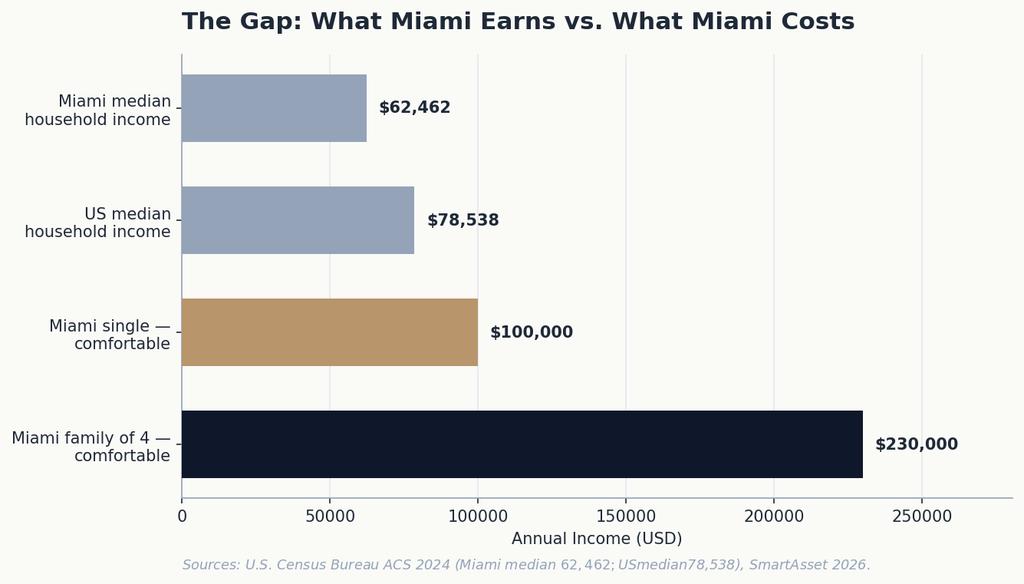
Miami's median household income of $62,462 sits below both the U.S. median ($78,538) and what MIT says a family of four needs just to cover basic expenses (around $115,000). That's not a small mismatch — it's structural.
Three forces drive it:
Housing. I covered this in depth in my Real Cost of Living post, but the short version: average rent hit $2,753/month in mid-2026, and Miami-Dade condo HOA fees run at a median north of $1,900/month in high-rises now. Between rent or mortgage, insurance, taxes, and association fees, housing takes a much bigger bite here than in most peer cities.
Insurance stack. Florida is the most expensive state in the country for homeowners insurance right now — $8,458 statewide average in 2026 per Insurify. Miami car insurance runs 50%+ above the state average. Neither of those show up on a "cost of living index" chart, but both hit your monthly budget hard.
Lifestyle inflation. Miami has become one of the top restaurant and nightlife markets in the country. $20 cocktails, $60 pasta, $100+ dinners for two are standard at popular spots. That's not a problem if you build for it — but if you assumed Miami dining would price like Tampa or Orlando, your "wants" bucket gets crushed fast.
Where Your $100K Actually Goes as a Single Professional
Let's break this down with a real example. Say you're a single professional earning $100K gross. Florida has no state income tax, so you take home closer to $77K after federal tax and FICA (assuming standard deductions, no 401(k) contributions). Under the 50/30/20 rule, here's how that splits:
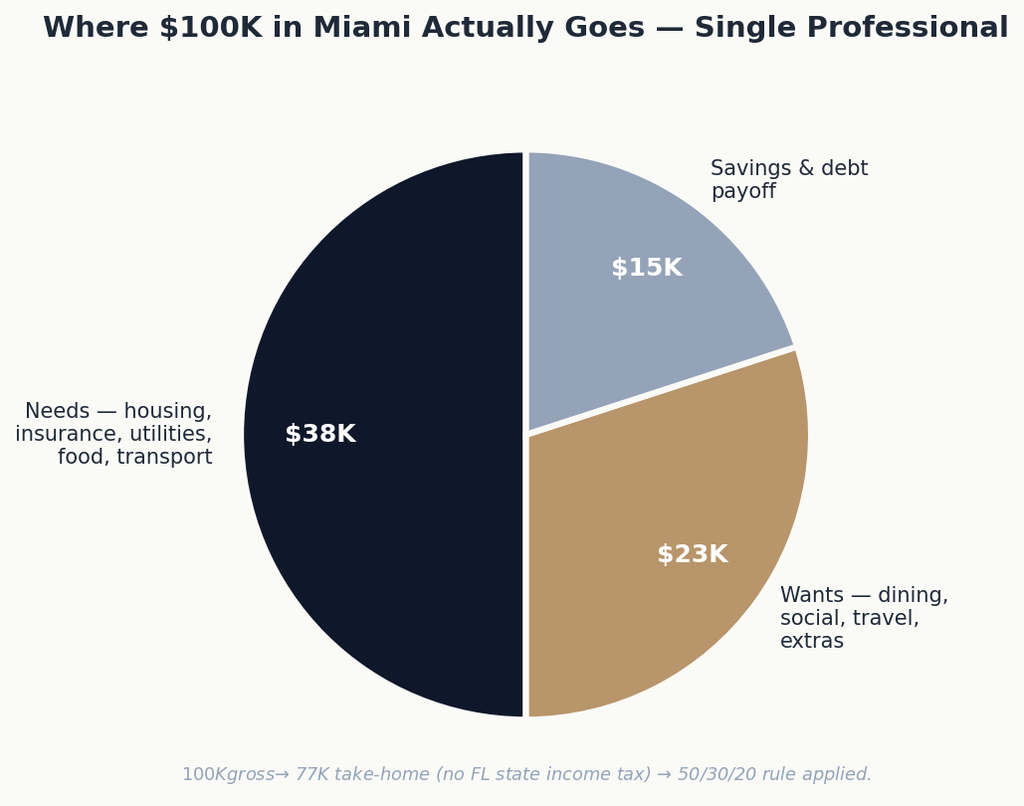
That $38K "needs" bucket is what covers your rent or mortgage, insurance (health + auto + renter's or HO-6), utilities, groceries, transportation, and phone. In Miami, this fills up fast — a $2,700/month rent alone eats $32K a year, leaving you $6K for literally everything else in your "needs" category. That's why comfort tends to require going higher than $100K, or making tradeoffs (roommates, further-out neighborhood, cheaper vehicle) to make the math work.
The $23K "wants" bucket is what makes Miami actually enjoyable — dining out, going to South Beach on weekends, boat days, travel, non-essential shopping. This is where I see relocation clients underspend the first year to compensate for higher housing costs, then wonder why the city doesn't feel as fun as they expected.
The $15K "savings" bucket is what protects you from the surprises I've written about elsewhere — hurricane damage not fully covered by insurance, condo special assessments, rising HOA fees, unexpected car repairs, an insurance renewal that jumps 20%.
The Buy vs. Rent Salary Math
Here's where it gets interesting. The salary you need to live comfortably in Miami depends heavily on which side of the housing question you're on.
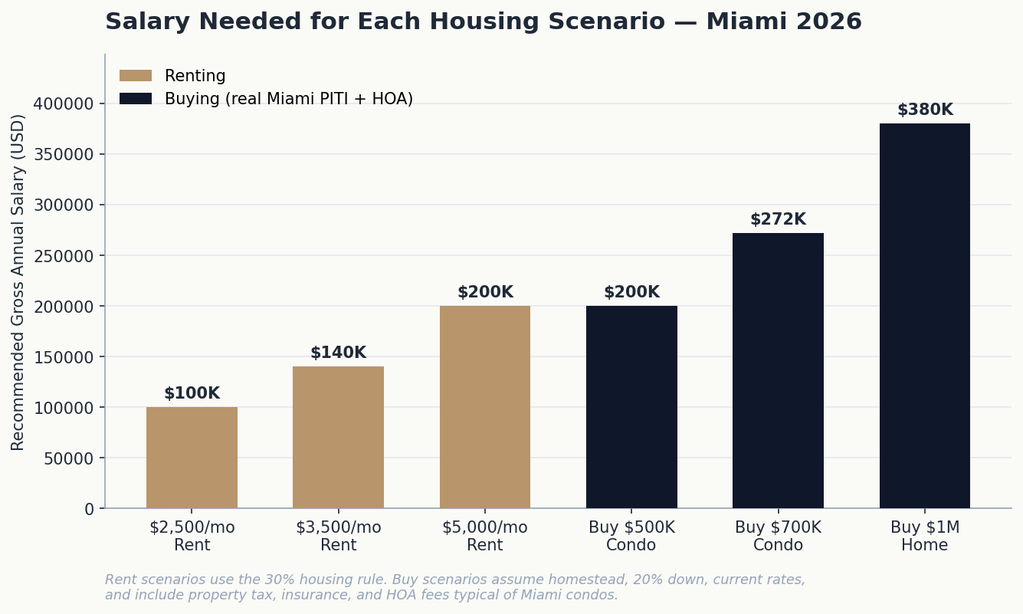
Notice how buying a $500K condo requires roughly the same salary as renting a $5,000/month apartment. That's because in Miami, once you factor in property taxes, homeowners insurance, and HOA fees, the "cheap" $500K condo carries about $5,000/month in real total monthly cost — even with 20% down and homestead status.
That's the piece most affordability calculators get wrong. The classic "3x your income" rule for buying assumes a normal cost structure. Miami doesn't have a normal cost structure. Between insurance and HOA fees, your monthly total on a Miami purchase runs 30-50% higher than the same price point would in Atlanta, Nashville, or Charlotte.
If you're actively working through this math for a specific price point, the Florida Mortgage Calculator is set up to include Florida-specific insurance and tax variables, which most national calculators leave out.
What Each Salary Level Actually Buys You in Miami
Let me get specific about what each income tier looks like in daily life here.
Under $75,000 — surviving. You can technically live in Miami at this income, but you're either sharing a place, living in Hialeah or a further-out neighborhood, or dealing with a genuinely tight budget every month. If you're moving here for a job at this salary and were expecting a Miami lifestyle, you'll be disappointed. If you're moving here for the city and are fine with the tradeoffs, it's workable.
$75,000 to $100,000 — getting by. Rent a decent 1-bedroom in a solid neighborhood (Wynwood, Coconut Grove edges, parts of Coral Gables). Dine out occasionally. Own a car. Take one vacation a year. Save a little. You're not stressed, but you're paying attention to your budget every month.
$100,000 to $150,000 — comfortable. This is the sweet spot for a single person. You can live in a nicer neighborhood, dine out regularly without checking prices, take real vacations, and still hit meaningful savings. Buying starts to become feasible if you have money set aside for a down payment.
$150,000 to $250,000 — comfortable-plus. You have real options here. Brickell or waterfront condo. Regular restaurant nights at Miami's higher-end spots. Boat days without stressing. Buying a starter condo. If you're a couple in this range, you're doing well.
$250,000 and up — luxury lifestyle unlocked. This is where the Miami you see on Instagram becomes accessible. Coconut Grove, Coral Gables, Miami Beach single-family homes. Ability to buy in the $700K–$1.5M range comfortably. Members clubs, private schools if you have kids, the full South Florida lifestyle without financial stress.
What Changes If You Have Kids
Everything.
For a family of four, comfortable Miami living jumps to $230,000. Childcare in Miami-Dade runs $1,500–$2,500 per child per month for daycare or preschool. Private school — which many families here consider given the mixed quality of public school options — runs $25,000 to $50,000+ per year per child at the well-known Miami private schools.
Space needs also jump. A 2-bedroom in Brickell doesn't work for a family of four. You're either buying a house in Coral Gables ($1.2M+ for anything move-in ready), Coconut Grove ($1.5M+), Pinecrest ($1.8M+), or renting a larger unit at $6,000–$10,000/month. This is why family relocations to Miami skew toward higher household incomes — the cost structure of raising a family here is genuinely steep.
If you're relocating a family, our community guides break down which neighborhoods work best for families at different price points — it's the biggest lever you have on making the family math work.
What the Salary Number Doesn't Tell You
A few things matter almost as much as your gross income when you're figuring out if Miami works for you:
Florida's no-state-income-tax matters — but only if you establish residency. Moving to Miami with a remote job from California doesn't automatically get you Florida tax treatment. You need to spend the majority of the year here, register vehicles here, shift your financial life here. If you're properly a Florida resident, you keep roughly 5-10% more of every dollar than you would in California or New York. On a $150K salary, that's real money — around $10,000 a year — that offsets a meaningful chunk of Miami's higher costs.
Remote workers have an unfair advantage here. If you're earning a San Francisco or NYC salary while paying Miami living costs, the math works dramatically better. A $180K remote tech role from a coastal company, applied to Miami living costs, gives you a lifestyle you couldn't afford in either origin city.
Your income stability matters as much as the number. Miami's cost structure has a lot of variable line items — insurance renewals, HOA increases, special assessments, storm expenses. Someone earning $120K with stable W-2 income handles this more comfortably than someone earning $180K in commission-based sales with income that swings quarter to quarter. Build a cash cushion into whatever your target is.
Buying vs. renting is a strategic question, not just a lifestyle one. For a lot of my newly relocated clients, renting the first 12–18 months is the smarter move — you learn the neighborhoods, watch how insurance and HOA fees behave, and buy from a position of information rather than urgency. Our Florida Leasing Process is set up specifically to help relocation clients navigate that period. When you are ready to buy, our Florida Buyers Guide walks through what changes.
The New Development Angle
One nuance worth flagging for higher earners: Miami's new development inventory changes the affordability math in an interesting way. Many new condo projects offer extended payment schedules on pre-construction (spread over 24-36 months rather than a single closing), which lets buyers stretch a purchase across a longer timeline than a resale would allow. That doesn't lower the price, but it makes higher price points reachable at income levels that couldn't handle the same purchase on a resale.
If you're looking at the $700K–$2M+ range, our Miami new developments page covers what's actively being built and how the payment structures compare across projects.
The Honest Bottom Line
Miami is expensive, but "expensive" isn't a static number — it's a moving target that depends on your household size, your ownership situation, your neighborhood, and your lifestyle expectations.
The safest planning framework I give my clients:
- Single, renting: target $100K+ to live comfortably. $75K works but expect tradeoffs.
- Couple, renting: $155K combined for comfort. $120K works with discipline.
- Family of four, renting: $230K combined for real comfort. Below that, you're making real tradeoffs on space, schools, or lifestyle.
- Buying at $500K: add roughly 40% to the equivalent rental salary threshold, because Miami's PITI + HOA stack is heavier than most markets.
- Buying at $1M+: $380K+ combined income is a realistic floor.
If your numbers are above these, you'll find Miami has more to offer than almost any city in the country right now. If they're below, it's worth having an honest conversation about tradeoffs before you sign a lease or write an offer.
That's the whole point of doing this work upfront. I'd rather help you build a plan that works than watch you learn the hard way what living here actually costs.
Frequently Asked Questions
Is $100,000 a good salary in Miami in 2026? For a single person, yes — $100K puts you in genuinely comfortable territory under the 50/30/20 budget rule, especially given Florida has no state income tax. You can rent a nice 1-bedroom, eat out regularly, and still save meaningfully. For a couple sharing costs, $100K combined is tighter but workable. For a family of four, $100K is well below what SmartAsset flags as the comfortable threshold.
Can you live in Miami on $60,000 a year? Technically yes, but you'll be making real tradeoffs. You're likely sharing a place, living further from the core, or dealing with a strict monthly budget. Miami's median household income is $62,462, so plenty of people do it — but "living in Miami" on that number looks very different from the lifestyle newcomers usually imagine.
How much do I need to earn to buy a home in Miami? For a $500K condo homesteaded with 20% down, plan on needing about $200,000 in gross annual income to fit within reasonable debt-to-income guidelines once you factor in Miami's real PITI + HOA total. For a $700K condo, that jumps to around $272,000. For a $1M single-family home, closer to $380,000. These are higher than national calculators suggest because Miami's insurance and HOA stack is heavier than most markets.
Does Florida's no-state-income-tax really make Miami affordable? It helps meaningfully, but doesn't fully offset Miami's higher housing, insurance, and lifestyle costs. On a $150K salary, avoiding state income tax saves you roughly $8,000–$12,000 per year vs. living in California or New York — real money, but not enough to close the total cost gap by itself. The tax benefit is a genuine perk, not a magic solution.
Should I move to Miami if I can't hit the $100K single or $230K family threshold? Depends on why you're moving. If it's for the city itself and you're willing to make tradeoffs on housing, dining, and lifestyle, plenty of people build good lives here at lower income levels. If you're expecting the Instagram version of Miami — Brickell high-rises, waterfront dining, boat days — you'll be disappointed. Be honest with yourself about which version you're actually chasing.
Working through whether Miami actually fits your numbers? Start with our Florida Relocation Process for the full guided walkthrough, or model your specific scenario against real Miami pricing using our Florida Mortgage Calculator. If you're leaning toward renting first, our Florida Leasing Process is built for exactly that. Ready to look at what to buy? The Florida Buyers Guide covers what to expect. Or if you want to explore new construction, our Miami new developments page covers what's actively coming to market. Either way — I'd rather have the honest conversation before you sign anything.
Check out this article next