The Real Cost of Living in Miami in 2026: What Nobody Budgets For
Let me be honest with you. Almost every relocation client I sit down with tells me the same thing in the first meeting: "I've done my research. I know Miami's expensive." Then we open a spreadsheet, walk through what it actually costs to live here in 2026 — not the advertised rent, not the mortgage estimator number, the real number — and there's always a pause. Miami isn't expensive in the way most people expect. It's expensive in a way you don't see until you're already living here. The listing price is only the opening bid. The mortgage estimator you ran online? That's about a third of the story. And the "average rent" you found on RentCafe is a real number, but it hides the two or three thousand dollars sitting quietly in every month's real total — the insurance you didn't quote, the HOA fee that's not what the listing said, the tolls, the special assessment nobody warned you about. I've watched this happen enough times that I want to walk you through it up front. Not to scare anyone off — I moved here from San Francisco, I'm not going anywhere — but so you build your budget around what Miami actually costs in 2026, not what the internet says it costs. If you're already thinking about a move, our Florida Relocation Process walks through exactly how we help clients plan for this. Or if you want to understand which neighborhoods fit which lifestyles first, our community guides are the best place to start.First, the Number Everyone Quotes
Cost of living in Miami sits around 21% above the national average right now. Housing is what drives most of that — the average rent citywide hit $2,753/month in mid-2026 (RentCafe), and Miami-Dade's median home price is running north of $573,000. That's the number you'll see on every relocation article and every YouTube video about moving to Miami. Here's what those articles don't tell you: that $2,753 is a citywide average. It smooths Hialeah and Brickell into one number that describes almost nobody's actual experience. The neighborhood you pick moves that number by $1,500 in either direction — before we even talk about ownership costs.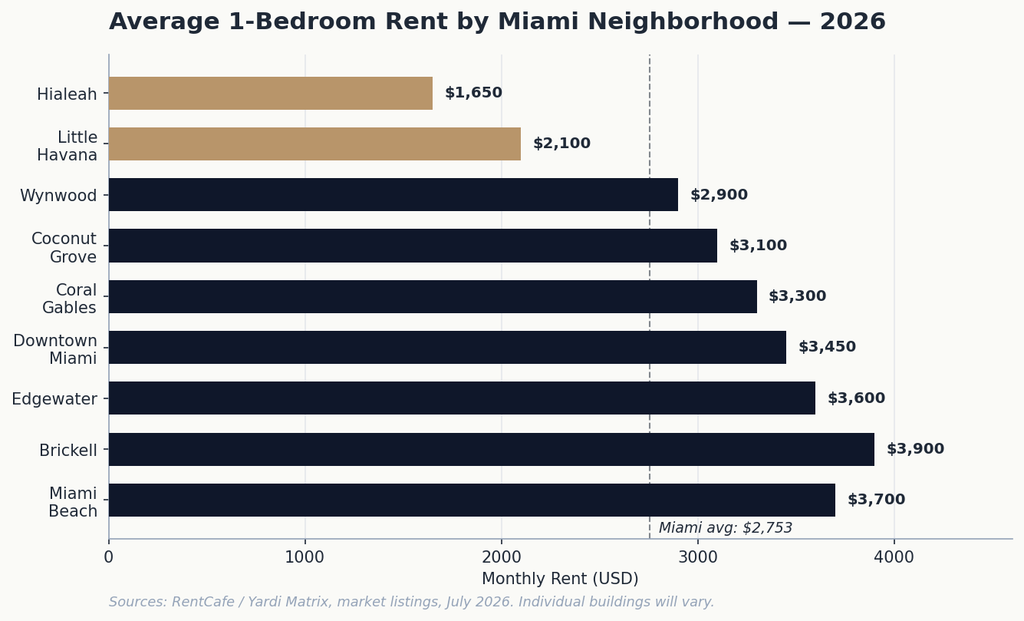 The gap between Hialeah at $1,650 and Brickell at $3,900 is bigger than most people's take-home pay. Same city. Same "Miami." Two completely different financial realities.
The first real move I ask clients to make: forget the citywide number. Figure out where in Miami you actually want to live, and then build your budget.
The gap between Hialeah at $1,650 and Brickell at $3,900 is bigger than most people's take-home pay. Same city. Same "Miami." Two completely different financial realities.
The first real move I ask clients to make: forget the citywide number. Figure out where in Miami you actually want to live, and then build your budget.
The Line Item Nobody Prices Out Up Front: Insurance
Here's where I lose people every single time. Florida is the most expensive state in the country for homeowners insurance right now. The average premium hit around $8,458 statewide in 2026, according to Insurify — nearly triple the national average. In Miami-Dade specifically, coastal homes routinely land in the $6,000 to $10,000+ per year range. That's $500 to $850 a month, tacked onto your mortgage payment, that never showed up in the online calculator you ran. There's some genuine good news I want to flag: after years of premium increases, 2026 is the first year the trend actually bent. Citizens Property Insurance filed an 8.7% statewide rate cut effective spring 2026, with a full 13.9% reduction in Miami-Dade specifically. State Farm cut roughly 10%. Eighteen new private carriers have re-entered the Florida market since the 2022 reforms. But "getting less expensive" and "cheap" are very different things. If you're comparing a $700K Miami-Dade home to the same house in Ohio, you're still looking at a premium three to four times higher. Then there's the piece almost nobody sees coming: HO-6 condo insurance. If you're buying a condo, your building's master policy covers the exterior and common areas — you still need your own policy for interior finishes, personal belongings, and liability. Those run about $1,800 to $2,800 a year in Miami. Separate line item. Separate check. And that's before flood insurance, which depending on your flood zone can add anywhere from $700 to $3,500+ per year on top.Property Taxes: The Sticker vs. the Bill
This one trips buyers up constantly. Miami-Dade's combined millage rate lands around 20 mills, or roughly 2% of your property's taxable value per year. On a $700K home, that's about $14,000 annually before exemptions — or $1,150 a month baked into your total payment. Here's the trap: people look at the seller's current tax bill on Zillow, see something like $6,000, and assume that's what they'll pay. Taxes usually get reassessed when a property sells. The seller may have owned the home for 15 years under the Save Our Homes cap, which limits their annual increases to 3%. You don't get their bill. You get the new bill, calculated off your purchase price. The homestead exemption helps if the home is your primary residence — it knocks $50,000 off your taxable value and caps future assessment increases at 3% a year going forward. But you have to file for it by March 1st, and it only applies to primary residences. If you're buying a rental or a second home, you pay the full unhomesteaded rate every year.Condo HOA Fees: The Second Mortgage
If you're buying a condo, this is the line item that hurts most. Miami-Dade high-rise condo HOA fees hit a median of over $1,900 a month in 2025, per industry data — up roughly $500 from the prior year. That's not luxury towers only. That's the median. In newer full-service buildings you'll commonly see fees running $0.75 to $1.50 per square foot per month, so on a 1,500 sq ft unit you're looking at $1,125 to $2,250 monthly just in association fees. That's before your mortgage. Before your taxes. Before your insurance. Why so high? Three forces stacked at once:- Post-Surfside reserve requirements — since the 2021 Surfside collapse, Florida law requires condos three stories or taller to fund full reserves and pass structural integrity studies. Buildings that spent decades underfunding maintenance are now catching up.
- Coastal insurance costs — the building's master policy is a huge line item in every association budget, and it moves the same direction as your homeowners premium.
- Special assessments — this is the wild card. When a building needs concrete restoration, roof replacement, or facade work and the reserves don't cover it, the owners get billed directly. Assessments of $10,000 to $100,000+ per unit have become common across Miami-Dade in the last three years.
Putting It All Together: The Real Monthly Number
Here's what a realistic monthly cost looks like on a $700K Miami condo, homesteaded, with a normal 20% down conventional loan at current rates: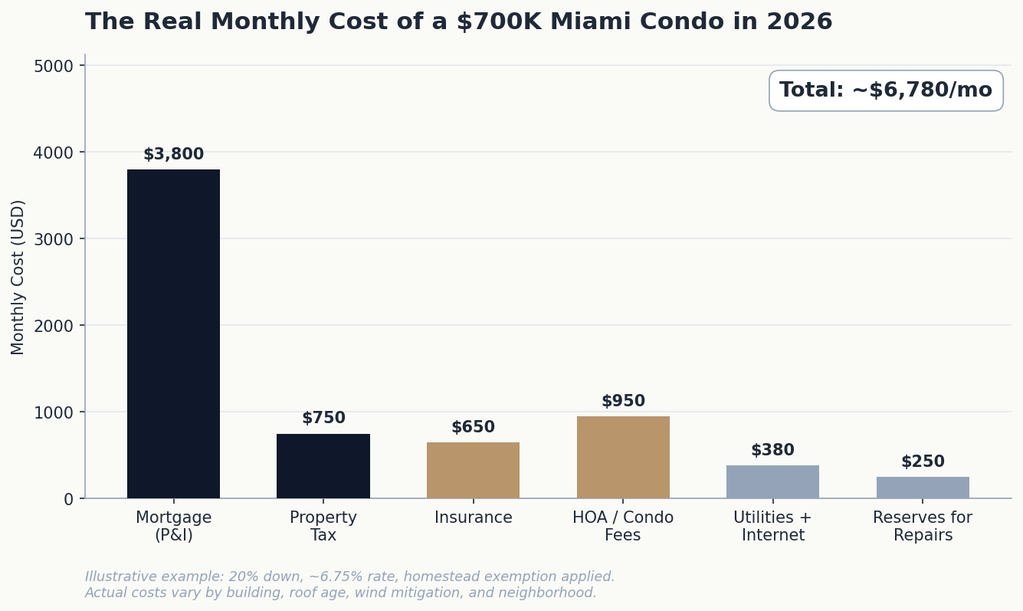 Just under $7,000 a month. On a $700K purchase.
That's a number most people budget as $4,500 — because that's roughly what the mortgage estimator spits out. The other $2,500 lives in the line items I just walked you through.
Now — I want to be fair. Florida has no state income tax. If you're moving from California, New York, or Illinois, that swing alone can offset a real chunk of what Miami charges you elsewhere. But that offset only shows up if you actually establish Florida residency (it's more than just buying a house here) and only if your income is high enough for state tax savings to be meaningful. Talk to a CPA before you build a plan around that math.
Just under $7,000 a month. On a $700K purchase.
That's a number most people budget as $4,500 — because that's roughly what the mortgage estimator spits out. The other $2,500 lives in the line items I just walked you through.
Now — I want to be fair. Florida has no state income tax. If you're moving from California, New York, or Illinois, that swing alone can offset a real chunk of what Miami charges you elsewhere. But that offset only shows up if you actually establish Florida residency (it's more than just buying a house here) and only if your income is high enough for state tax savings to be meaningful. Talk to a CPA before you build a plan around that math.
The Hidden Line Items Nobody Talks About
Beyond the big four (mortgage, taxes, insurance, HOA), there's a set of costs that quietly compound in a Miami budget.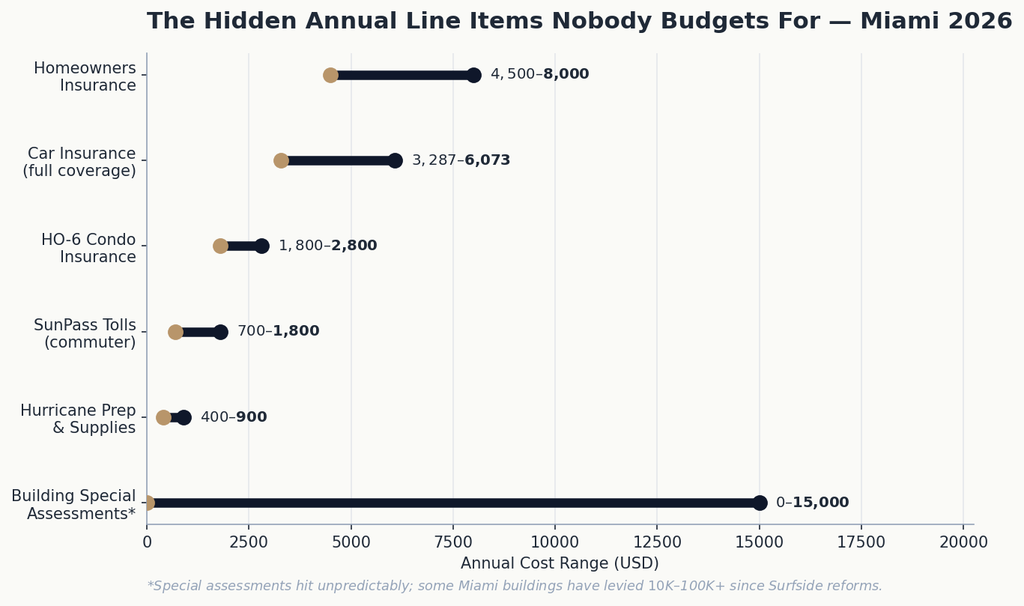 Let me walk through what each of these actually looks like in practice:
Car insurance in Miami is brutal. Miami sits among the highest car insurance markets in the country — full coverage in Miami averages around $3,287 a year, and NerdWallet's most recent Miami-specific analysis put the median closer to $6,073 depending on ZIP code, driving record, and vehicle. Compare that to $2,134 as the Florida statewide average, and Miami is running 50%+ above the state.
Tolls add up if you commute. Miami-Dade's toll network is nearly all cashless now, and if you drive from Kendall or Doral to Brickell daily, you can easily see $60 to $150 a month in SunPass charges. That's $700 to $1,800 a year, quietly, out of the budget.
Hurricane prep is a real annual line. Impact windows, shutters if you have them, generator maintenance, evacuation supplies, potential replacement of patio furniture and outdoor items after storms — new residents almost always underbudget this the first year, then course-correct.
Special assessments — the wild card. I said it above and I'll say it again: this is the one I've watched destroy the most budgets. A well-run building with real reserves protects you from this. A cheap-HOA building with deferred maintenance does not.
Let me walk through what each of these actually looks like in practice:
Car insurance in Miami is brutal. Miami sits among the highest car insurance markets in the country — full coverage in Miami averages around $3,287 a year, and NerdWallet's most recent Miami-specific analysis put the median closer to $6,073 depending on ZIP code, driving record, and vehicle. Compare that to $2,134 as the Florida statewide average, and Miami is running 50%+ above the state.
Tolls add up if you commute. Miami-Dade's toll network is nearly all cashless now, and if you drive from Kendall or Doral to Brickell daily, you can easily see $60 to $150 a month in SunPass charges. That's $700 to $1,800 a year, quietly, out of the budget.
Hurricane prep is a real annual line. Impact windows, shutters if you have them, generator maintenance, evacuation supplies, potential replacement of patio furniture and outdoor items after storms — new residents almost always underbudget this the first year, then course-correct.
Special assessments — the wild card. I said it above and I'll say it again: this is the one I've watched destroy the most budgets. A well-run building with real reserves protects you from this. A cheap-HOA building with deferred maintenance does not.
Renting? Read This Before Signing.
Rent looks like the simpler path — and in some ways it is. But renters get surprised too, mostly at move-in. Here's what actually walking into a Miami condo rental looks like on a $3,200/month unit: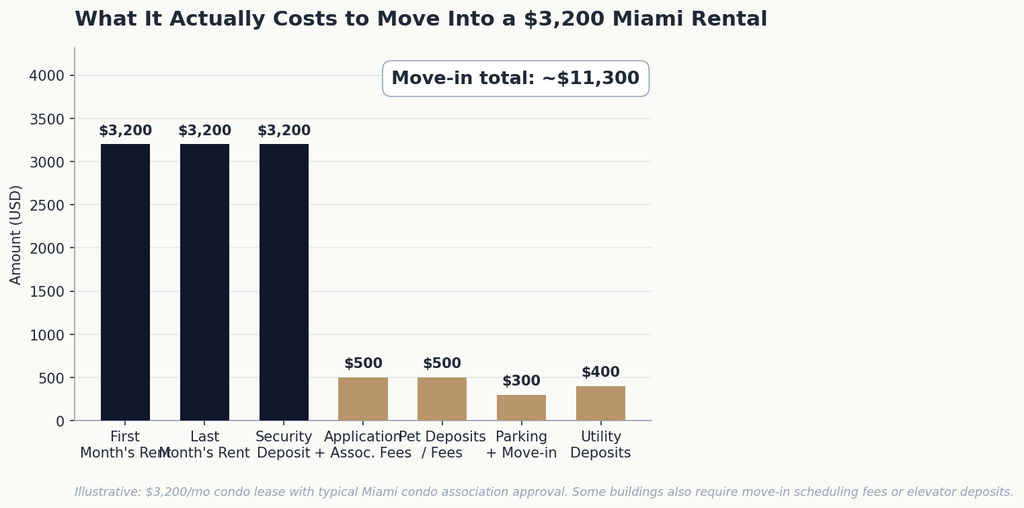 That's more than $11,000 to sign a lease. First, last, security deposit (all typically full month's rent), plus condo application fees the building charges on top of what the landlord charges, plus pet deposits if you have one, plus parking or move-in scheduling fees, plus utility deposits with FPL. This is standard, not an outlier.
A few Miami rental realities worth knowing before you fall in love with a listing:
That's more than $11,000 to sign a lease. First, last, security deposit (all typically full month's rent), plus condo application fees the building charges on top of what the landlord charges, plus pet deposits if you have one, plus parking or move-in scheduling fees, plus utility deposits with FPL. This is standard, not an outlier.
A few Miami rental realities worth knowing before you fall in love with a listing:
- Most Miami condos require association approval. That means a separate application to the building itself — background check, financial documents, sometimes an interview. Approval can take 2-4 weeks. Don't book movers before the building has confirmed your move-in date.
- Parking is rarely automatic. Many buildings assign one space per unit and charge for the second. Guest parking may cost extra. Downtown/Brickell buildings sometimes charge $150-300/month for a second space.
- Move-in windows are real. Buildings often restrict move-ins to weekdays, business hours, with elevator reservations required. If you're moving from another state, this can complicate everything.
A Few Costs I Never See in "Cost of Living" Articles
I'll close with the ones that don't show up in any spreadsheet but that reliably surprise every relocation client I work with: Groceries run ~7-10% above the national average. Publix is dominant here, but if you're used to Aldi or lower-cost regional chains, the weekly bill will noticeably climb. Dining out is a lifestyle here — and priced accordingly. Miami has become one of the top restaurant cities in the country, which means $20 cocktails, $60 pasta, $100+ dinners for two are normal at popular spots. Nothing's wrong with that, but if you're moving from a market where dining out was cheaper, your entertainment line will move. Climate control costs are year-round. In most of the country, you turn off the AC for six months. In Miami, you don't. Electric bills run around $246/month on average in Miami-Dade per EnergySage, and they don't dip nearly as much in winter as they do in northern markets. "Weather-adjacent" costs. Pool maintenance if you have one ($150-250/month). Landscaping in the humidity ($100-200/month for a house). Car detailing more often because of salt air near the coast. Wardrobe skews warm-weather and workout-heavy, which most people have to rebuild after moving from cooler cities. None of these are dealbreakers. But budget for them, and the first six months in Miami will feel like the honeymoon it should be — not a slow discovery that your money doesn't stretch the way you thought it would.So — Is It Worth It?
For most of my clients, yes. Emphatically yes. The tax picture, the international access, the year-round outdoor life, the business energy in the city right now, the food, the mix of cultures — those aren't small things. Miami is genuinely a different quality of life than what most transplants are used to, and once you're in the rhythm of it, most people don't want to leave. But the people who land well here are the ones who came in with clear eyes about the numbers. The ones who struggle are the ones who budgeted on a listing price and got blindsided six months in. That's the whole point of this post. I'd rather you know the number now.Frequently Asked Questions
What salary do you actually need to live comfortably in Miami in 2026? For a single person renting a 1-bedroom in a decent neighborhood, most local guidance points to $80,000–$100,000 as a comfortable starting range. For a couple looking to eventually buy, $150,000+ combined is a more realistic floor, especially factoring in insurance, HOA fees, and taxes on any ownership scenario. Luxury neighborhoods and larger homes scale up quickly from there. How much is homeowners insurance in Miami in 2026? Florida averages around $8,458 statewide, per Insurify. Miami-Dade coastal homes commonly land in the $6,000–$10,000+ per year range. Roof age, wind mitigation features, elevation, and construction type all affect the number substantially. Always get a quote on the specific address before making an offer. Why are Miami condo HOA fees so high? Post-Surfside legislation now requires condos three stories and taller to fund full reserves and pass structural inspections. Combined with rising insurance costs on building master policies, that's pushed high-rise HOA medians above $1,900/month in Miami-Dade. Newer, well-run buildings tend to have higher fees but lower special-assessment risk — older buildings with cheap fees are often the ones with expensive surprises. Is the Florida no-income-tax benefit real? Yes, but only if you legally establish Florida residency, which requires more than owning property. You typically need to spend the majority of the year here, register vehicles here, vote here, and shift your primary financial life to Florida. Talk to a CPA before treating it as a done deal. Should I rent before buying when moving to Miami? For most relocation clients, yes. Renting for 6-12 months gives you time to understand neighborhoods, commute patterns, insurance quotes on specific properties, and how the seasons actually feel here. Rushing into a purchase in the wrong neighborhood or building is more expensive than a year of renting while you get your bearings. Thinking about a move to Miami? The best way to avoid these surprises is to work through them before you sign anything. Start with our Florida Relocation Process for the full guided walkthrough, browse our community guides to figure out which part of Miami actually fits your life, or if leasing first makes more sense, our Florida Leasing Process covers what to expect. Or just reach out directly — I'd rather have the honest conversation upfront than let you learn any of this the hard way.Check out this article next