Where Should You Live in Miami? The Neighborhood Matchmaker Guide
I get this question more than any other.
Someone lands in a discovery call with me, they've already decided they're moving to Miami, and within the first two minutes they ask: "Where should I actually live?"
The honest answer is: it depends on what you want your Tuesday morning to look like. Not your Saturday night. Anyone can Google "best Miami neighborhoods" and find twenty articles telling you Brickell has the best nightlife or Miami Beach has the best beaches. That's not the question. The question is: on a normal Tuesday — when you're going to work, running errands, dealing with your kids' schedules, or figuring out where to grab lunch — which Miami neighborhood makes your life feel easier, and which one makes it feel harder?
Because I've watched enough relocation clients over the last several years to tell you this: people don't fall out of love with Miami. They fall out of love with the specific neighborhood they picked without thinking through their weekday routine.
So this is how I actually walk clients through it. Not "here are all the neighborhoods." Not "here's the vibe." What kind of person you are, what kind of life you're building, and which Miami neighborhood is genuinely built for it.
If you want to skip to the individual community deep dives, they're all here on our Florida Communities page. And when you're ready to actually start looking, our Florida Relocation Process is built specifically to work through this decision with you before you sign anything.
The First Thing to Understand: Miami Is Really Nine Neighborhoods, Not One
Everyone says "I'm moving to Miami." Almost nobody is. They're moving to Brickell, or Coconut Grove, or Doral, or Aventura — and those places have almost nothing in common with each other beyond a zip code prefix.
Brickell is a high-rise financial district that walks like Manhattan. Coconut Grove is a leafy waterfront village with banyan trees and marinas. Doral is planned-community suburbia twenty minutes west. Miami Beach is a barrier island across the causeway. If you told me your friend "lived in Miami," I couldn't picture their daily life until you told me which neighborhood. They might be walking to lunch in a suit or driving to Costco in flip-flops.
That's why the first real move is to stop thinking about "Miami" as one place and start thinking about which of these nine or ten distinct neighborhoods actually fits how you want to live.
What Are You Really Paying For?
Before we get to matching lifestyles, here's the price landscape. 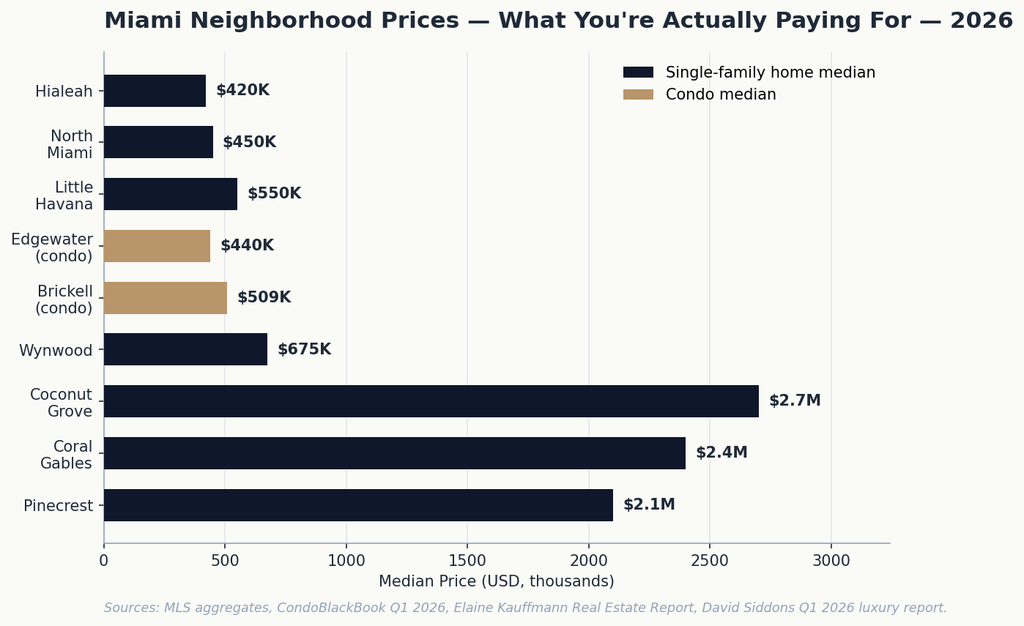 Two things jump out here.
First: the range is enormous. Hialeah's median home sits around $420K. Coconut Grove's is $2.7M. Same city. Same drive time to Downtown, roughly. Wildly different lives.
Second: condos and houses are separate markets. A Brickell condo at $509K is entirely different from a Coral Gables single-family home at $2.4M — and they attract entirely different buyers. If you're comparing them price-for-price, you're comparing apples to a completely different fruit. What you get for that Brickell condo is walkability, amenities, and low maintenance. What you get for the Coral Gables house is space, schools, privacy, and yard. Both are legitimate. Neither is a bargain relative to the other.
The takeaway isn't which neighborhood is "expensive" — it's which kind of ownership matches how you actually want to live day-to-day.
The Big Trade-Off Nobody Explains to You Up Front
Here's the tension I see clients wrestle with more than any other: 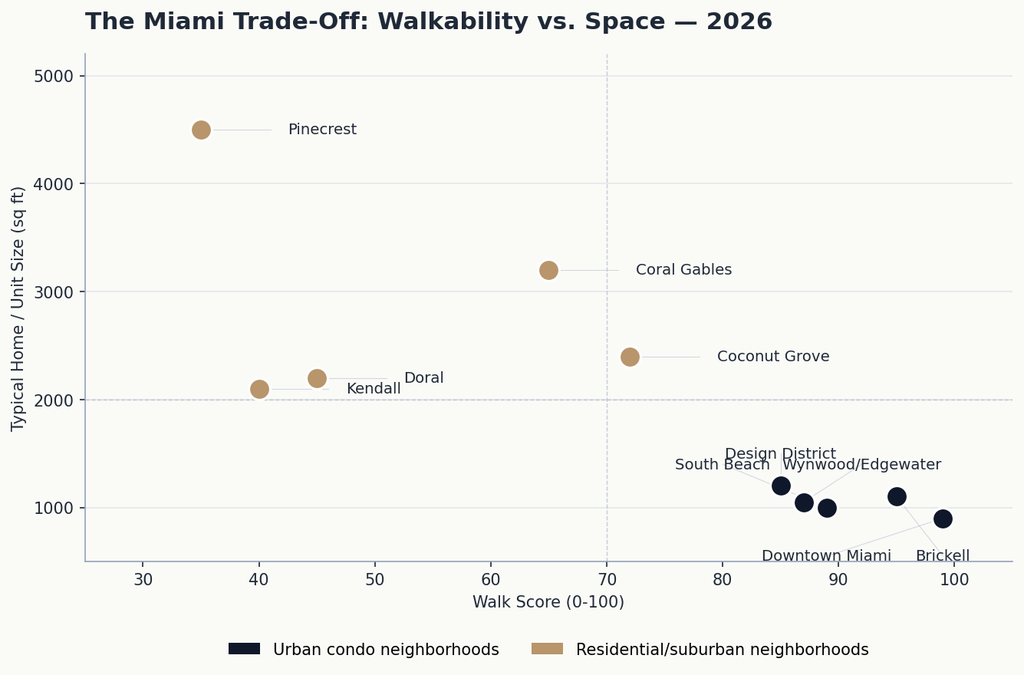 Every Miami neighborhood decision is essentially a point on this map.
The upper-left quadrant (suburban + space) is where you get square footage, yards, top-rated schools, and driveways. That's Pinecrest, Coral Gables, parts of Kendall. You give up walkability. You will be driving for everything.
The lower-right quadrant (urban + compact) is where you get walkability, restaurants, transit, and lifestyle density. That's Brickell, Downtown, Wynwood-Edgewater. You give up square footage. Your "yard" is your building's amenity deck.
Almost nowhere in Miami gets you both. Coconut Grove and Coral Gables come the closest to a middle path — Coral Gables has real walkability in Miracle Mile, Coconut Grove has genuine village character around CocoWalk and the marinas — but even they lean residential over urban.
I have relocation clients try to solve this by picking Brickell "because I want walkability" and then complaining six months later that their family of four is stuffed into 1,400 square feet. Or picking Pinecrest "because we need space" and then realizing they're driving 45 minutes for every dinner out.
You don't get to skip this trade-off. You just get to make it consciously.
The Match: Which Neighborhood Fits Which Life?
Here's how I actually match clients to neighborhoods when we go through relocation together: 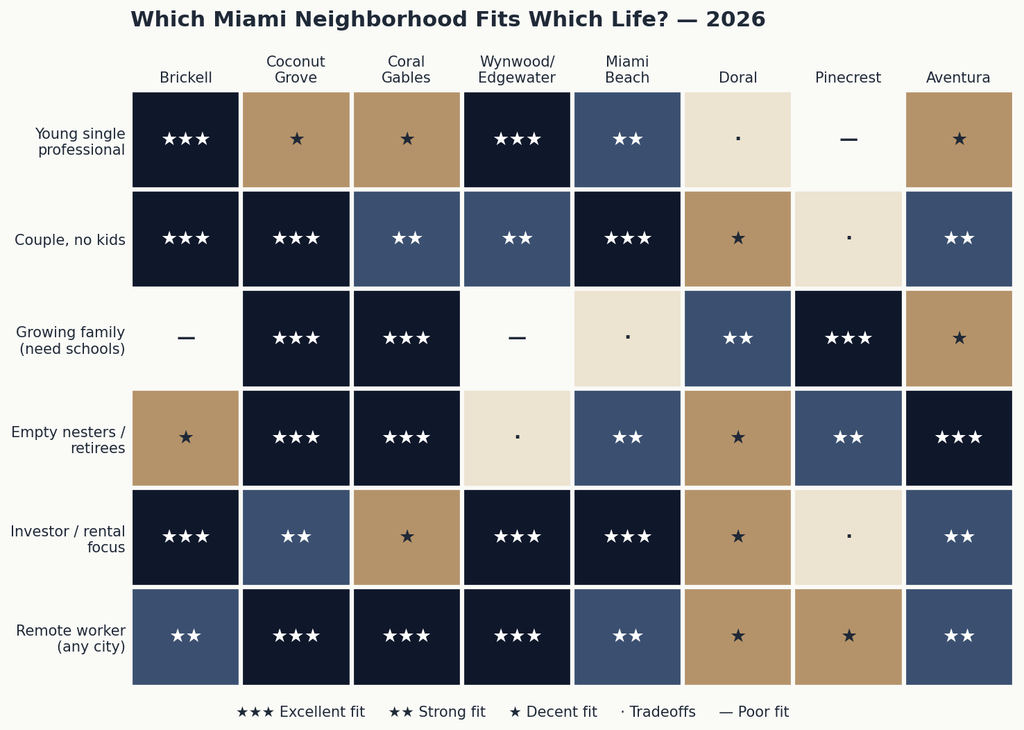 Let me walk you through each row.
Young single professional (25-35, first Miami move)
Best fits: Brickell, Wynwood-Edgewater.
If you're single, in your career-building years, and you want to actually experience Miami, you need to be walkable to nightlife, restaurants, and the professional network. Brickell is the obvious pick — financial district, 95 Walk Score, one-bedroom condos in the $2,800-$3,900/month rent range or $500K-$800K to buy. Wynwood-Edgewater is the more artistic/creative choice with slightly better value and comparable walkability at an 87 Walk Score.
Coconut Grove and Coral Gables can work if you want a quieter, more residential feel — but honestly, most young professionals I work with find them a little sleepy for this life stage.
Couple, no kids (dual income, prioritizing lifestyle)
Best fits: Brickell, Coconut Grove, Miami Beach.
You have the most flexibility here. Brickell if you're urban-oriented and both work near Downtown. Coconut Grove if you want a village feel with waterfront access and a proper "home" but still walkable to dinner. Miami Beach if the beach lifestyle is genuinely core to who you are — but understand you're committing to the causeway commute for anything mainland-based.
Growing family (2 kids, schools mandatory)
Best fits: Coral Gables, Coconut Grove, Pinecrest.
This is where Miami's neighborhood choice gets serious. Coral Gables and Coconut Grove have the best combination of top-rated public schools (Coral Gables Senior High and Palmetto both rate 9/10 on GreatSchools), private school access, and real family infrastructure.
Pinecrest offers the most space per dollar with excellent schools but requires accepting a more suburban lifestyle and longer commutes to central Miami. Brickell and Wynwood technically allow families — I've had clients do it — but you're fighting the neighborhood. School options are limited, unit sizes are small, and Brickell in particular wasn't designed with kids in mind.
Empty nesters and retirees
Best fits: Coconut Grove, Coral Gables, Aventura.
You've earned lock-and-leave living. Coconut Grove and Coral Gables give you established, walkable residential character with excellent healthcare access.
Aventura is genuinely underrated for retirees — great condos, easy access to Aventura Mall, walking-distance restaurants, and better value than Miami Beach for comparable amenities. Miami Beach can work too, but the transient tourist energy and traffic wear on many retirees within a few years.
Investor or rental-focused
Best fits: Brickell, Wynwood-Edgewater, Miami Beach.
If you're buying for cash flow or capital appreciation, these three consistently deliver. Brickell has the deepest long-term rental market driven by corporate demand from the financial district. Wynwood-Edgewater posted 120% transaction volume growth in Q1 2026 and remains one of the fastest-appreciating micro-markets. Miami Beach offers short-term rental options in certain buildings (though buyer beware: STR rules vary widely by building and by Miami Beach's own regulations).
If you're leaning toward brand-new inventory rather than resales, our Miami new developments page covers what's currently coming to market and how the pre-construction payment structures work.
Remote worker (portable income, choosing on lifestyle)
Best fits: Coconut Grove, Coral Gables, Wynwood-Edgewater.
You have a genuine luxury most Miami residents don't: you can optimize purely for lifestyle, not commute. Coconut Grove is my honest recommendation for most remote workers — waterfront, walkable village, cafes and coworking, easy access to the airport for travel.
Coral Gables offers similar strengths with a slightly more polished feel. Wynwood-Edgewater is the play if you skew younger and want urban energy without financial-district Brickell density.
Then Comes the Commute
Because even if you're mostly remote, you still need to think about how often you're going to Brickell, Downtown, the airport, and the beach. 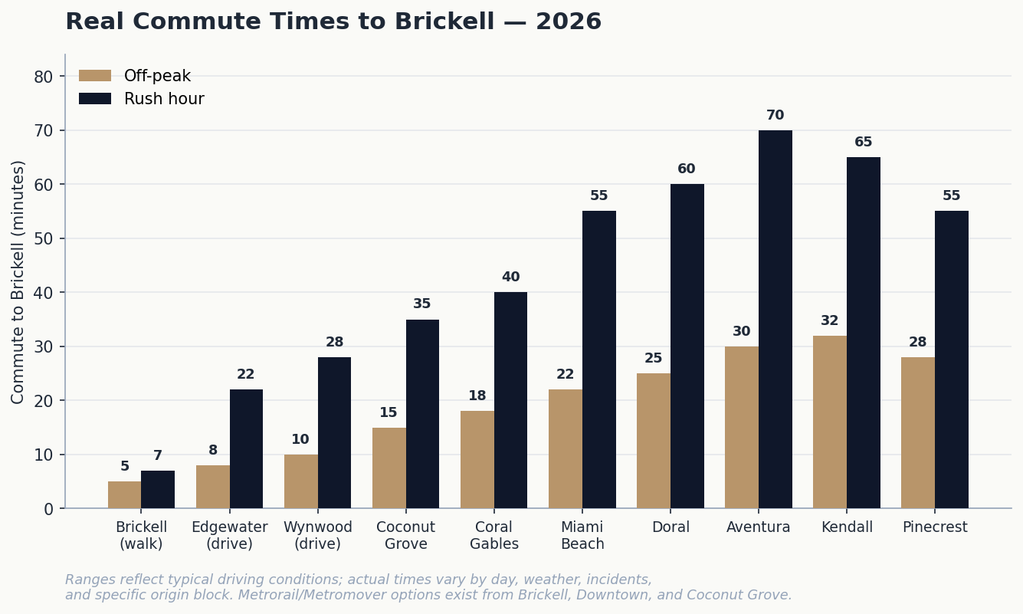 The gap between off-peak and rush hour tells you almost everything about how Miami traffic works. Live in Brickell? Walking, 5 minutes. Live in Aventura, commuting to Brickell? 30 minutes off-peak, 70 minutes at rush hour — that's a 40-minute daily swing depending on when you leave the house.
Here's what most transplants miss: Miami traffic isn't gradual, it's binary. You either beat rush hour by leaving before 7:30 AM (or after 9:30 AM), or you sit in it. There's very little in-between.
If you're going to be a hybrid worker with flexible hours, you can absorb this. If you're a 9-to-5 in-office worker, factor an extra hour of your day every day into your neighborhood decision.
Two important footnotes: Metrorail matters more than you think. Miami has real transit along a limited corridor — if you live near a Metrorail station (Brickell, Coconut Grove, Coral Gables, Dadeland) and work near one, you can genuinely commute without a car. That's a real quality-of-life gain most newcomers don't factor in. The causeways change everything. Getting to Miami Beach from the mainland means crossing MacArthur, Julia Tuttle, or Venetian.
Traffic on these can flip from 15 minutes to 55 minutes in a single accident. If you're deciding between mainland and Miami Beach, understand you're not just choosing a neighborhood — you're choosing whether a causeway is between you and your daily obligations.
A Few Neighborhoods I Get Asked About But Rarely Recommend
I try to be honest with clients rather than positive about every neighborhood, so here are the ones I typically steer people away from — with the reasons.
Downtown Miami (the core) — highest walkability score in the city, but the residential feel is still catching up. Weekend and evening street activity is thinner than you'd expect for a 99-Walk-Score neighborhood, and the transient-tourist and event traffic can wear on long-term residents.
Most people who think they want Downtown actually want Brickell. Hialeah — genuinely affordable, but only makes sense if you have real ties to the community, Spanish-first cultural preferences, and don't mind driving for professional and dining life. Great value, tough fit for most relocation clients. North Miami / Aventura's outer edges — some real value here, but the further north you go, the more you're actually committing to a Broward-oriented life. Great if you work in Fort Lauderdale. Confusing choice if your center of gravity is Miami-Dade. Key Biscayne — technically Miami, functionally an island.
Beautiful, tight-knit community, top schools — but that single-bridge access means a car accident on the Rickenbacker Causeway can genuinely trap you at home. Underrated for the right buyer, wrong for anyone with time-sensitive commuting.
What I Do Differently When I Match Clients to Neighborhoods
The chart above is a starting point. Here's what actually happens in a real matching conversation with me: We map your week, not your weekend.
Where do you work? How often are you in the office? Where do your kids go to school (or where might they)? Where do you exercise? Where do your closest friends and family live?
The neighborhood that fits your Tuesday morning is almost never the same as the one that fits your Saturday night. We factor real ownership costs, not just price. Two condos at $600K in different buildings can have wildly different monthly totals once HOA, insurance, and taxes are in — sometimes a $1,500/month difference.
The Real Cost of Living post I wrote earlier goes deep on this. We test drive the commute. Before you buy or lease, we drive from the actual property to your actual work at the actual time you'll be doing it. Sometimes twice.
This has changed more client decisions than any other single step. We separate lease from purchase. If you're new to Miami, our Florida Leasing Process is often the smart first move — 12 months of living in a neighborhood tells you things no amount of touring or research ever will. When you're ready to buy, our Florida Buyers Guide walks through what changes.
The Honest Bottom Line
There is no "best" Miami neighborhood. There's just the one that fits how you actually want your life to run. If I could put one thing on a t-shirt for every relocation client, it would be: choose your neighborhood the way you'd choose a job, not the way you'd choose a vacation destination. The vacation version of Miami is beautiful. So is the daily-life version — but they're different neighborhoods, and picking the wrong one is the fastest way to end up disappointed in a city you were supposed to love. The chart above will get you 70% of the way there. A real conversation gets you the rest. That's what I'm here for.
Frequently Asked Questions
What is the best Miami neighborhood to live in?
There isn't a single best neighborhood — the right choice depends entirely on your lifestyle stage and daily routine. Brickell and Wynwood-Edgewater suit young professionals wanting walkability. Coconut Grove, Coral Gables, and Pinecrest are the strongest choices for families needing top schools. Coconut Grove and Aventura tend to be the best fits for retirees. If you're a remote worker, Coconut Grove typically comes out ahead for most clients.
Which Miami neighborhood is best for families?
Coral Gables, Coconut Grove, and Pinecrest are the three most consistently recommended for growing families. Coral Gables and Pinecrest both offer 9/10 GreatSchools-rated public high schools (Coral Gables Senior High and Palmetto). All three have strong private school options, established residential character, and significantly better safety and infrastructure for kids than the urban condo neighborhoods.
Is it worth living in Brickell?
For young single professionals, couples without kids, and remote workers who want walkability and urban lifestyle, Brickell is one of the best neighborhoods in the country — 95 Walk Score, restaurant density, transit access, corporate proximity. For families needing space, school access, or a residential feel, Brickell is a challenging fit.
How bad is Miami traffic really?
Bad, but binary. If you can leave before 7:30 AM or after 9:30 AM in either direction, you can move through the city relatively easily. If you're locked into a 9-to-5 schedule during rush hour, expect a 30-60 minute commute for anything more than 5 miles from your home, and much more if you're crossing a causeway.
Should I rent before buying in Miami?
For most relocation clients, yes. Renting for 12 months lets you experience how neighborhoods actually feel day-to-day, how commutes actually work, and how insurance and HOA behavior actually plays out on specific properties — information you can't get from touring alone.
Ready to start the neighborhood matching conversation for yourself?
Our Florida Relocation Process is built specifically to walk through exactly this kind of decision before you commit. Want to explore individual neighborhoods in more depth first? Our Florida Communities guides cover each area with the detail this post can't.
If you're leaning toward renting first, our Florida Leasing Process is the right starting point. When you're ready to buy, our Florida Buyers Guide covers what to expect. Or if you're focused on new construction and pre-construction pricing, our Miami new developments page covers what's actively coming to market.
Either way — I'd rather help you match to the right neighborhood upfront than watch you learn the hard way six months in.
Check out this article next