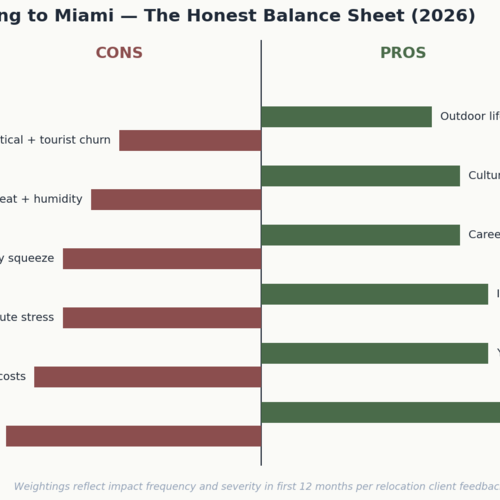
Let me tell you what I've learned watching people move to Miami. The ones who arrive stress-free aren't the ones with the most money, or the fanciest movers, or the perfect timing. They're the ones who started the checklist 90 days out and stuck to it. Every single time. The people who show up frazzled — sleeping on inflatable mattresses because the moving truck is delayed, driving without a Florida license three weeks in, discovering the day before move-in that their condo building requires association approval — those aren't unlucky people. They're the ones who thought Miami's moving process would work like any other city's. It doesn't.
Florida has its own legal deadlines, insurance requirements, and paperwork realities that trip up people who assume "moving is moving." Add in Miami-specific quirks like condo association approvals, hurricane prep, and the summer moving heat, and you have a process that punishes procrastination in ways most transplants don't see coming. So this is the actual checklist. Not the fluffy "make a list" version — the real one, day by day, in the order I walk relocation clients through it. What to do 90 days out, 60 days out, 30 days out, move day itself, and the critical first 30 days once you're here. If you're already working through this decision and want expert help, our Florida Relocation Process is designed around exactly this timeline.
Or if you're leaning toward leasing your first year to test-drive Miami before buying, our Florida Leasing Process walks through the condo association approvals and building requirements most people don't know about until they're already stuck.
The 90-Day Roadmap at a Glance
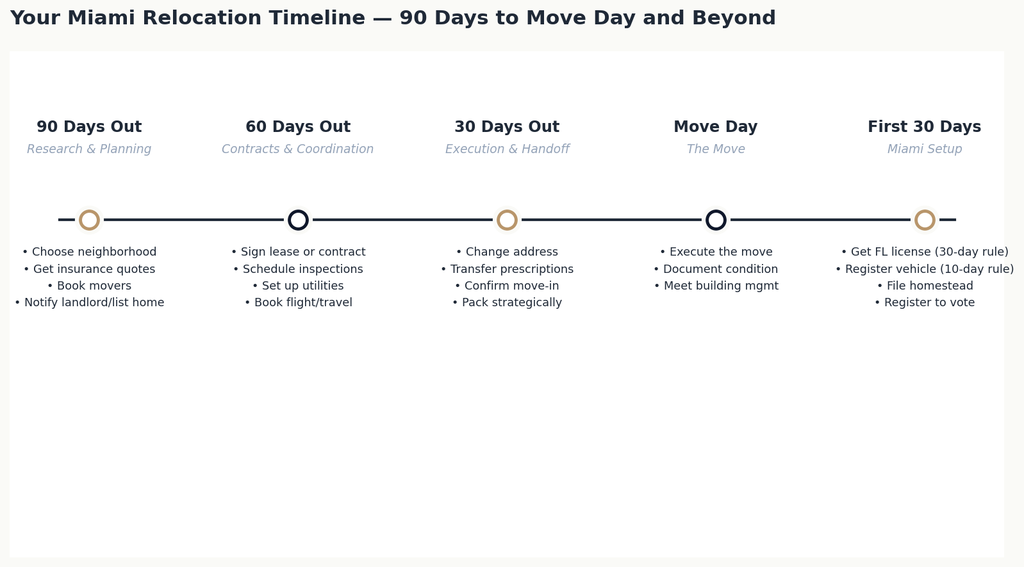
Here's the big picture. Then I'll walk you through each phase in detail — including the Miami-specific curveballs nobody warned you about.
90 Days Out: Research & Planning
This is when most people are still in "should I really do this?" mode. But if you're serious, this is when the real work starts.
Choose your neighborhood — or narrow it to 2-3. Don't try to pick the perfect neighborhood remotely. Do pick the two or three that fit your work, budget, and lifestyle so you can focus your search. I've written extensively on how to match yourself to a Miami neighborhood in The Neighborhood Matchmaker Guide — start there.
Get insurance quotes on real properties, not averages. This is the single biggest 90-day-out task most people skip. Florida homeowners insurance averages ~$8,458/year, and Miami-Dade coastal properties routinely run $6,000-$10,000+. Some properties are uninsurable at any price. Others need $50K+ in roof work before a carrier will write a policy. Waiting until you're under contract to discover this is how people lose their earnest money.
Book your moving company. Long-distance movers get booked out 4-8 weeks in advance, and summer moves (peak season) run 40-50% more expensive than winter moves. If you can time your move for October through April, you'll save real money.
Notify your current landlord or start listing your current home. Most leases require 60 days written notice; a home listing needs 30-60 days to sell in most markets. Time this backward from your target Miami move-in date.
Start compiling documents. Employment records, bank statements, tax returns from the past two years, prior insurance policies, medical records, school records if you have kids. Miami condo associations and Florida agencies will ask for more paperwork than you're used to.
Book a scouting trip if you haven't already visited. Two or three days on the ground in your top-choice neighborhoods, at rush hour, at night, and on a weekday morning. Tour groceries. Test the actual commute. Sit outside for 30 minutes and see what the block feels like. This trip has changed more client decisions than any research ever will.
60 Days Out: Contracts & Coordination
This is when abstract planning becomes real commitments.
Sign your lease or purchase contract. Ideally 60 days before you want to be in Miami — this leaves buffer for inspections, insurance, financing, and any surprises. If you're buying, our Florida Buyers Guide covers what to expect from this specific stage.
Schedule inspections and insurance quotes for the actual property. Home inspection, wind mitigation inspection (which affects insurance pricing), four-point inspection (required for many properties). Get insurance quotes on the actual address, not general estimates.
Set up utilities in advance. FPL (Florida Power & Light) is the electric provider for most of Miami-Dade — they need 2-3 weeks notice for new service. Miami-Dade Water & Sewer, internet (Xfinity, AT&T Fiber, or T-Mobile Home Internet are your main options), and gas if applicable. Do NOT wait until move week to set these up. FPL in particular sometimes has delays that will leave you without power on move-in day if you don't plan.
Book your flight and any bridge housing. If you can't move directly into your new place — because your closing is delayed, or your lease starts a week after your current one ends — Airbnb, corporate housing, or short-term rentals should be booked 60 days out. Miami short-term rates spike hard during major events (F1, Art Basel, Miami Open, boat show season, etc.), and last-minute bookings during peak season can cost $500-800/night.
If you have kids, start school records transfer. Miami-Dade Public Schools is the 4th largest district in the U.S. It runs efficiently, but paperwork takes 2-3 weeks minimum. Private and international school admissions can take much longer.
Start dealing with your current property. Home closing dates, cleaner scheduling, storage unit if furniture needs to sit while your Miami place is prepped, donation pickup for anything you're not moving.
30 Days Out: Execution & Handoff
Now it's real. This is when most people start to feel the pressure — and when small mistakes become expensive.
Change your address everywhere. USPS forwarding, banks, credit cards, subscriptions, HR at work, IRS if you file self-employment, all your recurring billing. Don't skip credit cards and banks — some financial institutions freeze accounts if statements bounce back, and unfreezing them takes days you don't have during move week. Transfer prescriptions to a Miami pharmacy. CVS, Walgreens, Publix Pharmacy, Navarro (Miami's largest local chain) all work fine. Do this 3-4 weeks before you move — running out of an important prescription because you tried to transfer it move week is a genuinely stressful problem.
Confirm your move-in with the building or seller. If you're moving into a Miami condo, get written confirmation of your move-in date from the building. Most Miami condo buildings require: - Move-in scheduling with the association (usually weekdays only, business hours) - Elevator reservations - Sometimes a security deposit for move-in damage - Certificate of insurance from your moving company I've had clients arrive at their new building on a Saturday with a moving truck and get turned away because the association only allows Monday-Friday moves. This is very Miami. Confirm the specifics in writing.
Pack strategically for the climate. Miami climate is brutal on stored items. Anything you're moving that's temperature-sensitive — artwork, electronics, wine, musical instruments, leather goods — needs climate-controlled transport. Uncontrolled moving trucks in Miami summer can hit 130°F+ inside; furniture warps, glue melts, screens crack. This is a real cost most people don't budget for.
Schedule utilities to disconnect at your current place, connect at Miami. This should already be set up from 60 days out — but confirm the actual dates now.
Update your auto insurance and health insurance to reflect Florida. Some carriers won't cover you in Florida under your current out-of-state policy. Others will, but at different rates. Get this locked before you drive to Miami.
The Real Move-In Budget
Before we get to move day, let's talk money. Because the number most people budget for their Miami move is significantly lower than what it actually costs.= 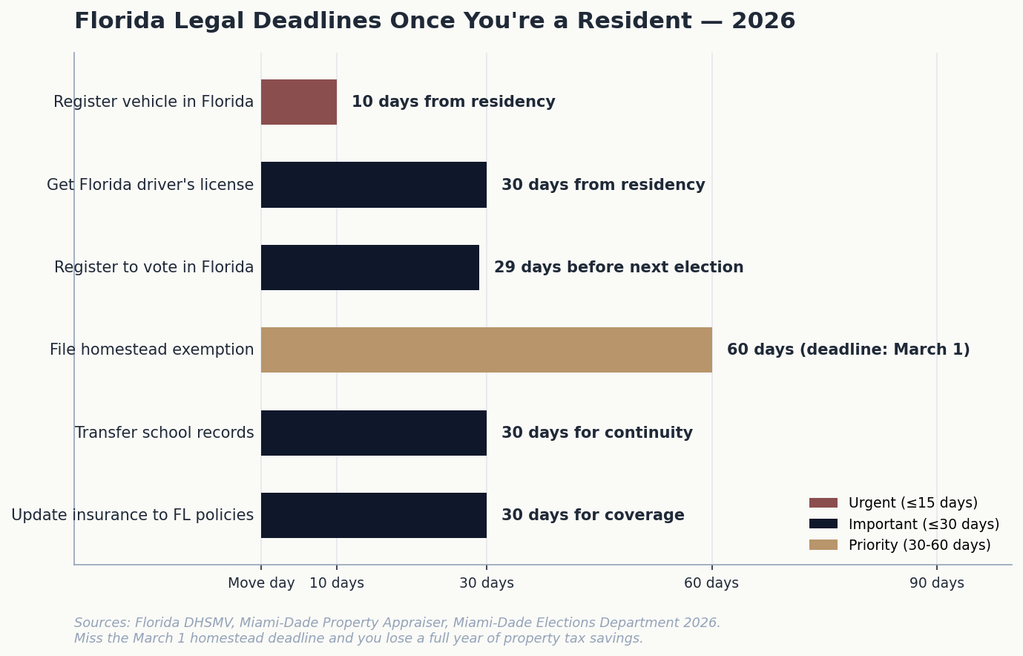
The realistic range is $10,000-$37,000 for a full cross-country relocation, before your rent/mortgage/deposits even come into play. Most first-time movers budget $5-8K and get blindsided. The two biggest surprises:
- Furniture strategy. Selling everything and buying new in Miami costs less than shipping cross-country for most movers coming from the East Coast — but not from the West Coast. Do the math on your specific origin. IKEA delivery in Miami is well-established, and there are plenty of West Elm, CB2, and Restoration Hardware options for higher-end furniture. But everything scales up if you have more than a small apartment worth of furniture.
- Deposits and move-in fees. Utility deposits ($100-400 depending on credit), condo association approval fees ($200-500), moving fee to the building ($150-500), elevator deposit ($300-1,000 refundable), pet deposits if applicable — this all adds up faster than expected. Keep a cash cushion of at least $5,000 beyond your planned move-in costs. Something will go wrong. Something always does.
Move Day: The Execution
The day itself, when done right, should be almost anticlimactic. If it's stressful, something in the 90/60/30 day planning got skipped.
Confirm the day before. Movers, building management, elevator reservation, utility activations, key handoff — call each one 24 hours out.
Do a thorough walkthrough with photos and video before anyone brings furniture in. If you're renting, this is your protection against being charged for existing damage when you move out. If you're buying, this is your record of any issues that came up between inspection and closing.
Meet building management if you're in a condo. Introduce yourself to security, the front desk, maintenance. Ask about package delivery procedures, guest policies, amenity access, garbage/recycling schedules. Miami condo life has rules; knowing them from day one prevents small friction.
Don't try to unpack everything on day one. Focus on the essentials: bed, bathroom, kitchen basics, work setup if you're working the next day. The rest can wait. You'll be too tired to make good unpacking decisions.
Order takeout and go to bed early. Miami is here tomorrow.
The First 30 Days: The Florida Legal Clock Starts Ticking
This is the phase most out-of-town relocation content skips. Florida has strict deadlines for new residents — and Miami-Dade specifically has some quirks worth knowing. 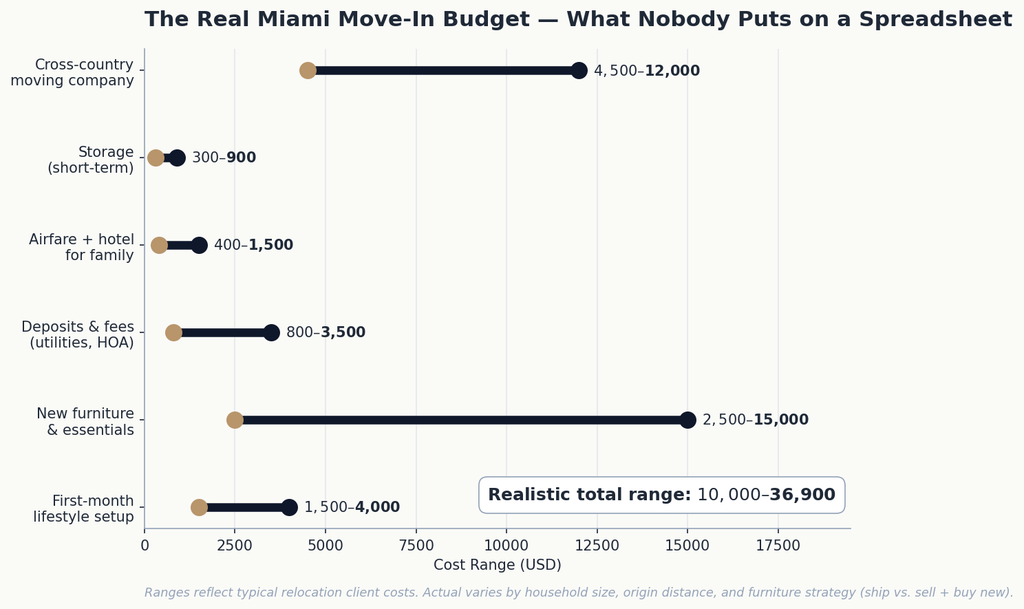 Let me walk through each one.
Vehicle registration: 10 days from establishing residency. This is the tightest deadline in the whole checklist and the one most people miss. You need to register your vehicle with the Miami-Dade Tax Collector within 10 days of becoming a Florida resident. Bring your out-of-state title, proof of Florida insurance, ID, and proof of residency (utility bill or lease). Expect to pay initial registration fee ($225) plus title transfer.
Florida driver's license: 30 days from residency. You have 30 days to convert your out-of-state license. Miami-Dade Tax Collector offices handle this now (transferred from DHSMV to the Tax Collector's office in recent years). Book an appointment online — walk-ins can wait 3-4 hours. Bring your out-of-state license, two proofs of Florida address, Social Security card, and passport or birth certificate.
Auto insurance conversion: same window. Your out-of-state auto insurance may or may not cover you as a Florida resident, and some policies drop coverage the moment you re-register your car in another state. Line up your Florida auto policy before that 30-day deadline hits. Miami car insurance runs 50%+ above the Florida state average, so expect a real jump from what you were paying elsewhere.
Homestead exemption: file by March 1. If you bought a home and it's your primary residence, this exemption saves you meaningful money on property taxes ($50,000 off assessed value + a 3% annual increase cap). You must file with the Miami-Dade Property Appraiser by March 1 to qualify for that tax year. Miss it and you wait a full year for the savings to kick in.
Voter registration: 29 days before the next election. Register through the Miami-Dade Elections Department. This also helps establish Florida residency for tax purposes if you're moving from a high-tax state that might audit your relocation.
School enrollment for kids. Miami-Dade Public Schools has specific documentation requirements: proof of residency (2 documents), immunization records (Florida requires specific immunizations that some states don't), birth certificate, previous school records. Start this before move day — the enrollment paperwork takes time.
Miami-Specific Setup Items Nobody Warns You About
Beyond the standard legal deadlines, there are Miami-specific setup items that aren't on any generic moving checklist. 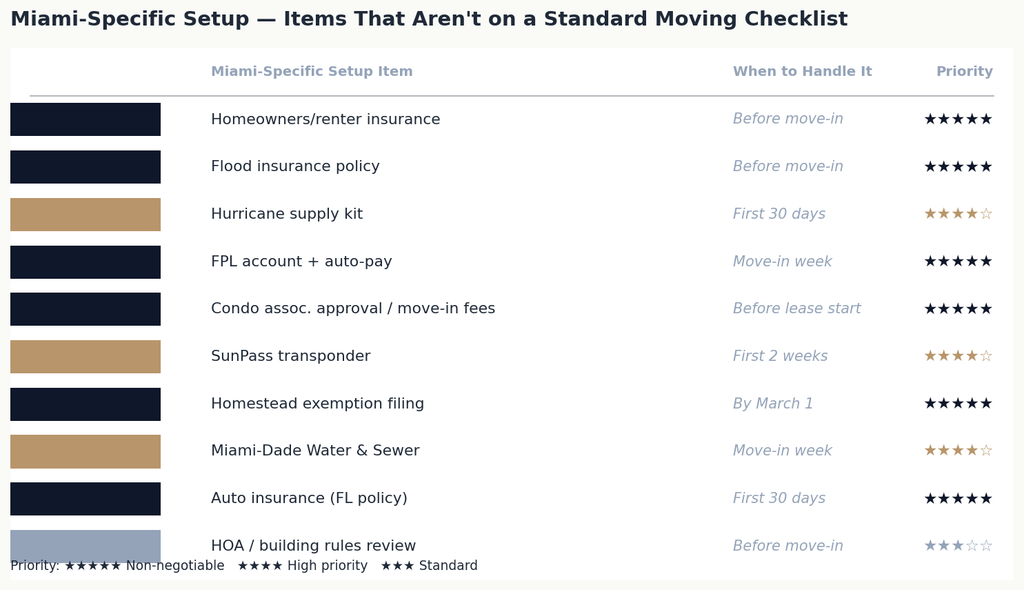
The ones that trip up people most consistently:
Hurricane supply kit. Hurricane season runs June 1 to November 30 in the Atlantic. Most seasoned Miamians keep a permanent kit stocked with water, non-perishable food, batteries, flashlights, portable radio, first-aid supplies, cash, and prescription medications. Building this in your first 30 days makes hurricane season a routine watch, not a scramble.
SunPass transponder. Miami-Dade is mostly cashless tolls now. Order a SunPass transponder (Florida's toll transponder) online before you get here — it arrives in 5-7 days. Without one, you're paying "toll-by-plate" fees that are meaningfully more expensive per crossing.
Condo association welcome packet. If you're in a condo, ask for the current CC&Rs (covenants), rules and regulations, and amenity access instructions. Learn the parking rules, pet rules, guest policies, elevator reservation process, and package delivery system in your first week — it prevents 90% of the small friction that turns condo life into daily stress.
FPL account with auto-pay. Set up your electric account with auto-pay from day one. Miami's electric bills average $246/month across Miami-Dade per EnergySage and can hit $400+ in peak summer months. Missing one payment during a heatwave is a bad way to start your Miami life.
What to Prioritize by Week
Here's my simplified week-by-week for your first month:
Week 1: FPL, water, internet all active. Building management introductions done. Address changes submitted for critical accounts (bank, credit cards, employer, IRS). Move-in walkthrough documented.
Week 2: Vehicle registered with Miami-Dade Tax Collector. Florida auto insurance active. SunPass transponder ordered/received. Prescription pharmacy transferred and first refill picked up. Building rules and amenity access sorted.
Week 3: Florida driver's license appointment scheduled and completed. Voter registration submitted. Kids' school enrollment complete if applicable. First hurricane supply kit purchased.
Week 4: Homestead exemption paperwork filed if you bought. Health insurance updated for Florida providers. Auto and homeowners/renter's insurance confirmed. Miami-Dade library card, if you want one. Meet your neighbors — I promise you'll thank me for this in year two.
The Costs You're Not Budgeting For
Beyond the direct moving costs, factor in the "settling in" costs:
- Furnishing the outdoor space. If your Miami place has a balcony, patio, or yard, you'll want outdoor furniture. Miami living is outdoor living. Budget $500-3,000 depending on scope.
- Wardrobe pivot. Most people moving to Miami discover they own too many warm-weather clothes and not enough of the right ones. You'll want breathable fabrics, plenty of workout clothes (Miami exercises a lot), swimwear, and event-appropriate warm weather formal wear. Budget $1,000-3,000 the first few months.
- Small appliances for the climate. A dehumidifier for closets, extra fans, better-quality window treatments if your unit gets afternoon sun. Small stuff that adds up to $500-1,500.
- Restaurant discovery period. Miami's food scene is one of its best features. Budget for the first three months to include real "trying Miami" money — $200-400 more per month than you'd normally spend on dining out. It's part of learning the city.
What I Wish More People Would Do
Two things separate the people who land in Miami feeling great from the people who feel stressed for months:
They over-communicate with everyone. Building management, movers, landlord, insurance agents, utility companies, employer HR. Assume everyone drops the ball on something. If you're proactive on confirmations, you catch problems while they're still solvable.
They give themselves 30 days of buffer for everything. Move-in date is 30 days before job start date if possible. Lease ends 30 days after new lease begins, not the same day. Movers arrive 3-5 days before your first day at work, not the night before. Miami will find ways to delay you. Buffer is your friend. That's the whole checklist. If you follow it, your move will be one of the more organized ones I've seen — and your first 30 days in Miami will feel like arrival, not survival.
Frequently Asked Questions
What should I do 90, 60, and 30 days before relocating to Miami? 90 days out: choose your neighborhood, get insurance quotes on real properties, book movers, notify your current landlord or list your home. 60 days out: sign your lease or contract, schedule inspections and utility setup, book bridge housing if needed, transfer school records. 30 days out: change your address everywhere, transfer prescriptions, confirm move-in with the building or seller, pack strategically for the climate.
How long does it take to move to Miami? The active moving process typically takes 90 days from decision to move-in day, plus another 30 days of setup once you arrive. Compressing this timeline is possible but expensive — last-minute movers cost 40-50% more, and you'll miss key Florida deadlines like the March 1 homestead exemption filing if you rush.
What Florida deadlines do I need to know as a new Miami resident? Vehicle registration within 10 days. Florida driver's license within 30 days. Homestead exemption filing by March 1 if you bought a home. Auto and homeowners insurance updated to Florida policies within 30 days. Voter registration at least 29 days before the next election.
How much does moving to Miami actually cost? Realistic total range is $10,000-$37,000 for a full cross-country relocation before rent/mortgage deposits — cross-country moving company ($4,500-$12,000), storage ($300-$900), airfare/hotel for family ($400-$1,500), utility and HOA deposits ($800-$3,500), new furniture ($2,500-$15,000), and first-month lifestyle setup ($1,500-$4,000). Keep at least $5,000 cash cushion beyond this range for unexpected costs.
Should I set up utilities before I move to Miami? Yes. FPL (Florida Power & Light) needs 2-3 weeks of notice for new service. Miami-Dade Water & Sewer, internet, and gas should all be set up during the 60-days-out phase. Waiting until move week is how people end up without power or water on their first day in the city.
Ready to actually work through this timeline with expert guidance? Our Florida Relocation Process is designed around exactly the 90-day structure I just walked you through. If you're leaning toward leasing your first year to test-drive Miami before committing, our Florida Leasing Process covers the condo association approvals and building requirements most transplants don't see coming. When you're ready to buy, our Florida Buyers Guide covers what changes for that stage. Either way — I'd rather help you land in Miami feeling organized than watch you learn the checklist the hard way.
Check out this article next