Let me tell you the conversation I have with almost every family moving to Miami. They start with the question they think they need answered: "What are the best schools in Miami?" And I have to gently redirect them to the question they actually need answered first: "Which of the four Miami school systems is right for your family?" Because Miami-Dade doesn't have one school system. It has four — and they operate under completely different rules, admissions processes, and financial expectations.
A family that assumes "we'll just enroll our kid in the best public school we can find" often discovers that "best" in Miami means something completely different than it did in their old city. Miami-Dade has 562 public schools serving 347,545 students, 183 public charter schools serving another 94,698, roughly 300 magnet programs within the public system, and 545 private schools serving 94,376 students — with private school tuition ranging from $17,000 to $57,000+ per year at the top of the market. That's 21% of Miami-Dade K-12 students in private schools, compared to a Florida state average of just 14%. So let me walk you through what each of these four systems actually is, how you get in, what they cost, and — critically — how to think about which one fits your family before you make a housing decision.
Because in Miami, your school choice often drives your neighborhood decision more than the other way around. If you're already working through Miami school planning and want expert guidance on matching schools to neighborhoods, our Florida Relocation Process is designed for exactly this decision. When you're ready to look at homes near specific schools, our community guides break down each neighborhood's school context in detail.
The 4 Miami-Dade School Systems at a Glance
Before we go deep, here's the honest overview of your four options: 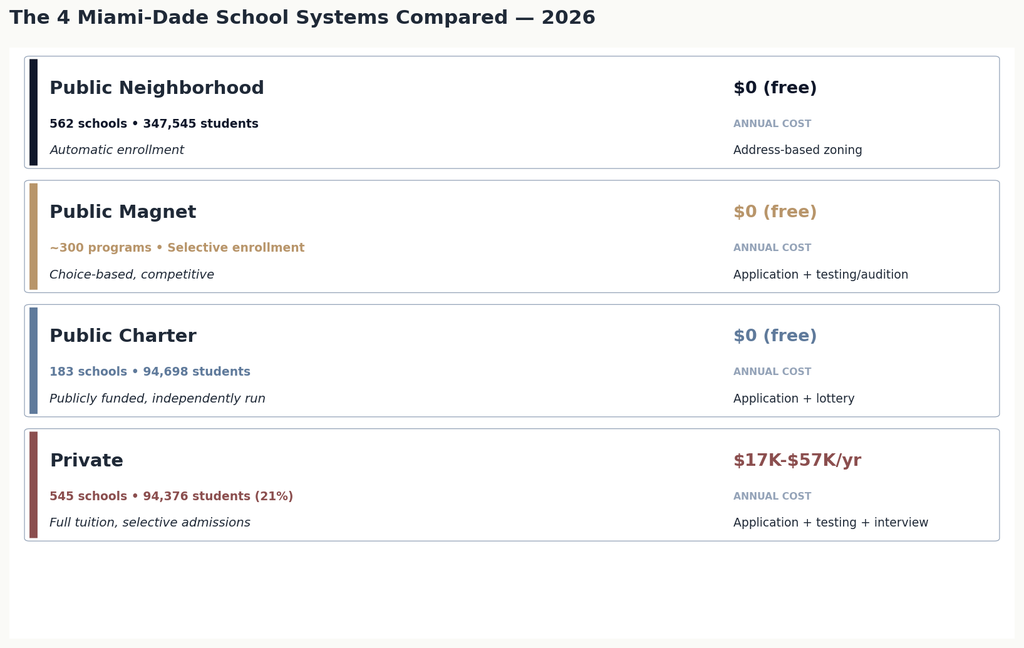 Each of these represents a completely different path with different rules, timelines, and outcomes. Let me walk through each one in detail.
System 1: Public Neighborhood Schools
This is the default. Every Miami-Dade address is zoned to a specific public elementary, middle, and high school based on street address. Enrollment is automatic — you provide proof of residency to Miami-Dade County Public Schools (M-DCPS) and your kids attend the assigned schools.
How it works: Miami-Dade Public Schools operates 562 schools across the county — the third-largest school district in the United States. Assignment is address-based. You cannot choose your neighborhood school; it's determined by where you live.
What you pay: Nothing. Full public funding.
When it works well: - Your target neighborhood has strong-performing schools that fit your kids - You value neighborhood stability and don't want to add commute stress - You're moving to established family neighborhoods like Coral Gables, Pinecrest, Palmetto Bay, or Miami Beach where the neighborhood schools have long track records
When it doesn't work: - You end up in a neighborhood zoned to underperforming schools - Your kids need specialized programs the neighborhood school doesn't offer - Boundaries change and your zoning shifts unexpectedly
The gotcha nobody warns you about: Miami-Dade school boundaries can change year to year. A home that's zoned for Coral Gables Senior High today might be re-zoned in a boundary adjustment next spring. Always verify the current zoning at the specific address AFTER your offer is accepted and BEFORE closing. I've had families move for a specific school zone and then discover mid-transaction that the boundary had shifted.
How to verify zoning: Use the M-DCPS school locator (dadeschools.net) to enter the exact address and confirm the assigned schools. Do this before you write an offer, and confirm again before closing.
System 2: Public Magnet Schools
This is where Miami-Dade genuinely excels compared to most public school systems in America. Magnet programs are specialized, choice-based public school programs focused on specific themes — arts, science, technology, international studies, dual enrollment. There are roughly 300 magnet programs across Miami-Dade.
How it works: You apply through Miami-Dade's Choice Program (yourchoicemiami.org) during the annual application window (typically October through January). Students apply to specific programs at specific schools. Admission is based on program-specific criteria: for arts magnets, an audition and portfolio; for STEM magnets, testing and grades; for International Baccalaureate programs, application and essay. Some programs are highly competitive with acceptance rates below 10%. Others operate with lottery systems where geographic priority matters (siblings of current students get priority, students living in the school's feeder pattern get preference, etc.).
What you pay: Nothing. Fully public. Top-tier public magnet programs to know about: 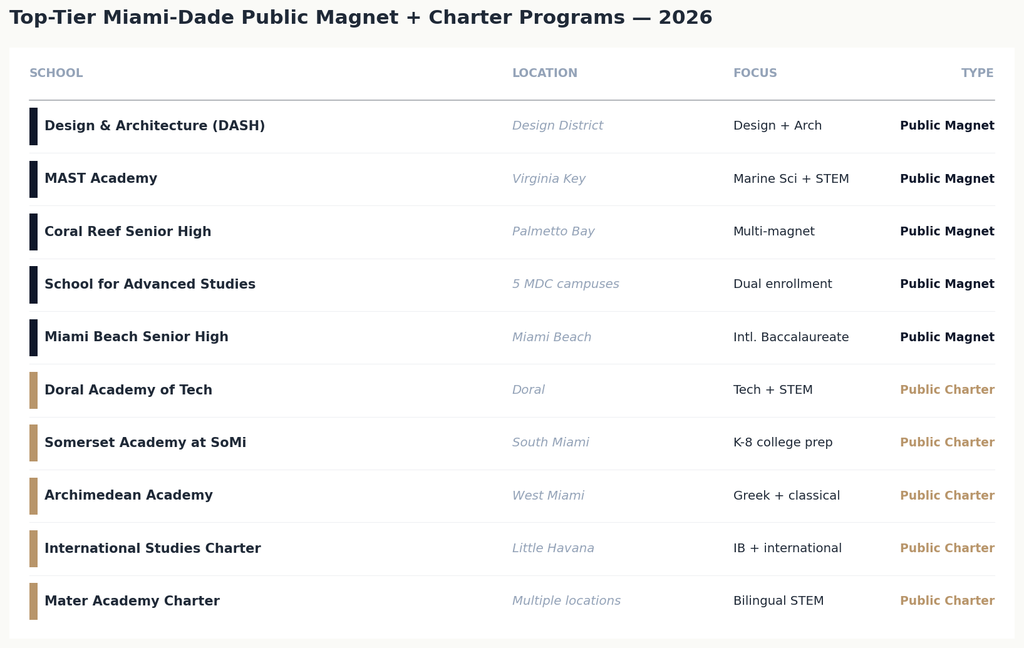 Design & Architecture Senior High (DASH) in the Design District is a nationally-ranked magnet for design, architecture, and visual arts. Consistently rated among the top public high schools in the country. Audition required.
MAST Academy (Marine and Science Technology) on Virginia Key focuses on marine science, environmental science, and STEM. Located on a working oceanographic campus with access to marine research facilities. Application + testing.
Coral Reef Senior High School in Palmetto Bay is one of the largest and most academically strong public high schools in Florida, offering multiple magnet strands (agriscience, business, computer science, digital media, health science, international studies, visual arts).
School for Advanced Studies (SAS) operates on five Miami Dade College campuses and enables 11th and 12th graders to complete high school while earning an associate's degree simultaneously. Free college education while in high school. Highly competitive academic admission.
Miami Beach Senior High School offers a strong International Baccalaureate program alongside its regular curriculum. IB attracts serious college-track students who want globally-recognized curriculum.
When magnets work well: - Your child has demonstrated aptitude in a specific area (arts, STEM, languages) - Your family is willing to accept longer commutes to attend a strong magnet program - You want top-tier public education without private school tuition
When magnets don't work: - Your child doesn't yet know their academic interests or hasn't developed a portfolio - You're relocating late in the application cycle (magnet windows are strict) - Competitive magnets have limited seats — a family with three kids can't count on all three getting in
System 3: Public Charter Schools
Charter schools are publicly funded schools operated by independent organizations under charters granted by the state. They're free to attend but operate outside M-DCPS's direct control, with their own curriculum, culture, and admissions processes.
How it works: Miami-Dade has 183 public charter schools serving 94,698 students — one of the largest charter school populations in the U.S. Most charters admit via lottery when demand exceeds seats (which it usually does at the top-tier schools). Some charters require an application, but they cannot use academic testing for admission — that would violate their public status.
What you pay: Nothing. Fully publicly funded.
Top-tier charter networks in Miami-Dade:
- Somerset Academy (multiple locations) — K-12 college prep. Somerset Academy at SoMi has been ranked #1 charter elementary in Florida.
- Doral Academy (Doral) — technology and STEM focus. Doral Academy of Technology ranked #1 charter middle school in Florida.
- Mater Academy (multiple locations) — bilingual STEM, one of the largest charter networks in Florida.
- Archimedean Academy (West Miami) — classical education with Greek language focus, top academic performance.
- International Studies Charter High School (Little Havana) — International Baccalaureate program, strong college placement.
- Pinecrest Preparatory (multiple locations) — college-prep focus, top performance.
When charters work well: - You want free education with more academic focus or specialized curriculum than typical public schools - Your assigned neighborhood public school isn't strong - You value specific educational philosophies (classical education, dual language, project-based learning) - You're willing to enter a lottery (or apply early enough to get in)
When charters don't work: - You don't want to gamble on lottery outcomes - You're relocating late and top charters are already full for the year - Your child needs specific special education services that a specific charter may not provide
The application timing that matters: Most Miami-Dade charter school applications open in the fall (October-December) for the following school year. If you're relocating mid-year, seats are often unavailable at top charters. Plan 12+ months ahead if a specific charter is your target.
System 4: Private Schools
Miami has one of the most robust private school markets in the country — 545 private schools serving 94,376 students, or 21% of the K-12 population (compared to 14% Florida statewide). This is disproportionately high because Miami has significant HNW population, extensive Catholic school infrastructure, and international families who often prefer private education.
How it works: You apply directly to each school. Admissions processes typically include an application, standardized testing (SSAT or ISEE for grades 5+), student and parent interviews, transcript review, and often a shadow day. Highly selective schools have acceptance rates under 20%. What you pay: A lot. Here's the honest 2026 landscape: 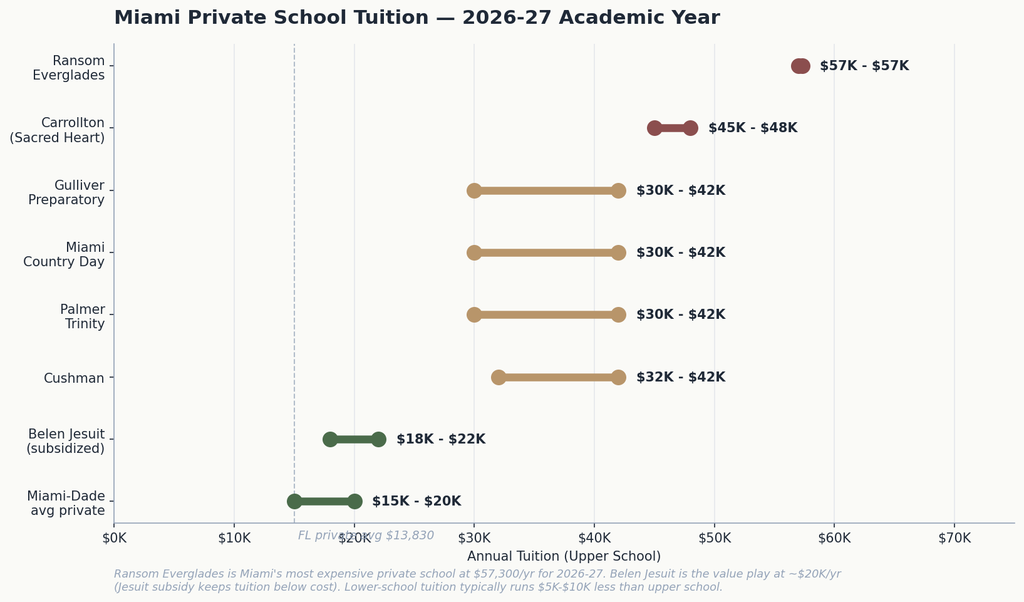 Miami's private school tuition landscape covers a wide range:
Ransom Everglades ($57,300/year for 2026-27) — Miami's most expensive private school, co-ed grades 6-12 in Coconut Grove. Founded in 1903, deeply established alumni network, exceptional college placement (Ivies and top LACs).
Carrollton School of the Sacred Heart ($45K-$48K) — All-girls Catholic in Coconut Grove. Part of the international Sacred Heart network. Strong academic reputation.
Gulliver Preparatory ($30K-$42K) — Co-ed K-12 with multiple campuses (main campus in Pinecrest). One of the largest private schools in Miami-Dade with the widest program range.
Miami Country Day ($30K-$42K) — Co-ed K-12 in North Miami. Diverse student body, strong arts and athletics programs.
Palmer Trinity ($30K-$42K) — Episcopal co-ed grades 6-12 in Palmetto Bay. 55-acre campus, one of the largest in Miami-Dade.
Cushman ($32K-$42K) — Co-ed K-12 in Coconut Grove. Founded 1924, strong academic and family community.
Belen Jesuit ($18K-$22K) — All-boys Catholic grades 6-12 in western Miami-Dade. Founded in Havana in 1854, reestablished in Miami in 1961. This is Miami's value play in private education — Jesuit subsidy keeps tuition well below cost while academic performance rivals schools charging twice as much. Extremely competitive admissions among Cuban-American families.
Miami-Dade average private tuition: $15K-$20K — When you strip out the top-tier schools, Miami has a robust middle-tier private school market with tuition in the $15K-$25K range covering many Catholic diocesan schools, Christian schools, and mid-tier independents.
When private works well: - You value specific pedagogical approach (Jesuit, Sacred Heart, Episcopal, Montessori, IB) - Your family has the income to sustain 13 years of tuition ($200K-$700K total per child) - You want the specific networking and alumni benefits of established private schools - Your target neighborhood's public schools don't fit your family - You want the smaller class sizes, more individualized attention, and specific culture private schools offer
When private doesn't work: - The financial commitment strains your household budget - You value diversity and public school community integration - Your kids will thrive equally in public magnet/charter without the cost - You'd rather redirect that $30K-$57K/year to college savings, family experiences, or other priorities
The financial reality check: At $40K/year per child in Miami private school, a family with two kids spends $1.04M over K-12 combined. That's not a decision to make casually. The Miami families who thrive with private schools are the ones who've genuinely committed to it as a values decision, not a status decision.
The Decision Framework: Which System Fits Your Family?
Rather than "what are the best schools," here's the honest framework I use with relocation families:
Choose public neighborhood schools if: - You're moving to an established family neighborhood with strong public schools (Coral Gables, Pinecrest, Palmetto Bay, Miami Beach, Aventura) - You value neighborhood community and short commutes over specialized programs - Your children are academically flexible and thrive in most environments
Choose magnet schools if: - Your child has clear specialized interests (arts, STEM, languages) - You're comfortable navigating M-DCPS's application system - You're willing to commute for the right program - You want top-tier education without private tuition
Choose charter schools if: - Your assigned neighborhood public school doesn't fit your family - You value specific educational philosophies (classical, dual language, project-based) - You're comfortable with lottery admissions - You're applying at least 12 months in advance
Choose private schools if: - You genuinely value the specific pedagogical approach, culture, or network - The financial commitment fits your household budget without strain - Your kids need smaller class sizes or specific support - You want to sidestep the M-DCPS bureaucracy and boundary uncertainty
Choose a hybrid strategy if: - Different kids in your family have different needs - You'll try neighborhood public schools for elementary and reassess for middle/high - You want to keep multiple options open Many Miami families end up in some form of hybrid — public magnet for elementary, private for middle and high, or vice versa. There's no "right" answer, only right fit for your family.
The Timeline That Actually Matters
Miami school enrollment is not something you can figure out in the last month before school starts. Here's the realistic timeline for a family relocating to Miami: 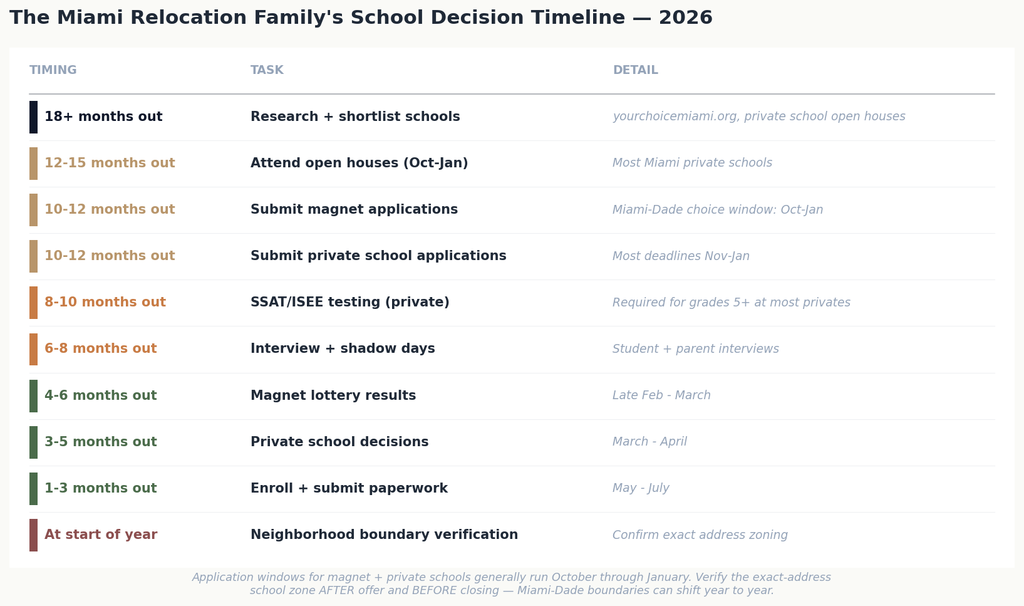 The critical windows to know:
October-January is application season. Both magnet and private school applications open in fall. If you're relocating mid-year, you've likely missed the window for the current school year and need to plan for next year.
February-March is decision season for magnets. Magnet lottery results are announced.
March-April is decision season for privates. Private school acceptances go out. Deposit deadlines follow shortly after.
May-July is enrollment paperwork. Verify final school assignments, submit health records, sign contracts, register for classes.
At start of school year: Confirm neighborhood boundary hasn't changed. This is the deal-breaker item — Miami-Dade can shift boundaries year to year.
The Neighborhood-School Interlock
This is the piece that makes Miami school planning genuinely different from other cities: your neighborhood choice often has to be made in coordination with your school choice. If your target school is a specific public neighborhood school (say, Coral Gables Elementary), you need to buy or lease in that specific school's zone — which may be a smaller area than "Coral Gables" broadly. If your target is a specific magnet school (say, DASH in the Design District), you can live anywhere in Miami-Dade but you'll be commuting your student to that campus daily. If your target is a specific private school (say, Ransom Everglades in Coconut Grove), you probably want to live within a 20-minute morning commute of that campus. The Miami families I see thrive in relocation are the ones who make the school decision first, then let it drive the neighborhood decision. The families who struggle are the ones who fall in love with a neighborhood, then discover after moving that the schools don't fit.
What Most Newcomers Get Wrong
Four common mistakes I see relocation families make:
1. Assuming Miami public schools are like their old city's public schools. They're not. M-DCPS is one of the largest and most complex public school systems in America, with dramatic variation in quality from school to school. "Miami public schools" isn't one thing — it's 562 different things.
2. Underestimating magnet school competitiveness. Top magnets like DASH, MAST, and School for Advanced Studies have admission rates that rival Ivy League colleges. If your child hasn't already developed a portfolio in the target area, admission is unlikely.
3. Skipping charter schools out of unfamiliarity. Families from cities without strong charter systems often don't realize how good Miami charters can be. Doral Academy of Technology and Somerset Academy at SoMi are ranked among the best public schools in Florida — and they're free.
4. Not verifying school zoning at the exact address. I've said it three times because it matters. Two houses on the same street can be in different zones. Never assume based on the neighborhood.
The Bottom Line
Miami has one of the most diverse educational landscapes in America. That's both the good news and the challenge for relocation families. Public neighborhood schools, magnet programs, charter schools, and private schools each offer completely different paths with different rules, timelines, and outcomes. The families who navigate this well start with an honest assessment of what their kids need and what they value, then work backward to identify the specific schools that fit — regardless of which system those schools operate under. Then they let the school decision inform the neighborhood decision, not the other way around.
That's the conversation I want to have with you before you make a housing decision. Not "what's the best neighborhood" — but "which school system fits your family, which specific schools within that system are the right fit, and how does that intersect with your neighborhood options."
Frequently Asked Questions
How many schools does Miami-Dade County have? Miami-Dade County has 562 public schools serving 347,545 students, 183 public charter schools serving 94,698 students, roughly 300 magnet programs within the public system, and 545 private schools serving 94,376 students. About 21% of all Miami-Dade K-12 students attend private schools, compared to 14% statewide in Florida.
How much does private school cost in Miami? Miami private school tuition ranges from $15,000 to $57,000+ per year for the 2026-27 academic year. The most expensive schools include Ransom Everglades ($57,300), Carrollton School of the Sacred Heart ($45K-$48K), Gulliver Preparatory ($30K-$42K), Miami Country Day, Palmer Trinity, and Cushman (all $30K-$42K). Belen Jesuit is the notable value at $18K-$22K due to Jesuit subsidy. Miami-Dade average private school tuition is $17,330 — meaningfully higher than the Florida state average of $13,830.
What are magnet schools in Miami and how do they differ from charter schools? Magnet schools are specialized public schools focused on specific themes (arts, STEM, international studies, IB) operated by Miami-Dade County Public Schools. Admission is choice-based with program-specific criteria (auditions, testing, portfolios). Charter schools are independently-operated public schools funded by the state but run outside the M-DCPS district structure. They typically admit via lottery, cannot use academic testing for admission, and have their own curriculum and culture. Both are completely free to attend.
When should I apply to Miami schools if I'm relocating? Application windows for both magnet and private schools generally run October through January for the following school year. Ideal planning starts 18+ months before your target start date — research and shortlist in late summer, attend open houses October-January, submit applications by winter deadlines, complete testing (SSAT/ISEE for private) in fall or winter, attend interviews February-March, receive decisions March-April, enroll and complete paperwork May-July. If you're relocating mid-year, you've likely missed windows for that school year and should plan for next year.
Should I choose my Miami neighborhood based on schools? Yes, especially if your children are school-age. Miami-Dade school assignment is address-based for public neighborhood schools, and two houses on the same street can be in different zones. If your target school is a specific public neighborhood school, you must buy or lease in that school's exact zone. If your target is a magnet or private school, you can live anywhere but want reasonable commute distance to the school. Always verify the exact-address school zoning with Miami-Dade County Public Schools before writing an offer, and again before closing — boundaries can shift year to year.
Ready to work through the school-and-neighborhood decision for your Miami relocation? Our Florida Relocation Process is designed specifically for this — matching your family's school priorities with the neighborhoods that make them possible. If you're leaning toward leasing your first year while you sort out the school decision, our Florida Leasing Process covers what to expect at that stage. When you're ready to buy near a specific school, our Florida Buyers Guide walks through what changes for that decision. For deeper neighborhood-by-neighborhood context, our community guides break down each area's school situation in detail. Either way — I'd rather help you make the school-and-neighborhood decision with clear eyes than watch you learn expensive lessons about Miami's school system after you've already signed a lease or a purchase contract.
Check out this article next