Let me tell you the honest thing about hurricane season in Miami that most people who've never lived here don't fully understand.
For six months out of the year — June through November — every serious Miami resident is quietly checking three things every week: the National Hurricane Center's five-day outlook, the FEMA flood forecast for their specific block, and their own preparation status. It's not paranoia. It's the operating system of living here.
The good news: Miami is arguably the best-prepared city in America for hurricanes. Post-Andrew (1992), Miami-Dade adopted the strictest building code in the country. Modern buildings routinely withstand Category 4 winds with minimal damage. Insurance markets, while expensive, have stabilized after the 2022-2024 crisis. Flood insurance is available and, for most properties, affordable.
The honest news: the specific address you buy or rent in Miami has a much bigger impact on your hurricane exposure than most newcomers realize. Two properties one block apart can have completely different flood zone designations, wildly different insurance costs, and different evacuation requirements. Making an informed choice starts with understanding what all three actually mean.
So let me walk you through the reality of Miami hurricanes, FEMA flood zones, and insurance in 2026 — not to scare you, but to help you make a decision with clear eyes.
If you're actively considering a Miami purchase and want expert guidance on evaluating specific properties for hurricane and flood risk, our Florida Buyers Guide walks through the full due diligence process. For accurate monthly payment modeling that includes real Miami insurance costs, our Miami Mortgage Calculator is built for exactly this.
The 3 Storm Risks Miami Actually Faces
Miami newcomers often think about "hurricane risk" as one thing. It's actually three different risks — each with its own mitigation strategy and its own insurance policy.
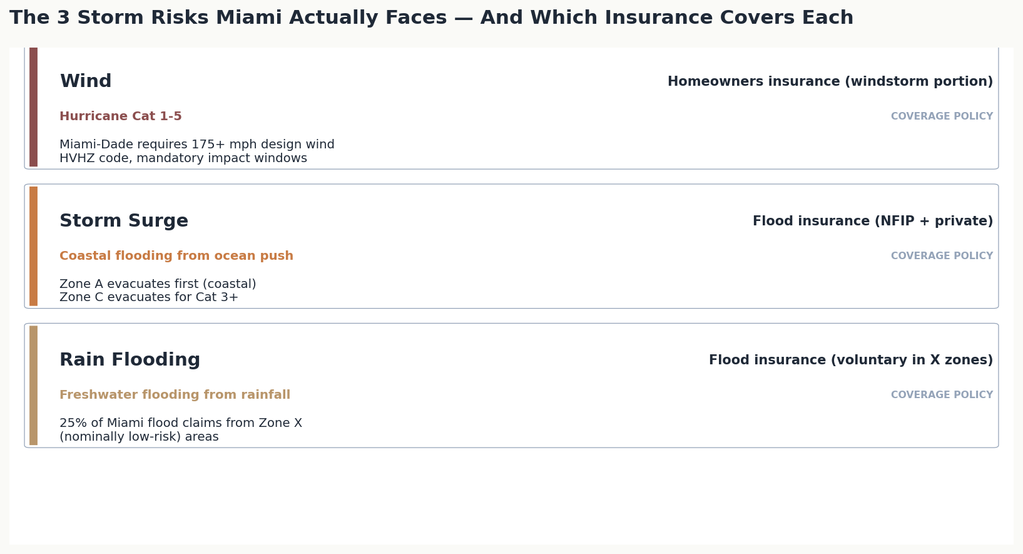
Understanding this three-part breakdown matters because different Miami neighborhoods face very different combinations of these risks. A high-rise Brickell condo on the 30th floor has almost zero storm surge risk but significant wind exposure. A ground-floor Coconut Grove home near the water has all three risks in serious form. A Pinecrest single-family home has meaningful wind risk but minimal storm surge or ocean-side flooding exposure.
Your specific address determines which risks you're actually taking on.
Risk 1: Wind Damage
Modern Miami buildings are engineered to withstand hurricane winds because Miami-Dade sits in what building code calls the High Velocity Hurricane Zone (HVHZ). Since the 2002 code update (post-Hurricane Andrew), every new building in Miami-Dade must be designed to withstand 175+ mph winds. Impact-resistant windows or hurricane shutters are legally required on every exterior opening.
If you buy a home built after 2002 in Miami-Dade, wind damage is largely a solvable engineering problem. The building will survive most storms. If you buy something older, wind resistance depends heavily on retrofits — impact windows, roof-to-wall hurricane straps, updated garage doors.
What covers wind damage: Your homeowners insurance (specifically the windstorm portion, which usually carries a separate deductible triggered only during named storms — typically 2% of your home's value).
Risk 2: Storm Surge
This is the risk that killed the most people in Hurricane Ian (2022) and Hurricane Katrina (2005). Storm surge is the wall of ocean water that a hurricane pushes inland ahead of itself — sometimes 15-25 feet high in a Category 4-5 event. It's mostly a coastal risk. If you're within a few miles of the coast, you need to know your evacuation zone.
Miami-Dade categorizes evacuation risk into three zones:
- Zone A — coastal and low-lying areas. Evacuate first for any hurricane. This includes Miami Beach, South Beach, Key Biscayne, Fisher Island, Bal Harbour, and low-elevation coastal Coconut Grove.
- Zone B — slightly inland but still vulnerable to flooding. Evacuate for Category 2 or stronger. This includes much of Coral Gables near water, parts of Downtown, Edgewater, and Wynwood.
- Zone C — evacuate only for Category 3 or stronger. Includes most of interior Miami-Dade, Pinecrest, and Kendall.
To check your specific address, use the Miami-Dade Hurricane Readiness Map (updated every season). Every Miami-Dade property is in one of these three zones.
What covers storm surge damage: Flood insurance (NFIP or private) — NOT homeowners insurance. Homeowners policies explicitly exclude flood damage of any kind.
Risk 3: Rain Flooding
This is the risk most newcomers dramatically underestimate. Miami's flat topography, high water table, and 60+ inches of annual rainfall mean that heavy rain events can flood streets, driveways, and ground floors — even miles from the coast.
Roughly 25% of Miami flood insurance claims come from Zone X properties — the "low risk" areas where flood insurance is technically optional. That's not a small number. It means one in four flood claims happens in areas that aren't officially flood zones.
What covers rain flooding damage: Flood insurance (voluntary in Zone X but strongly recommended in Miami).
Understanding Miami Flood Zones
The single most important step in evaluating a Miami property for hurricane risk is looking up its FEMA flood zone. Here's what the zones actually mean and what they cost:
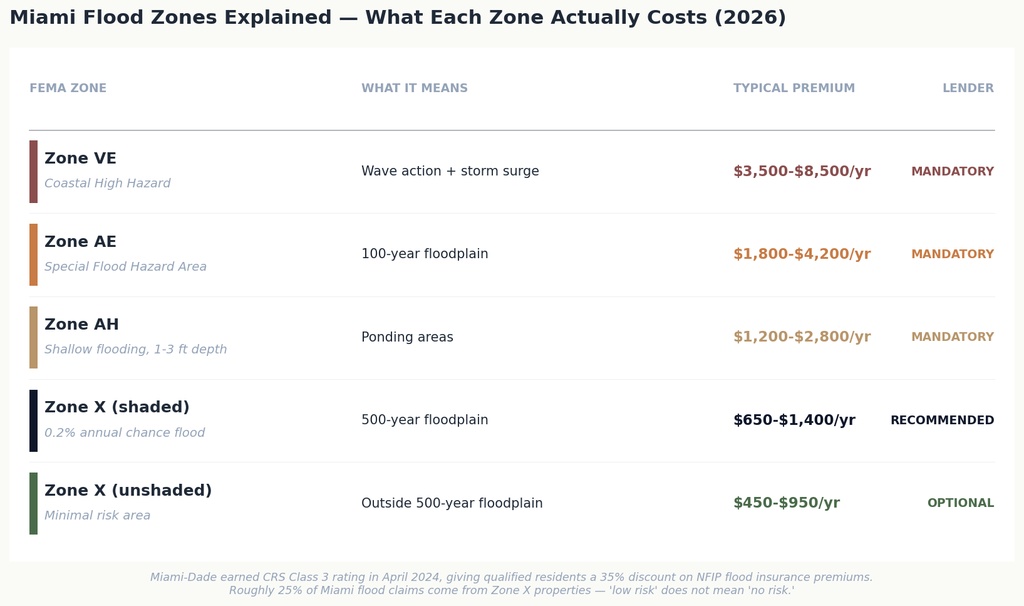
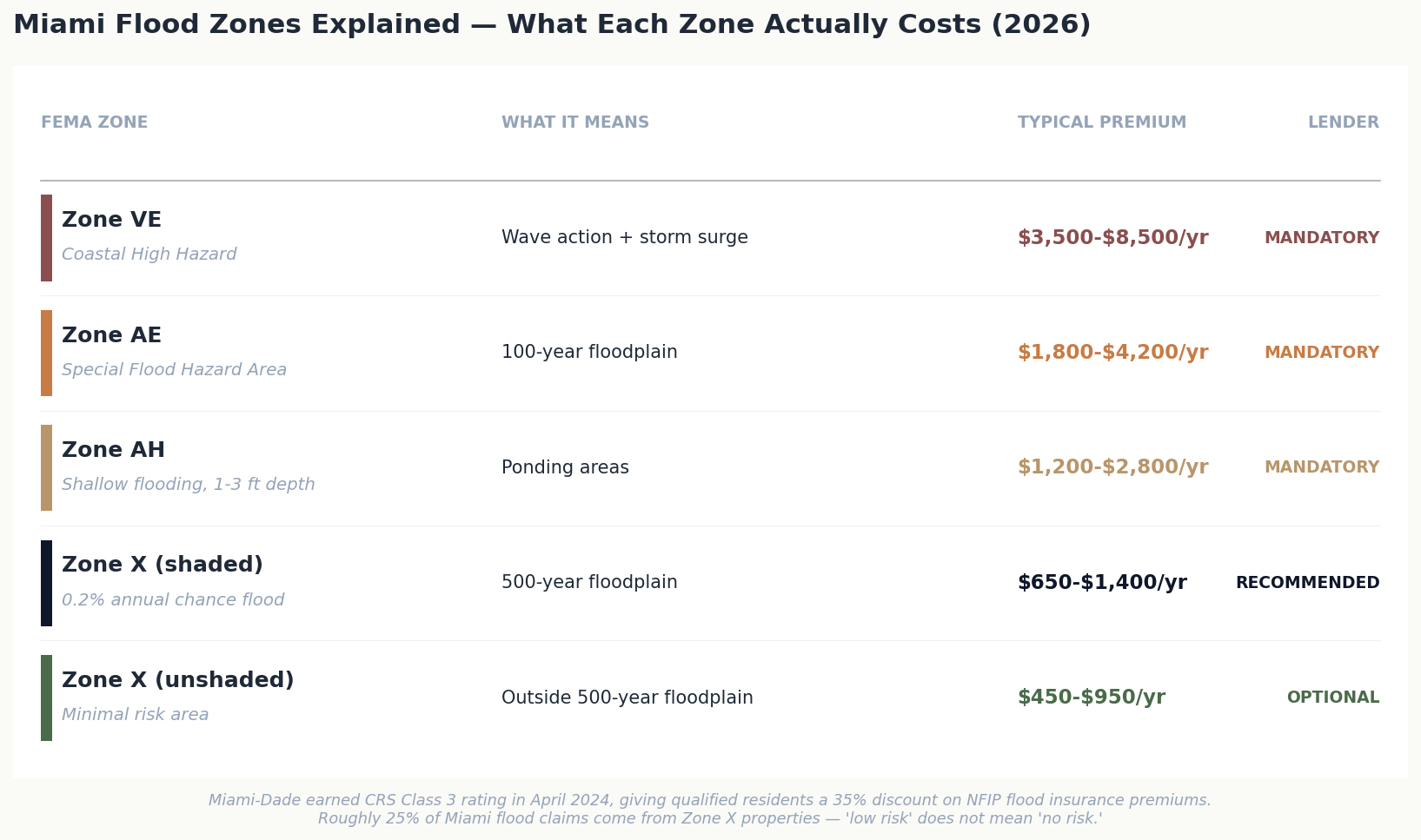
Zone VE — Coastal High Hazard. This is the most severe designation, applied to coastal areas exposed to wave action during storm surge. If you buy in a VE zone, your lender will require flood insurance and it will cost significantly more than any other zone. VE zones typically require homes to be elevated on pilings above base flood elevation. Miami Beach barrier island homes, Key Biscayne oceanfront properties, and parts of Fisher Island are often VE.
Zone AE — Special Flood Hazard Area (100-year floodplain). This is a high-risk area with a 1% annual chance of flooding. Lenders require flood insurance for any federally-backed mortgage. Most of Miami's coastal-adjacent neighborhoods have significant AE-zoned properties: parts of Coconut Grove, coastal Coral Gables, Edgewater's waterfront blocks, most of Miami Beach's mainland-adjacent areas.
Zone AH — Shallow Flooding. Areas subject to flooding 1-3 feet deep, typically from ponding rather than storm surge. Less severe than AE but still requires flood insurance. Common in inland pockets of Miami with poor drainage.
Zone X (shaded) — 500-year floodplain. Moderate risk area with a 0.2% annual chance of flooding. Flood insurance not required but strongly recommended. Represents about 25% of Miami flood claims.
Zone X (unshaded) — Minimal risk. Outside the 500-year floodplain. Flood insurance optional. Still not "no risk" — heavy rain events can flood anywhere in Miami.
The critical insight for newcomers: two houses one block apart can have completely different flood zone designations. Elevation matters enormously — even a few feet of elevation can move a property from Zone AE to Zone X. Always check the specific address at FEMA's Flood Map Service Center (msc.fema.gov/portal) before making an offer.
The Miami-Dade CRS Class 3 Advantage
Here's something most newcomers don't know: Miami-Dade County is one of the top-rated communities in the country for flood mitigation. In April 2024, Miami-Dade earned a Class 3 rating in FEMA's Community Rating System (up from Class 5), which gives qualified residents a 35% discount on NFIP flood insurance premiums in most of the unincorporated county.
This is genuinely meaningful money. A $2,500/year NFIP flood policy becomes $1,625/year with the discount applied. Over 30 years of ownership, that's $26,000+ in savings.
Not every Miami-Dade address qualifies for the discount — it depends on whether your specific property sits in the unincorporated Municipal Service Area. Confirm with your insurance broker when getting quotes.
What Insurance Actually Costs — Beyond Just the Number
I covered Miami homeowners insurance in detail in a separate 2026 guide. The short version: Miami-Dade averages $6,045/year for standard homeowners insurance in 2026 (after Spring's 14% Citizens rate cut). Coastal single-family homes routinely quote $9,000-$18,000/year.
Flood insurance is a separate policy on top. NFIP flood insurance costs $650-$3,000+ per year depending on your zone and elevation. Higher-value homes above NFIP's $250K coverage cap need supplemental private flood insurance.
The math for a typical Miami purchase looks like this:
- $600K condo, non-flood zone: ~$300/mo homeowners + $0 flood = $3,600/year
- $600K condo, Zone AE: ~$300/mo homeowners + $130/mo flood = $5,160/year
- $1M SFH, non-flood zone: ~$700/mo homeowners + $0 flood = $8,400/year
- $1M SFH, Zone AE with private flood coverage: ~$700/mo homeowners + $250/mo flood = $11,400/year
- $2M waterfront, Zone VE: ~$1,500/mo homeowners + $600/mo flood = $25,200/year
The waterfront premium is dramatic. This is why so many Miami buyers who love the idea of waterfront living end up backing off once they see actual insurance quotes.
How to Actually Cut Your Insurance Cost (Wind Mitigation)
The single biggest lever Miami homeowners have on their insurance premium is wind mitigation. Every hurricane-hardening feature on your home reduces the windstorm portion of your premium.
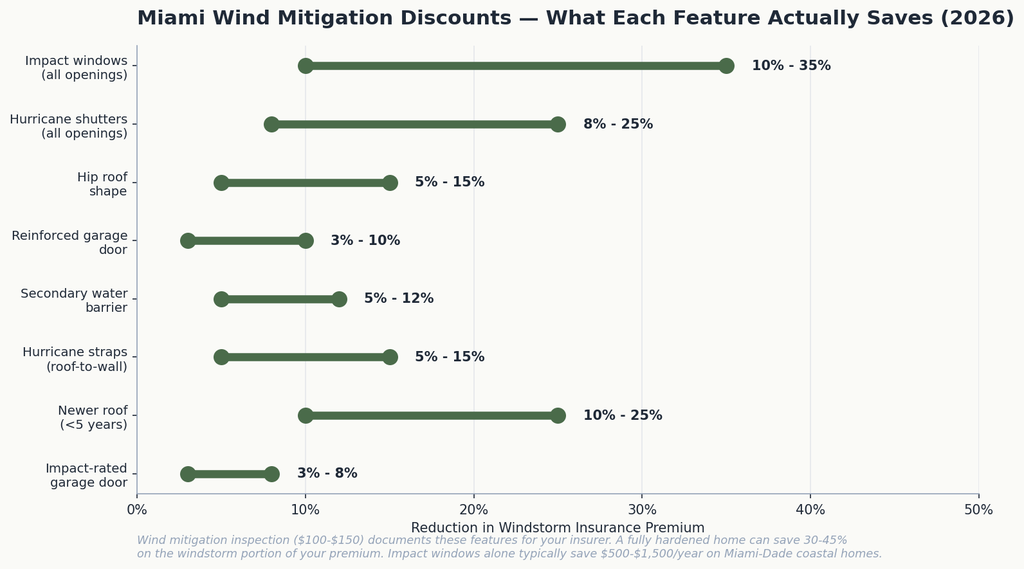
The economics are compelling:
Impact windows are the highest-ROI improvement. They save 10-35% on the windstorm portion of your premium — typically $500-$1,500/year on a Miami-Dade coastal home. Impact windows also eliminate the need to install/remove hurricane shutters every storm season, which saves labor cost and stress. Installation costs $8,000-$25,000+ depending on home size, but insurance savings can offset the cost within 10-15 years, and you get the storm protection benefit permanently.
Hurricane shutters offer similar savings at lower upfront cost. $2,000-$8,000 to install accordion or roll-down shutters. Downside: you have to deploy them every storm, which is stressful during evacuation.
Newer roofs (under 5 years old) can save 10-25% on premiums. This is why roof age has become the #1 rating factor in Florida insurance since 2022.
Hip roof shape saves 5-15%. Hip roofs (sloped on all four sides) shed wind better than gable roofs (with vertical end walls). You can't change your roof shape easily, but knowing your roof type helps predict your insurance cost.
Reinforced garage doors and hurricane straps each add smaller savings that stack.
To capture these discounts, you need a wind mitigation inspection ($100-$150). This is a report that documents your home's specific features for your insurance carrier. It's the highest-ROI inspection Miami homeowners can pay for. Every insurance broker will ask for it.
The Building Code Reality (HVHZ)
Miami-Dade and Broward Counties operate under the strictest building code in the United States: the High Velocity Hurricane Zone (HVHZ). This has practical implications for buyers:
All new construction since 2002 must meet HVHZ standards. Design wind speeds of 175+ mph, impact-rated windows or approved shutter systems on every opening, continuous load path engineering, and Miami-Dade NOA (Notice of Acceptance) certification on every window, door, and roof system. These homes are genuinely storm-hardened.
Older homes (pre-2002) may not meet current code. Wind mitigation retrofits (impact windows, roof straps, garage door reinforcement) are strongly recommended and often required by insurance carriers for coverage.
The 30% rule is a hidden gotcha. If you replace more than 30% of a home's exterior openings (windows and doors), Florida code can require you to bring the entire home envelope up to current HVHZ standards. This can turn a "just replace the windows" project into a much bigger renovation.
Code updates every 3 years. The 8th Edition Florida Building Code (currently in effect) will be replaced by the 9th Edition on December 31, 2026. New construction permits pulled before that date lock into the current code; permits pulled after must meet tightened requirements.
What Newcomers Should Actually Do Before Buying
Here's the specific playbook I walk relocation buyers through:
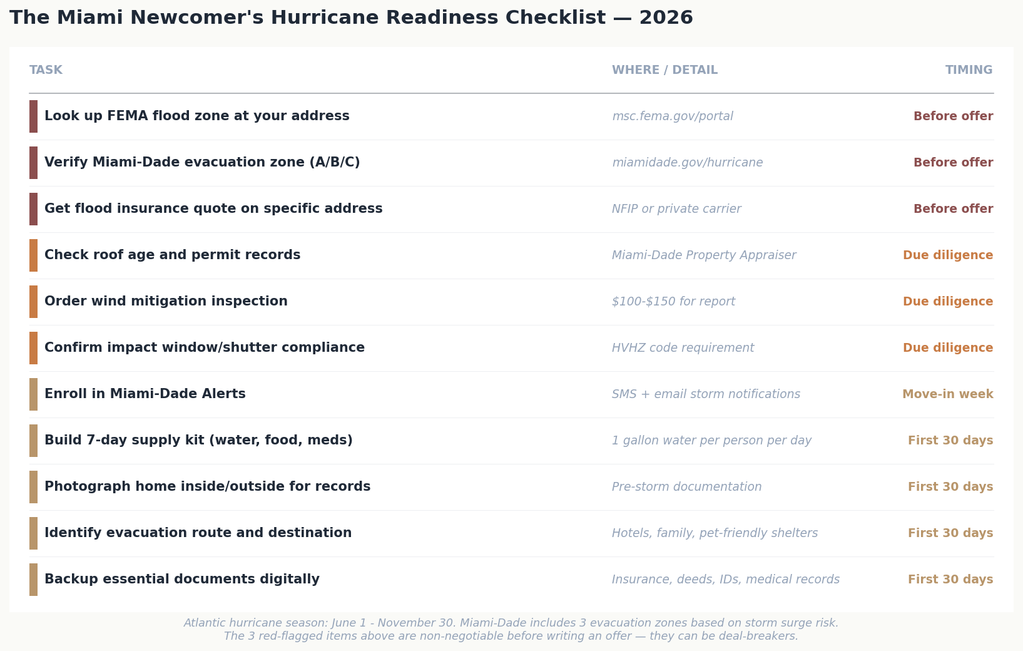
The 3 red-flagged items are non-negotiable before writing an offer:
1. Look up the FEMA flood zone at the specific address. Not the neighborhood — the exact address. Use msc.fema.gov/portal. This takes 2 minutes and determines whether you need mandatory flood insurance.
2. Verify the Miami-Dade evacuation zone (A/B/C). Use miamidade.gov/hurricane. This tells you whether you'll evacuate for every storm or only major ones, and where you'll need to go.
3. Get a flood insurance quote on the specific address. Never assume based on neighborhood. A quote takes 24-48 hours. Get it during your option period, not after you're committed to closing.
The 3 orange-flagged items belong to due diligence:
Check the roof age and permit records at the Miami-Dade Property Appraiser's website. Anything over 15 years old is a serious insurance risk.
Order a wind mitigation inspection during due diligence. Cost is $100-$150 and can save you thousands per year in premium reductions if the home has hurricane-hardening features.
Confirm impact window/shutter compliance with HVHZ code. Older homes especially may have non-compliant openings that insurance carriers require you to remediate.
The remaining items belong to your first 30 days as a Miami resident.
The First 30 Days: Getting Actually Prepared
Once you close and move in, hurricane preparedness becomes an ongoing part of Miami life. The specific things to do in your first month:
Enroll in Miami-Dade Alerts. This is the county's official emergency notification system. You'll get SMS and email notifications about approaching storms, evacuation orders, and shelter openings. Sign up at miamidade.gov/alerts.
Build a 7-day supply kit. Not 3-day — 7-day. Miami's dense population means grocery restocking after a hurricane is slow. Standard supplies: 1 gallon of water per person per day, non-perishable food, flashlights, batteries, portable radio, first-aid kit, prescription medications for 2 weeks, cash (ATMs often don't work post-storm), phone chargers, portable battery banks.
Photograph your home inside and outside. Every room, every wall, every valuable. Store the photos in cloud storage. If a storm damages your property, these photos are your insurance claim documentation.
Identify your evacuation route and destination. If you're in Zone A or B, know where you'll go before the season starts. Options include family/friends in Zone C or outside Florida, pet-friendly hotels along evacuation routes (I-75, I-95 north), or official public shelters (last resort for most, but essential for people without other options).
Backup essential documents digitally. Insurance policies, deeds, IDs, medical records, prescription lists, contact info for family. Cloud storage (iCloud, Google Drive, Dropbox) works. Physical waterproof safe as backup.
The Reality Nobody Warns You About
Two things about Miami hurricane life that don't show up in the guides:
The stress is real but manageable. For most Miami residents, hurricane season is 5-6 months of low-grade background awareness punctuated by occasional acute stress when a specific storm looks like it might hit. Most seasons pass without a direct hit. The last major hurricane to hit Miami directly was Hurricane Wilma in 2005 (Cat 3 landfall). We've had close calls since — Matthew (2016), Irma (2017, hit as Cat 4 in the Keys but weakened before Miami), Ian (2022, hit Fort Myers) — but Miami-Dade specifically has been relatively fortunate.
Your specific address determines your stress level. People in Miami Beach have a fundamentally different relationship to hurricane season than people in Pinecrest. Barrier island residents pay attention to every storm's five-day cone. Inland residents mostly just make sure their supply kit is stocked. Your neighborhood choice affects your daily life during hurricane season far more than most newcomers expect.
The Bottom Line
Hurricanes are the Miami cost of admission. They're real. They're not going away. The building code has made Miami dramatically safer than it was in 1992, insurance markets have stabilized after the 2022-2024 crisis, and modern hurricane forecasting gives residents 3-5 days of advance warning to prepare.
The key to living well with this reality is making informed decisions upfront:
- Check the FEMA flood zone before you make an offer
- Get real insurance quotes on the specific address, not neighborhood averages
- Prioritize wind-mitigation features (impact windows, newer roof, hip roof shape)
- Understand your evacuation zone before hurricane season starts
- Build your supply kit and evacuation plan in June, not when a storm is 3 days out
The Miami residents who thrive here aren't the ones who ignore hurricane risk — they're the ones who prepared properly and made smart neighborhood choices upfront.
That's the conversation I'd rather have with you before you make an offer than watch you learn expensive lessons after.
Frequently Asked Questions
What are the FEMA flood zones in Miami and what do they mean?
Miami has five main FEMA flood zone designations. Zone VE is coastal high hazard with wave action risk, typically $3,500-$8,500/year for flood insurance. Zone AE is the special flood hazard area or 100-year floodplain, typically $1,800-$4,200/year. Zone AH is shallow flooding (1-3 feet), typically $1,200-$2,800/year. Zone X (shaded) is the 500-year floodplain, insurance recommended at $650-$1,400/year. Zone X (unshaded) is minimal risk, insurance optional at $450-$950/year. Lenders require mandatory flood insurance for VE, AE, and AH zones.
Do I need flood insurance in Miami if I'm not in a flood zone?
Strongly recommended. Approximately 25% of Miami flood insurance claims come from Zone X properties — the "low risk" areas where flood insurance is technically optional. Miami's flat topography, high water table, and heavy rainfall mean freshwater rain flooding can occur miles from the coast. Voluntary flood insurance in Zone X costs $450-$1,400/year and provides critical protection.
What are Miami-Dade hurricane evacuation zones?
Miami-Dade has three evacuation zones. Zone A includes coastal and low-lying areas (Miami Beach, Key Biscayne, Fisher Island, low-elevation coastal areas) and evacuates first for any hurricane. Zone B is slightly inland but still vulnerable to flooding, evacuating for Category 2 or stronger. Zone C is interior areas that evacuate only for Category 3 or stronger. Check your specific address at miamidade.gov/hurricane.
How can I reduce my Miami home insurance premium?
Wind mitigation features are the biggest lever. Impact windows on all openings can save 10-35% on the windstorm portion of your premium. Hurricane shutters save 8-25%. A newer roof (under 5 years) saves 10-25%. Hip roof shape saves 5-15%. Hurricane straps, reinforced garage doors, and secondary water barriers each add smaller savings. Get a wind mitigation inspection ($100-$150) to document all features for your insurer. Miami-Dade residents in the unincorporated area also qualify for a 35% NFIP flood insurance discount from the county's CRS Class 3 rating.
Is Miami's building code enough to protect against hurricanes?
Homes built in Miami-Dade after 2002 must meet the High Velocity Hurricane Zone (HVHZ) code, the strictest in the United States. Requirements include 175+ mph design wind speeds, impact-rated windows on every opening, continuous load path engineering, and Miami-Dade NOA certification on all products. Modern HVHZ homes routinely withstand Category 4 winds with minimal damage. Older homes (pre-2002) may need wind mitigation retrofits — impact windows, roof-to-wall straps, updated garage doors — to meet current insurance requirements and safety standards.
Ready to work through the hurricane and flood risk on a specific Miami property you're considering? Our Florida Buyers Guide walks through the full due diligence process including flood zone verification, insurance shopping, and wind mitigation assessment. For accurate monthly payment modeling that includes real Miami insurance costs (not the generic estimate your out-of-state lender will give you), our Miami Mortgage Calculator is built for exactly this. If you're leaning toward leasing your first year to experience a full hurricane season before committing to a purchase, our Florida Leasing Process is designed for that test-drive approach. Either way — I'd rather help you evaluate the real risk on a specific property upfront than watch you learn expensive lessons after closing.
Check out this article next