Let me tell you the sentence I hear most from relocation clients considering Miami.
"Florida has no state income tax — that alone makes the move worth it."
Sometimes they're right. Sometimes they're spectacularly wrong. And the difference between the two isn't about attitude or optimism — it's about specific numbers, specific circumstances, and whether they understand what "no state income tax" actually means for their situation.
For a NYC family earning $500K, moving to Miami saves approximately $55,000 per year in state and city income taxes. Over 30 years, invested at 7%, that compounds to $5.6 million in additional wealth. That's not marketing — that's real math. For a California household at the same income, it's about $51,000 per year, or $5.2 million over 30 years.
But for a young professional earning $85,000 moving from Chicago to Miami, the tax savings are around $4,200 per year — which can be almost entirely eaten up by higher Miami insurance, higher car costs, and higher property tax if they buy. In that specific case, "Florida has no state income tax" doesn't actually save anything on net.
So let me walk you through what the tax savings actually look like at different income levels, what offsets to expect on the Miami side, and — critically — how to make Florida residency legally stick so you actually keep the savings when your old state audits you.
If you're already seriously considering a Miami move and want expert guidance on the financial trade-offs, our Florida Relocation Process is built around exactly this decision. When you're ready to buy, our Florida Buyers Guide walks through what changes on the property side.
The Real Numbers: What You Actually Save by Income Level
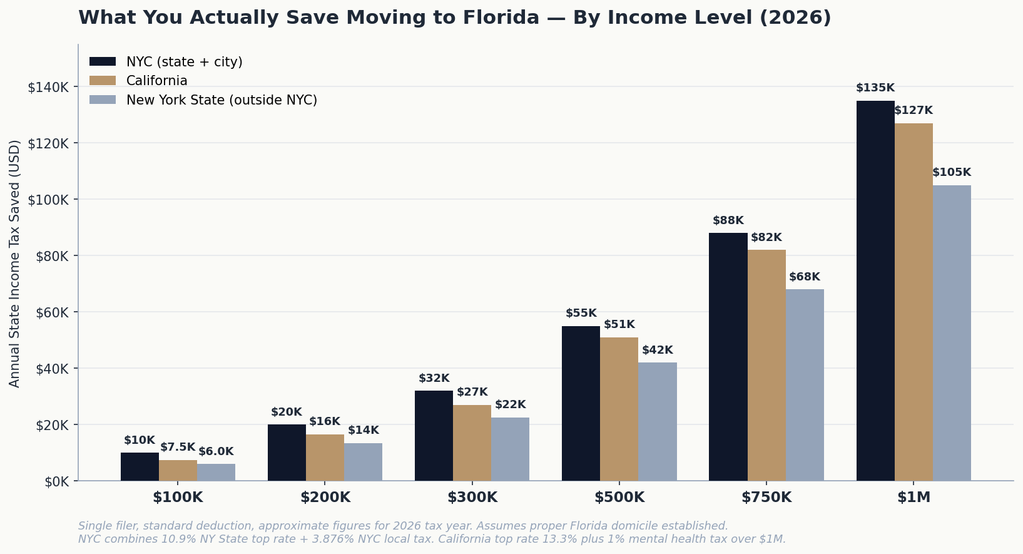
Here's what Florida's zero-income-tax status actually saves you per year, by income and origin state:
A few things to notice:
The savings scale with income, but not linearly. At $100K, moving from NYC to Florida saves you about $10K/year. At $500K, it's $55K. At $1M, it jumps to $135K. That's because both NYC and California use progressive tax brackets with top rates that don't hit until high income levels — 10.9% for NY State (plus 3.876% NYC), 13.3% for California, plus California's 1% mental health tax on income over $1M.
NYC is the highest-tax origin. New York City residents pay both state and city income tax, so the combined top rate is 14.776% — the highest in the nation. Moving from NYC to Florida almost always makes financial sense for high earners. Moving from California is a close second.
"Outside NYC" NY State is meaningfully lower. If you're in Westchester, Long Island, or upstate New York, you pay state tax but not the NYC city tax. Your savings from moving to Florida are still real but roughly 20-25% smaller than NYC residents'.
The $100K savings floor is real but small. At $100K income from any high-tax state, you're saving $6-10K/year. That's meaningful money — but not the "life-changing" savings you'll see in Miami relocation marketing.
Middle-tax states get much less benefit. Illinois has a 4.95% flat rate. Pennsylvania has 3.07%. Georgia is 5.75%. Moving from these states to Florida still saves you money, but it's typically $3,000-$7,000/year for middle-income households — often less than the additional Florida insurance and property tax costs.
The 30-Year Compounding Story
Here's where Florida's tax structure gets genuinely powerful. If you invest your annual tax savings at a reasonable 7% return, this is what compounds over 30 years:
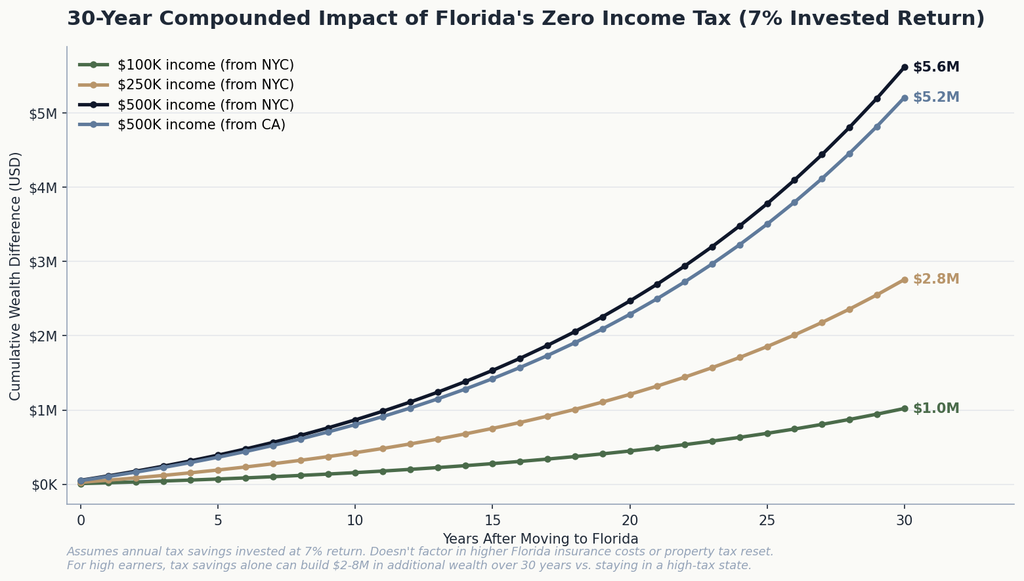
At $500K income from NYC, disciplined investment of your tax savings builds $5.6 million over 30 years. Same person moving from California builds $5.2 million. A $250K NYC earner builds $2.8 million. Even a $100K earner from NYC builds $1 million over three decades.
This is the piece of Florida's tax structure that HNW clients understand intuitively. It's not about saving money on next April's tax return. It's about the compounding effect of keeping more of your annual income for 20-30 years and letting it grow.
Two important caveats on this math:
It assumes you actually invest the savings. If you just spend the extra $55K/year on lifestyle upgrades, the compounding doesn't happen. This is the difference between clients who use Florida residency as a wealth-building tool versus those who use it as a permission slip to spend more.
It doesn't factor in the Miami cost offsets. The chart shows gross tax savings. Real net savings are lower after you account for higher Miami insurance, property tax reset, and car ownership costs. Let me show you that math next.
The Honest Net: Tax Savings Minus Miami Cost Offsets
This is the part most Florida tax content skips. When you move to Miami, you don't just capture the tax savings and move on. You also pay meaningfully more in several categories that Miami is expensive on:
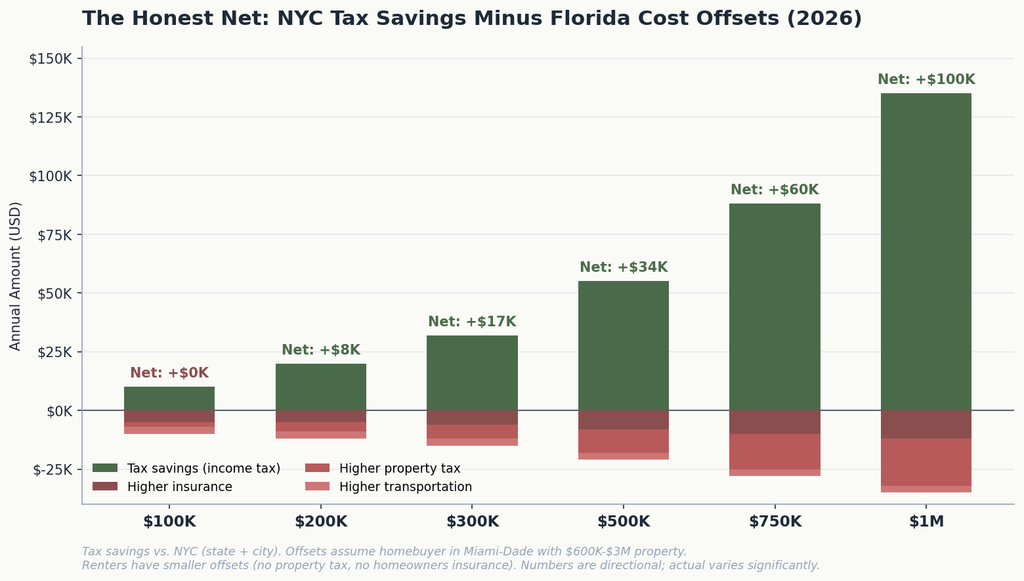
The offsets:
Homeowners insurance runs $5,000-$12,000/year higher in Miami than NYC. Miami-Dade averages $6,045 in 2026, and coastal single-family homes routinely quote $9,000-$18,000. NYC apartments have minimal insurance costs by comparison.
Property tax resets on purchase. When you buy in Florida, your property is reassessed at full market value. Miami-Dade effective property tax rate is roughly 1.75-2% of assessed value annually. On a $600K home, that's $10,000-$12,000/year — real money that NYC renters don't pay at all.
Transportation costs are higher. Miami car ownership averages $700+/month per AAA data — insurance premiums 50%+ above state average, plus gas, parking, maintenance. NYC subway commuters may add $3,000-$5,000/year in transportation moving to Miami.
Sales tax adds up. Florida charges 6% state sales tax plus 1-1.5% local (7-7.5% total in Miami). NYC sales tax is 8.875%. So Miami is actually slightly cheaper on sales tax — but Florida has fewer exemptions on services, so the practical impact varies.
The pattern that emerges:
- $100K income: Net savings ~$0. The tax savings are almost exactly offset by higher insurance, property tax, and transportation costs. Moving to Miami at this income makes sense for lifestyle reasons, not financial ones.
- $200K income: Net savings ~$8K/year. Positive but modest.
- $300K income: Net savings ~$17K/year. Meaningfully better.
- $500K income: Net savings ~$34K/year. Now the move makes strong financial sense.
- $750K income: Net savings ~$60K/year. Significant.
- $1M+ income: Net savings $100K+/year. This is where Miami relocation becomes a genuine wealth strategy.
The break-even income where Florida's tax savings clearly beat Miami's cost offsets is somewhere between $150K and $200K for most buyer profiles. Below that, the tax argument alone doesn't justify the move. Above that, it becomes progressively more compelling.
What Florida Actually Doesn't Tax (The Full List)
For clarity — and because this is what really drives the wealth compounding — here's what Florida doesn't tax:
- Wage and salary income. Zero state income tax.
- Self-employment income and pass-through business income. Zero.
- Investment income. Zero on interest, dividends, and short-term capital gains.
- Long-term capital gains. Zero at the state level. You still pay federal capital gains (0%, 15%, or 20% depending on income), but no state layer.
- Pension income and IRA/401(k) withdrawals. Zero.
- Social Security. Zero. Florida is also one of the states that doesn't tax Social Security at all.
- Estate tax. Florida repealed its estate tax in 2004. No inheritance tax.
- Gift tax. No state gift tax.
For high-income earners with significant investment income, this compounds meaningfully. A Miami resident selling $2M in appreciated stock pays roughly $400,000 less in California's 13.3% top rate than they would selling the same stock as a California resident. That single transaction can pay for years of a Miami home.
The Domicile Trap: Why Some People Move to Florida and Still Pay New York Tax
Here's the piece most relocation advisors don't emphasize enough: moving your body to Florida doesn't automatically make you a Florida resident for tax purposes.
New York and California both run aggressive residency audit programs. Their tax authorities know that many high earners claim Florida residency while still spending most of their time and keeping most of their life in the origin state. If they successfully challenge your Florida domicile, you owe your old state's income tax for every year they can go back — plus penalties and interest.
Two specific tests matter:
1. The 183-day rule (statutory residency). If you spend 183+ days in your old state, or maintain a "permanent place of abode" there and spend 183+ days, you're still considered a resident for tax purposes. This is the easiest test for auditors to prove — they subpoena credit card records, EZ-Pass logs, cell phone data, and social media posts to reconstruct where you actually were.
2. The domicile test. Even if you spend fewer than 183 days in your old state, you can still be considered domiciled there if the "totality of circumstances" shows your true home hasn't changed. This includes where your family lives, where your kids go to school, where you vote, where your primary doctor is, where your church or religious community is, where your safety deposit box is, and where your "cherished possessions" are located.
New York's Department of Taxation and Finance won 60%+ of residency audits between 2018-2024. They actively target claimed Florida residents earning $500K+ who kept a NY apartment. If you didn't do this right, you could owe six figures in back taxes.
The Audit-Proof Domicile Checklist
If you're moving to Florida for tax savings, here's what you actually need to do to make it stick:
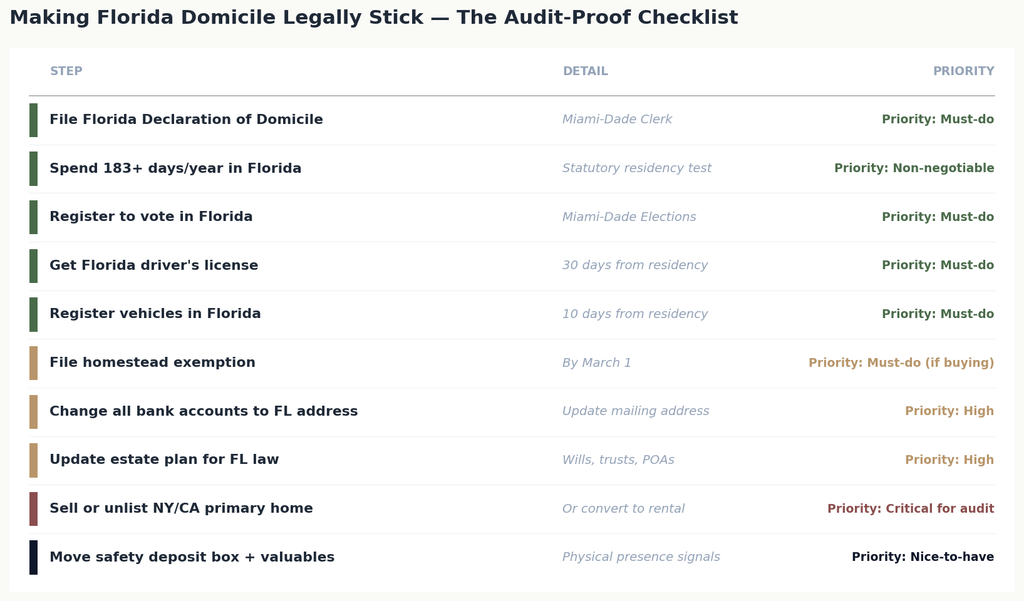
Let me walk through the specific critical items:
File the Florida Declaration of Domicile. This is a specific form you file with the Miami-Dade Clerk of Court establishing Florida as your intended permanent residence. It's not automatic — you have to file it. Cost is minimal (about $10) but it's the foundational document if you're ever audited.
Spend 183+ days per year in Florida. This is the single most important thing. Track every trip. Use an app if you travel frequently. If you can't credibly document 184+ days in Florida for any given year, your Florida domicile claim is vulnerable.
Register to vote in Florida. Miami-Dade Elections Department. Do this within your first 60 days. Auditors love pulling voter registration records because they're publicly verifiable.
Get your Florida driver's license within 30 days. Legally required. Also strong evidence of domicile.
Register your vehicles in Florida within 10 days. Tightest deadline. Vehicle registration is another paper trail auditors check.
File homestead exemption if you buy. Must be filed with Miami-Dade Property Appraiser by March 1 to qualify for that tax year. Saves you $50K off assessed value plus caps annual assessment increases at 3%. Also demonstrates domicile intent.
Change ALL bank accounts to your Florida address. Not just some — all of them. Banks report your address to the IRS on 1099s and to state tax authorities. If you have a NY-based bank account still showing your old address, that's evidence against your domicile claim.
Update your estate plan for Florida law. Have your will, trusts, and powers of attorney re-executed under Florida law. This is a big signal to auditors and also protects you if you die or become incapacitated as a Florida resident.
Sell or unlist your NY/CA primary home. This is the biggest audit red flag. If you claim Florida domicile but still own your NYC apartment or California house as your primary residence, expect an audit. Convert to a rental with proper documentation, or sell. Owning a "vacation home" in your old state is fine — as long as it's demonstrably a vacation home, not your primary residence.
Move safety deposit box + valuables. This is what auditors call "totality of circumstances" evidence. Where is your wedding ring? Your art collection? Your family photos? Ideally in Miami.
When Does the Move Actually Make Sense?
Based on all of the above, here's when Florida's tax structure genuinely makes moving to Miami financially compelling:
Strong yes on tax alone:
- Household income $300K+ from NYC, NJ, CA, or other high-tax state
- Selling a significantly appreciated business or stock position
- Retiring with substantial 401(k)/IRA that you'll be drawing down
- Bringing significant investment income into your peak earning years
Yes for tax + lifestyle:
- $150K-$300K income from a high-tax state
- Remote worker keeping high-tax-state salary while paying Florida taxes
- Family with significant education expenses (private school savings from tax reduction)
Not a tax move — reconsider your reasons:
- Income under $100K from any state
- Coming from a state with income tax below 5% (Illinois, Pennsylvania, most Southern states)
- Not planning to establish real Florida domicile
Explicit no:
- Trying to claim Florida residency while keeping your job in NYC or California
- Planning to spend most of the year in your old state
- Not willing to sell your old primary residence
The Piece I Wish More Miami Buyers Understood
The Florida tax advantage is real. But it's not a magic wealth-generator that works regardless of your situation. It's specifically a wealth-preservation tool for people with meaningful income who properly establish domicile.
The clients I see benefit most from Florida's tax structure are the ones who plan the move as a comprehensive wealth strategy — not just as a lifestyle change. They work with a CPA to plan the timing of any large stock sales. They document their residency change meticulously. They actually invest the tax savings rather than spending them. They understand the audit risk from their old state and take it seriously.
The clients who benefit least are the ones who assume "Florida saves you money" is a slogan that applies to everyone. It's a specific financial tool for specific circumstances.
That's the conversation I want to have with you before you list your NY or California home. Understanding whether Florida's tax structure actually works for your specific income and situation is more valuable than any generic "move to no-tax state" advice you'll read elsewhere.
Frequently Asked Questions
How much do you actually save moving to Florida from a high-tax state?
At $100K income moving from NYC, you save about $10,000/year in state and city income taxes. At $500K, you save approximately $55,000. At $1M, you save $135,000. From California, savings are slightly lower: $7,500 at $100K, $51,000 at $500K, $127,000 at $1M. From New York State outside NYC (Long Island, Westchester, upstate), savings are 20-25% smaller than NYC residents because there's no city tax layer.
Do Florida's tax savings actually beat Miami's higher costs?
It depends on your income. Below $150K household income, higher Miami costs (insurance, property tax, transportation) can offset most or all of your tax savings. Between $150K-$300K, net savings are modest but positive ($8-17K/year). Above $300K, the tax savings meaningfully exceed the cost offsets. Above $500K, Miami's zero-income-tax structure becomes a significant wealth-building tool.
What does Florida not tax that other states do?
Florida has no personal income tax on any income type — wages, self-employment, investment income, short-term or long-term capital gains, pension and IRA/401(k) withdrawals, Social Security. Florida also has no estate tax (repealed 2004) and no gift tax. Sales tax is 6% state plus 1-1.5% local (7-7.5% total in Miami). Property tax averages 1.75-2% of assessed value in Miami-Dade, with a $50K homestead exemption and 3% annual assessment cap for primary residences.
How do I make Florida residency actually stick for tax purposes?
File a Declaration of Domicile with Miami-Dade Clerk of Court. Spend at least 183 days per year physically in Florida. Register to vote in Florida. Get Florida driver's license within 30 days and register vehicles within 10 days. File homestead exemption on any Florida home purchase by March 1. Change all bank accounts and financial records to your Florida address. Update your estate plan under Florida law. Sell or convert your primary residence in your old state. New York and California audit high-earner domicile changes aggressively, and getting caught means paying back taxes plus penalties.
Will my old state audit my move to Florida?
Very likely if you earn $500K+ and previously lived in NYC, California, New Jersey, Illinois, or Massachusetts. New York's Department of Taxation and Finance wins 60%+ of residency audits, and California's Franchise Tax Board is equally aggressive. Auditors subpoena credit card records, cell phone data, EZ-Pass logs, and social media posts to reconstruct where you actually were. Document your Florida presence meticulously and don't keep a "permanent place of abode" in your old state.
Ready to work through whether Florida's tax structure actually makes financial sense for your specific situation? Our Florida Relocation Process is designed for exactly this decision — walking through the honest math before you commit. When you're ready to buy, our Florida Buyers Guide covers what changes on the property side, including realistic insurance and property tax numbers that most tax-savings calculators skip. If you'd rather test-drive Miami with a 12-month lease first while you plan the tax move, our Florida Leasing Process is built for exactly that. Either way — I'd rather help you understand the real net financial impact before you make the move than watch you learn the hard way that "Florida has no state income tax" doesn't automatically translate to being better off.
Check out this article next